العربية
 Español
 Français
 中文
 हिन्दी
What Is the Purpose of Life in Islam?

At some point almost everyone asks it: Why am I here? Is life just an accident, a few decades of work and rest before it all ends? Islam gives a clear and hopeful answer — and it is an answer that changes how ordinary days feel.
Created on purpose
The Qur’an insists that human life is not random or pointless. God asks:
أَفَحَسِبْتُمْ أَنَّمَا خَلَقْنَٰكُمْ عَبَثًۭا وَأَنَّكُمْ إِلَيْنَا لَا تُرْجَعُونَ ﴿١١٥﴾ Then did you think that We created you uselessly and that to Us you would not be returned?"
Couldn't load — please try again.
In other words, we were made deliberately, by a wise Creator, and we will return to Him. That means our lives have a direction and our choices have weight.
To know and worship God
The Qur’an states the purpose of human life in a single sentence:
وَمَا خَلَقْتُ ٱلْجِنَّ وَٱلْإِنسَ إِلَّا لِيَعْبُدُونِ ﴿٥٦﴾ And I did not create the jinn and mankind except to worship Me.
Couldn't load — please try again.
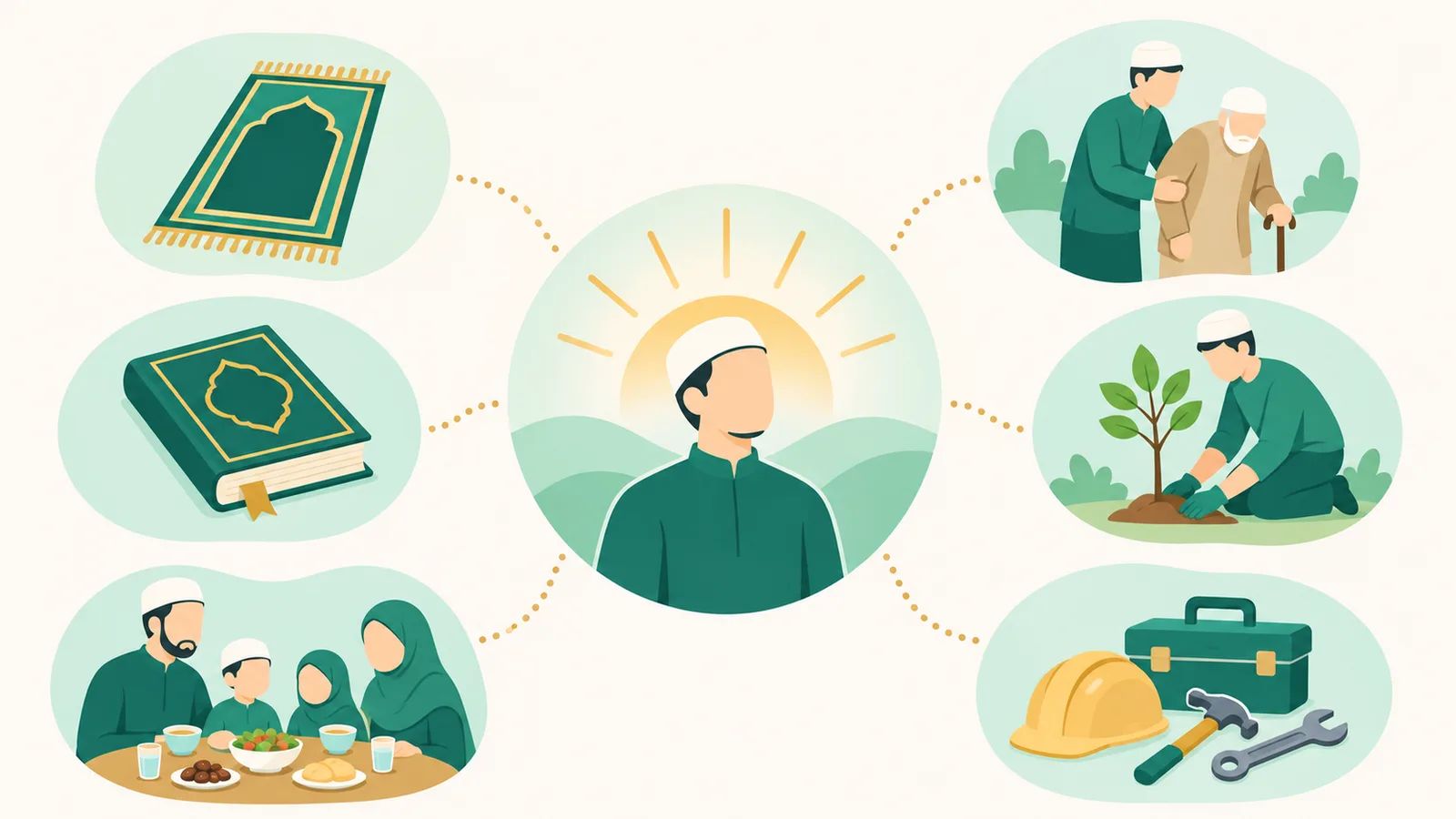
For many people, “worship” brings to mind only prayers or religious services. In Islam, the word ‘ibadah is much wider. It includes the five daily prayers, fasting and remembering God — but it also includes anything good that a person does sincerely for God’s sake: working honestly to support a family, being kind to parents, smiling at a neighbour, studying, planting a tree, or simply refraining from harm.
What turns an ordinary act into worship is the intention behind it. The Prophet ﷺ taught:
…The reward of deeds depends upon the intentions and every person will get the reward according to what he has intended.…
Couldn't load — please try again.
So the purpose of life is not to withdraw from the world, but to live in it with God in mind. Islam does not ask believers to retreat into a monastery; the believer prays, works, marries, laughs and serves others, and all of it can become part of a life of worship.
Worship is also, Muslims believe, for our own good. God does not need our worship — He is perfect and needs nothing. It is we who need Him. Knowing and loving our Creator is what the human soul was made for, and it is where it finds peace. You can read more about God in Who Is Allah?
Life as a test
The Qur’an also describes this life as a test:
ٱلَّذِى خَلَقَ ٱلْمَوْتَ وَٱلْحَيَوٰةَ لِيَبْلُوَكُمْ أَيُّكُمْ أَحْسَنُ عَمَلًۭا ۚ وَهُوَ ٱلْعَزِيزُ ٱلْغَفُورُ ﴿٢﴾ [He] who created death and life to test you [as to] which of you is best in deed - and He is the Exalted in Might, the Forgiving -
Couldn't load — please try again.
Notice that the test is not about who is the richest, the most famous or the most powerful, but about the quality of our deeds. And notice too that the verse ends with God’s names the Exalted in Might and the Forgiving: the test is set by a God who is ready to forgive those who stumble and turn back to Him.
The test comes in both good times and hard times. Wealth and health test whether we are grateful; loss and pain test whether we are patient and keep trusting God (Qur’an 2:155-157). The Prophet ﷺ described how a believer can find good in every situation:
Suhaib reported that Allah's Messenger (ﷺ) said:Strange are the ways of a believer for there is good in every affair of his and this is not the case with anyone else except in the case of a believer for if he has an occasion to feel delight, he thanks (God), thus there is a good for him in it, and if he gets into trouble and shows resignation (and endures it patiently), there is a good for him in it
Couldn't load — please try again.
This does not mean Muslims never feel sadness or struggle. The prophets themselves wept and grieved. But it means no experience is wasted — not even suffering. Everything can become a way back to God. For more on this, see Mental Health and Hope.
A short life, an eternal home
Islam teaches that this life is short compared with what comes after it. Death is not the end, but a doorway to an eternal life in which God’s perfect justice and mercy will be seen in full. Every good deed — even the smallest — will be found there. Read more in What Happens After Death in Islam?
This gives Muslims a balance. They are taught to enjoy the good things of this world, which are gifts from God, while remembering that they are not the final goal. A well-known prayer from the Qur’an asks God for good in this world and good in the Hereafter (Qur’an 2:201).
A life with meaning
Seen this way, nothing in life is wasted: not the quiet kindness no one notices, not the patience in a hard season, not a sincere prayer whispered at night. Each of them matters to the One who created us.
If these questions are on your mind, you are not alone — and you are welcome to keep exploring. A good next step is What Is Islam? A Simple Introduction.
Key takeaways
- The Qur'an says we were created to worship God — to know Him, love Him and live by His guidance.
- Worship in Islam is broad — honest work, kindness and caring for family can all be worship.
- Life is a test, and both ease and hardship are part of it.
- Nothing is meaningless — every intention and every good deed counts with God.