العربية
 Español
 Français
 中文
 हिन्दी
What Does Islam Say About Mental Health and Hope?

Many people silently carry anxiety, depression, grief or exhaustion. Some religious people even feel ashamed of these struggles, as if a strong believer should never feel low. Islam gives a gentler and more honest answer: sadness is part of being human, help should be sought, and hope is never lost.
If you are in crisis or thinking about harming yourself, please contact your local emergency services or a crisis line in your country right now. You deserve support, and reaching out is a sign of strength, not weakness.
Sadness is not a lack of faith
The Prophet Muhammad ﷺ was the most beloved person to God, yet he knew deep grief. He lost his parents as a child, his beloved wife Khadijah and his protective uncle in the same period of his life, and several of his children. When his infant son Ibrahim was dying, he wept, and when a Companion was surprised, he explained:
…The eyes are shedding tears and the heart is grieved, and we will not say except what pleases our Lord…
Couldn't load — please try again.
Tears and a grieving heart were not a weakness in him; he called them a mercy. The Qur’an also describes the prophet Jacob (peace be upon him), who grieved for years over his lost son Joseph, and who turned to God with his pain:
قَالَ إِنَّمَآ أَشْكُوا۟ بَثِّى وَحُزْنِىٓ إِلَى ٱللَّهِ وَأَعْلَمُ مِنَ ٱللَّهِ مَا لَا تَعْلَمُونَ ﴿٨٦﴾ He said, "I only complain of my suffering and my grief to Allah, and I know from Allah that which you do not know.
Couldn't load — please try again.
There is a lesson here. Jacob did not hide his sorrow or pretend to be fine. He brought it honestly to God — and he never lost hope.
Seeking help is part of faith
Some people worry that seeing a doctor, counsellor or psychiatrist shows a lack of trust in God. Islam teaches the opposite. When people asked the Prophet ﷺ whether they should seek treatment for illness, he answered clearly:
…Make use of medical treatment, for Allah has not made a disease without appointing a remedy for it, with the exception of one disease, namely old age…
Couldn't load — please try again.
Muslim scholars and doctors of the past wrote about illnesses of the mind as well as the body, and historic hospitals in the Muslim world cared for people with mental illness. Today, therapy, counselling and medication — alongside prayer — are ways of taking the means God has provided. Trusting God and seeking treatment go together.
Comfort for the heart
Islam also offers spiritual resources that many people find deeply calming. The Qur’an speaks of the peace that comes from remembering God:
ٱلَّذِينَ ءَامَنُوا۟ وَتَطْمَئِنُّ قُلُوبُهُم بِذِكْرِ ٱللَّهِ ۗ أَلَا بِذِكْرِ ٱللَّهِ تَطْمَئِنُّ ٱلْقُلُوبُ ﴿٢٨﴾ Those who have believed and whose hearts are assured by the remembrance of Allah. Unquestionably, by the remembrance of Allah hearts are assured."
Couldn't load — please try again.
Remembrance (dhikr) can be as simple as repeating God’s names, reading the Qur’an slowly, or speaking to God in one’s own words. The Prophet ﷺ himself regularly asked God for protection from the heaviness of anxiety and sorrow:
…O Allah! I seek refuge with You from worry and grief, from incapacity and laziness, from cowardice and miserliness, from being heavily in debt and from being overpowered by (other) men.…
Couldn't load — please try again.
That he made this prayer at all shows that worry and grief are experiences even the best of people face. Islam also stresses community: visiting the sick, checking on neighbours and supporting one another are acts of worship. No one is meant to carry their burdens alone.
Hope that does not run out
One short chapter of the Qur’an was revealed to comfort the Prophet ﷺ during a difficult time. Its central promise is repeated twice:
فَإِنَّ مَعَ ٱلْعُسْرِ يُسْرًا ﴿٥﴾ إِنَّ مَعَ ٱلْعُسْرِ يُسْرًۭا ﴿٦﴾ 5For indeed, with hardship [will be] ease. 6Indeed, with hardship [will be] ease.
Couldn't load — please try again.
Muslim scholars have noted that the Arabic suggests the same hardship is met by more than one ease — that difficulty is never left alone. The Qur’an also reminds us that God does not burden any soul beyond what it can bear (2:286), and Jacob told his sons never to despair of relief from God (12:87).
This hope does not mean pain will vanish overnight, or that someone who is still struggling has failed. Healing can be slow. But Islam teaches that every moment of patient suffering is seen by God, that none of it is wasted, and that His mercy is always closer than we think.
A closing thought
If you are struggling, please be gentle with yourself: talk to someone you trust, seek professional help, and — if you are in danger — contact emergency services or a crisis line straight away. Islam teaches that your life is precious and that ease will come. To read more about God’s mercy, see why Islam is called a religion of mercy.
Key takeaways
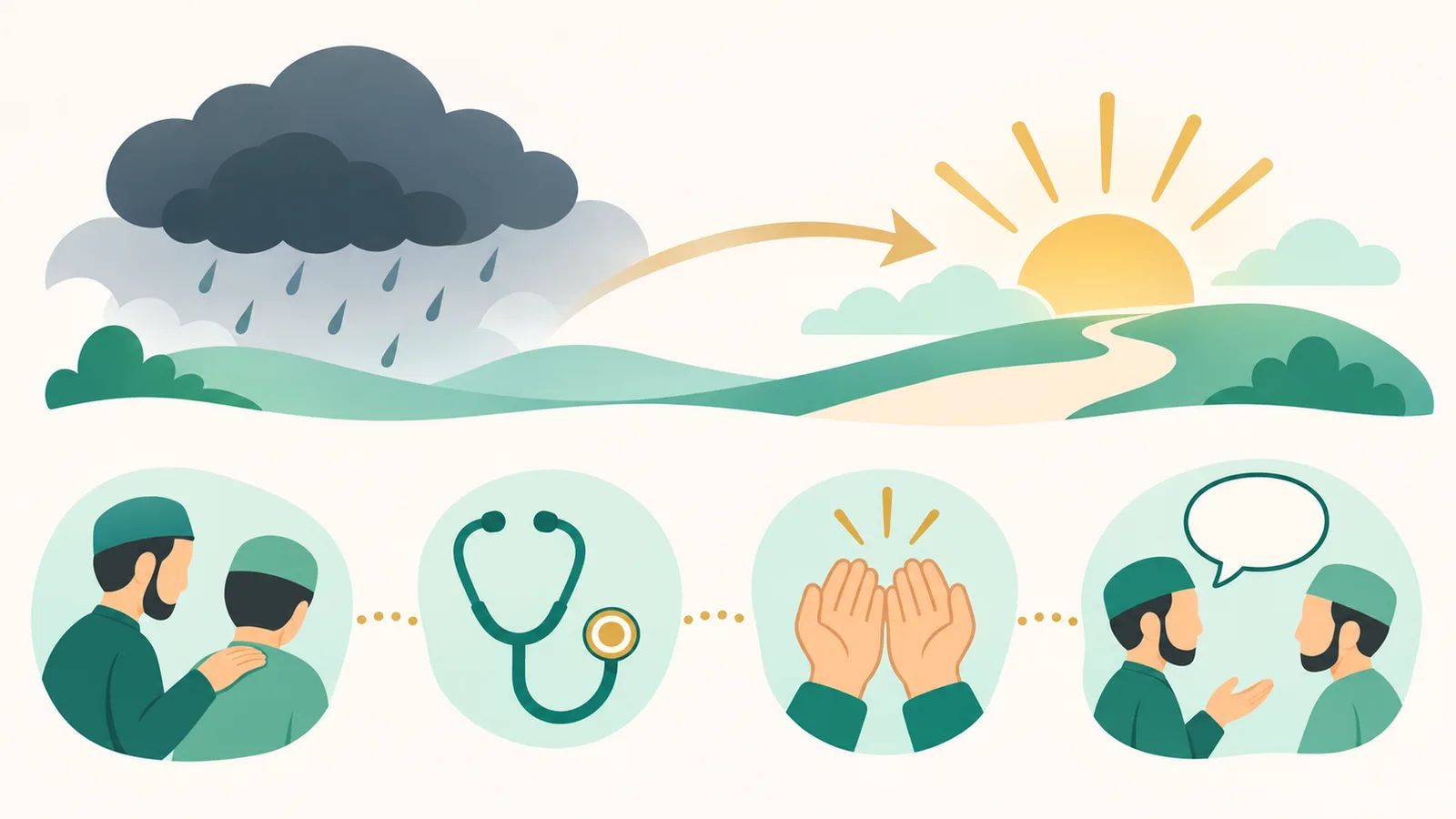
- Sadness and grief are human, not a failure of faith — the Prophet ﷺ wept openly.
- Seeking treatment, including for mental health, is encouraged in Islam.
- Prayer and remembrance of God bring calm to the heart.
- The Qur'an promises that with hardship comes ease.
- If you are in crisis, please contact local emergency services or a crisis line now.