العربية
 Español
 Français
 中文
 हिन्दी
Why Is Good Character So Important in Islam?

We usually judge a religion by what it believes and how it prays. But most people meet a faith first through the behaviour of its followers: the neighbour who returns a lost wallet, the colleague who keeps his word, the stranger who smiles. Islam takes this seriously. In its teaching, how you treat people is inseparable from how you relate to God.
Character is at the heart of faith
The Arabic word for character is khuluq (plural akhlaq). When the Qur’an praises the Prophet Muhammad ﷺ, it does not praise his wealth, his power or even his eloquence — it praises his character:
وَإِنَّكَ لَعَلَىٰ خُلُقٍ عَظِيمٍۢ ﴿٤﴾ And indeed, you are of a great moral character.
Couldn't load — please try again.
The Prophet ﷺ made character the measure of a person’s worth:
Narrated Masruq: We were sitting with `Abdullah bin `Amr who was narrating to us (Hadith): He said, "Allah's Messenger (ﷺ) was neither a Fahish nor a Mutafahhish, and he used to say, 'The best among you are the best in character (having good manners)
Couldn't load — please try again.
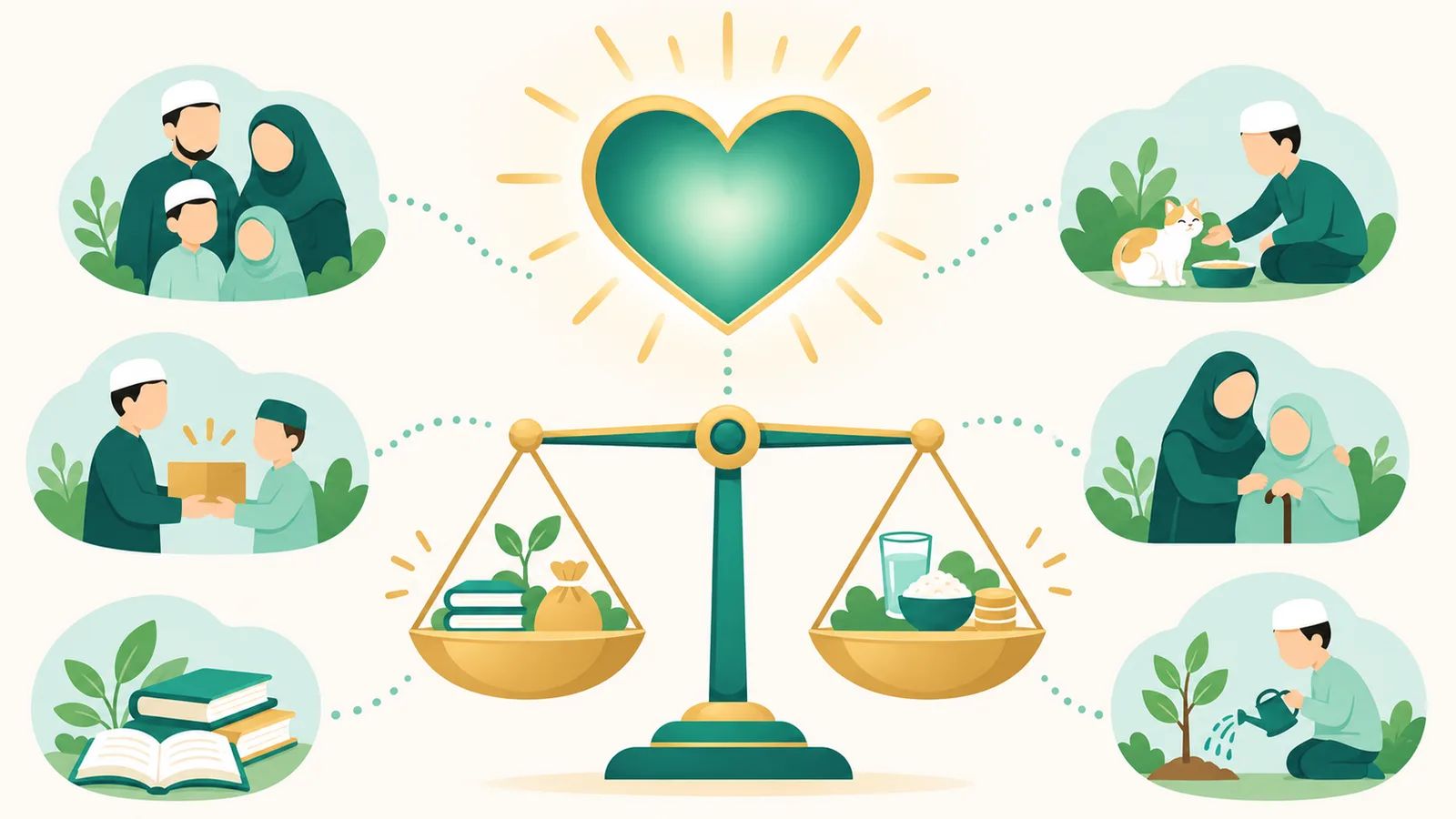
He also taught that on the Day of Judgement, when deeds are weighed, good character will be among the heaviest of all:
Abu Ad-Dardh narrated that the Messenger of Allah said:"Nothing is placed on the Scale that is heavier than good character. Indeed the person with good character will have attained the rank of the person of fasting and prayer
Couldn't load — please try again.
This is a remarkable claim. Someone who prays and fasts but treats people badly has missed something essential, while someone with beautiful manners can reach the rank of those who spend their nights in worship.
Honesty
Islam treats truthfulness as a road that leads somewhere — and lying as a road that leads somewhere else:
Narrated `Abdullah: The Prophet (ﷺ) said, "Truthfulness leads to righteousness, and righteousness leads to Paradise. And a man keeps on telling the truth until he becomes a truthful person. Falsehood leads to Al-Fajur (i.e. wickedness, evil-doing), and Al-Fajur (wickedness) leads to the (Hell) Fire, and a man may keep on telling lies till he is written before Allah, a liar
Couldn't load — please try again.
Before he received revelation, the people of Mecca already called Muhammad ﷺ al-Amin, “the trustworthy”. Islam asks every believer to earn the same name: to keep promises, to be fair in buying and selling, and to speak the truth even when it is inconvenient.
Kindness and gentleness
Gentleness is not weakness in Islam; it is a quality God Himself loves:
A'isha, the wife of Allah's Apostle (ﷺ), reported that Allah's Messenger (ﷺ) said:'A'isha, verily Allah is kind and He loves kindness and confers upon kindness which he does not confer upon severity and does not confer upon anything else besides it (kindness)
Couldn't load — please try again.
The Prophet ﷺ also said that even smiling at your brother counts as charity (Jami’ at-Tirmidhi 1956). Small courtesies — a greeting, a kind word, removing something harmful from the road — are all treated as good deeds.
Patience
Life brings frustration, loss and people who treat us unfairly. The Qur’an asks believers to seek help through patience and prayer, and assures them that God is with the patient (2:153). It goes further, asking them to answer bad behaviour with something better, so that an enemy might even become a close friend (41:34). The Prophet ﷺ said that no one is given a gift better or wider than patience (Sahih al-Bukhari 1469).
Humility
Pride is one of the most dangerous traits in Islamic teaching, and humility one of the most beautiful. The Qur’an describes the true servants of the Most Merciful as people who walk on the earth gently, and who answer rudeness with words of peace (25:63). The Prophet ﷺ promised that humility never lowers a person:
Abu Huraira reported Allah's Messenger (ﷺ) as saying:Charity does not decrease wealth, no one forgives another except that Allah increases his honor, and no one humbles himself for the sake of Allah except that Allah raises his status
Couldn't load — please try again.
Notice the pattern: giving, forgiving and humility all look like losses at first, but God turns each of them into a gain. The Prophet ﷺ lived this way himself: he sat with the poor, helped with work at home, and greeted children as he passed them (Sahih al-Bukhari 6247) — the conduct of a leader who never thought himself too important for ordinary people.
Why character matters so much
For Muslims, good character is not just social politeness. It flows from belief in a God who sees everything, and it is part of worship. Being honest when no one is watching, patient when no one would blame you for anger, and kind to people who can do nothing for you — these are ways of serving God through serving His creation.
Of course, Muslims do not always live up to these ideals, and no one should judge Islam by its weakest examples. But the standard is clear, and it is high.
A closing thought
If you want to understand what Islam hopes to make of a person, look at the character it praises: truthful, gentle, patient and humble. To learn more about the man Muslims see as the best example of that character, read Who was Prophet Muhammad ﷺ?
Key takeaways
- The Qur'an praises the Prophet ﷺ for his great moral character.
- The best people, he taught, are those with the best character.
- Honesty, kindness, patience and humility are central Islamic virtues.
- Good character is an act of worship with great reward.