العربية
 Español
 Français
 中文
 हिन्दी
Who Was Prophet Muhammad ﷺ?
Well over a billion people try to follow his example every day — in how they pray, eat, greet one another and treat their families. Yet many non-Muslims know very little about him. Here is a short introduction to the man Muslims love more than any other human being.
An orphan in Mecca
Muhammad ﷺ was born in the city of Mecca, in western Arabia, around the year 570 CE. His father died before he was born, and his mother died when he was a small child. He was cared for first by his grandfather and then by his uncle, Abu Talib.
As a young man he worked as a shepherd and later as a merchant. He became so well known for his honesty that the people of Mecca called him al-Amin — “the trustworthy”. At around twenty-five he married Khadijah, a respected businesswoman, and they shared a loving marriage for about twenty-five years until her death.
Mecca at that time was a centre of idol worship. Muhammad ﷺ never took part in it. He would often go alone to a cave called Hira, on a mountain outside the city, to reflect.
The first revelation
At about the age of forty, in around 610 CE, Muslims believe the angel Gabriel (Jibril) came to him in the cave of Hira with the first words of the Qur’an — a command to read and recite in the name of God, the Creator (Qur’an 96:1-5). You can read more about this in What Is the Qur’an?
From then on he called people to worship the one God, to give up idols, to care for the poor and orphans, and to live honestly and justly. Many of the powerful leaders of Mecca opposed him fiercely, and his early followers were mocked, boycotted and some tortured.
Migration, hardship and victory
In 622 CE, after years of persecution, Muhammad ﷺ and his followers migrated to the city of Medina, where he was welcomed and became its leader. This migration, the Hijrah, marks the start of the Islamic calendar. In Medina he built a community based on faith, justice and brotherhood.
Some years later he returned to Mecca at the head of a large army. Instead of taking revenge on the people who had persecuted him for two decades, he forgave them. He died in Medina in 632 CE, at about sixty-three years of age, leaving no wealth behind. For the fuller story, see The Life of Prophet Muhammad ﷺ.
His character
The Qur’an itself praises his character:
وَإِنَّكَ لَعَلَىٰ خُلُقٍ عَظِيمٍۢ ﴿٤﴾ And indeed, you are of a great moral character.
Couldn't load — please try again.
It also describes how his gentleness drew people to him:
فَبِمَا رَحْمَةٍۢ مِّنَ ٱللَّهِ لِنتَ لَهُمْ ۖ وَلَوْ كُنتَ فَظًّا غَلِيظَ ٱلْقَلْبِ لَٱنفَضُّوا۟ مِنْ حَوْلِكَ ۖ فَٱعْفُ عَنْهُمْ وَٱسْتَغْفِرْ لَهُمْ وَشَاوِرْهُمْ فِى ٱلْأَمْرِ ۖ فَإِذَا عَزَمْتَ فَتَوَكَّلْ عَلَى ٱللَّهِ ۚ إِنَّ ٱللَّهَ يُحِبُّ ٱلْمُتَوَكِّلِينَ ﴿١٥٩﴾ So by mercy from Allah, [O Muhammad], you were lenient with them. And if you had been rude [in speech] and harsh in heart, they would have disbanded from about you. So pardon them and ask forgiveness for them and consult them in the matter. And when you have decided, then rely upon Allah. Indeed, Allah loves those who rely [upon Him].
Couldn't load — please try again.
His wife Aisha, who knew him more closely than anyone, described his everyday conduct:
Narrated `Aisha: Whenever Allah's Messenger (ﷺ) was given the choice of one of two matters, he would choose the easier of the two, as long as it was not sinful to do so, but if it was sinful to do so, he would not approach it. Allah's Messenger (ﷺ) never took revenge (over anybody) for his own sake but (he did) only when Allah's Legal Bindings were outraged in which case he would take revenge for Allah's Sake
Couldn't load — please try again.
He mended his own clothes, helped with work at home, played with children and visited the sick. He taught that good character is at the very centre of religion:
…The best among you are the best in character (having good manners)…
Couldn't load — please try again.
The final messenger
Muslims believe that God sent prophets to every nation — among them Noah, Abraham, Moses and Jesus (peace be upon them) — and that Muhammad ﷺ was the last of them:
مَّا كَانَ مُحَمَّدٌ أَبَآ أَحَدٍۢ مِّن رِّجَالِكُمْ وَلَٰكِن رَّسُولَ ٱللَّهِ وَخَاتَمَ ٱلنَّبِيِّۦنَ ۗ وَكَانَ ٱللَّهُ بِكُلِّ شَىْءٍ عَلِيمًۭا ﴿٤٠﴾ Muhammad is not the father of [any] one of your men, but [he is] the Messenger of Allah and last of the prophets. And ever is Allah, of all things, Knowing.
Couldn't load — please try again.
Unlike earlier prophets, who were sent to their own people, his message is for all of humanity (Qur’an 34:28), and the Qur’an describes him as a mercy to the worlds (Qur’an 21:107). See Muhammad ﷺ Is the Final Messenger.
Loved, followed — but not worshipped
Muslims honour him deeply. Whenever they mention his name they add a prayer for him, sallallahu alayhi wa sallam — “may God bless him and grant him peace”, written ﷺ. Out of respect, and to protect against anyone ever worshipping him, Muslims do not make pictures or images of him.
But he was a human being, not God and not the son of God. He ate, slept, married, grieved and died like any person. Muslims worship God alone and follow Muhammad ﷺ as His messenger and their best example.
If you would like to understand why Muslims love him so much, a good next step is Why Is Islam Called a Religion of Mercy? — because, as the Qur’an says, his whole mission was mercy.
Key takeaways
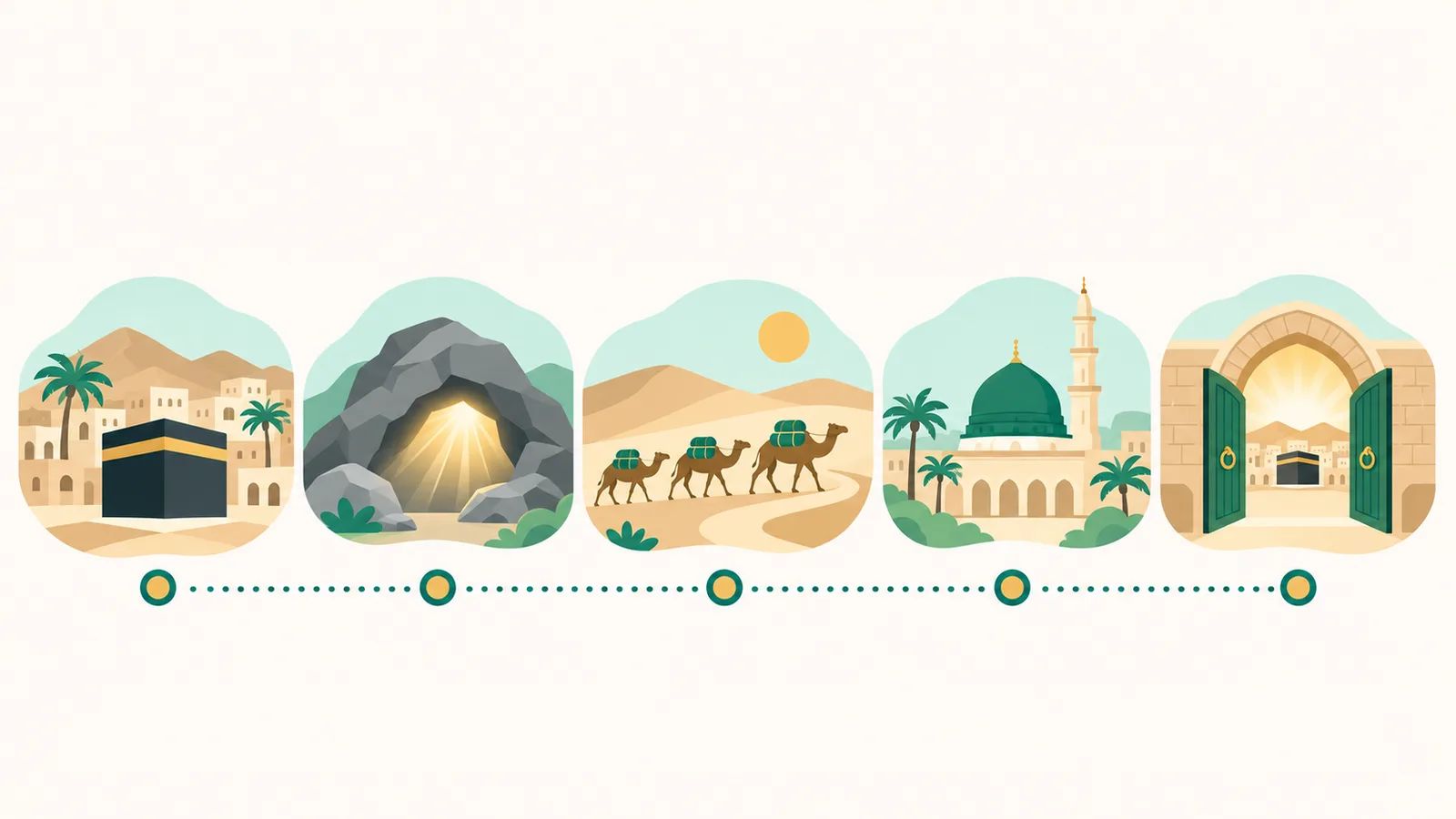
- Muhammad ﷺ was born in Mecca around 570 CE and grew up an orphan.
- He was known as al-Amin, "the trustworthy", long before he became a prophet.
- Muslims believe he is the final messenger of God, sent to all of humanity.
- Muslims love and follow him, but worship God alone — he was a human being, not divine.