العربية
 Español
 Français
 中文
 हिन्दी
How to Find a Mosque and What to Expect on Your First Visit

The first time you walk into a mosque as a Muslim can be a quiet, moving moment — and also a nervous one. Where do I go? What do I do with my shoes? What if I do something wrong? This guide answers those questions so that you can walk in with confidence.
Why a mosque matters
A mosque (masjid, literally “place of prostration”) is a house of God, built for worship of Him alone:
وَأَنَّ ٱلْمَسَٰجِدَ لِلَّهِ فَلَا تَدْعُوا۟ مَعَ ٱللَّهِ أَحَدًۭا ﴿١٨﴾ And [He revealed] that the masjids are for Allah, so do not invoke with Allah anyone.
Couldn't load — please try again.
But it is also the heart of Muslim community life: a place to pray, learn, ask questions, celebrate, and find friends who share your faith. For a new Muslim, a good mosque can be a lifeline. Praying together also carries a special reward:
Narrated `Abdullah bin `Umar: Allah's Messenger (ﷺ) said, "The prayer in congregation is twenty seven times superior to the prayer offered by a person alone
Couldn't load — please try again.
How to find one
- Search online. Mosque-finder websites and prayer-time apps list mosques near you, often with photos, timings and contact details.
- Ask Muslims you know. A friend, colleague or neighbour can recommend a mosque and may even go with you the first time.
- Look at university and community centres. Many universities have prayer rooms and Muslim student societies, and some cities have Islamic centres with programmes in the local language.
- Contact them first. A short email or call — “I recently became Muslim and would like to visit” — usually brings a warm reply, and someone may meet you at the door.
If there are several mosques near you, it is fine to visit a few. Look for one where talks are given in a language you understand, where there are classes or mentors for new Muslims, and where people are kind and patient. Mosques differ in culture and style, and that is normal. A healthy mosque welcomes questions and does not pressure you.
What to expect inside
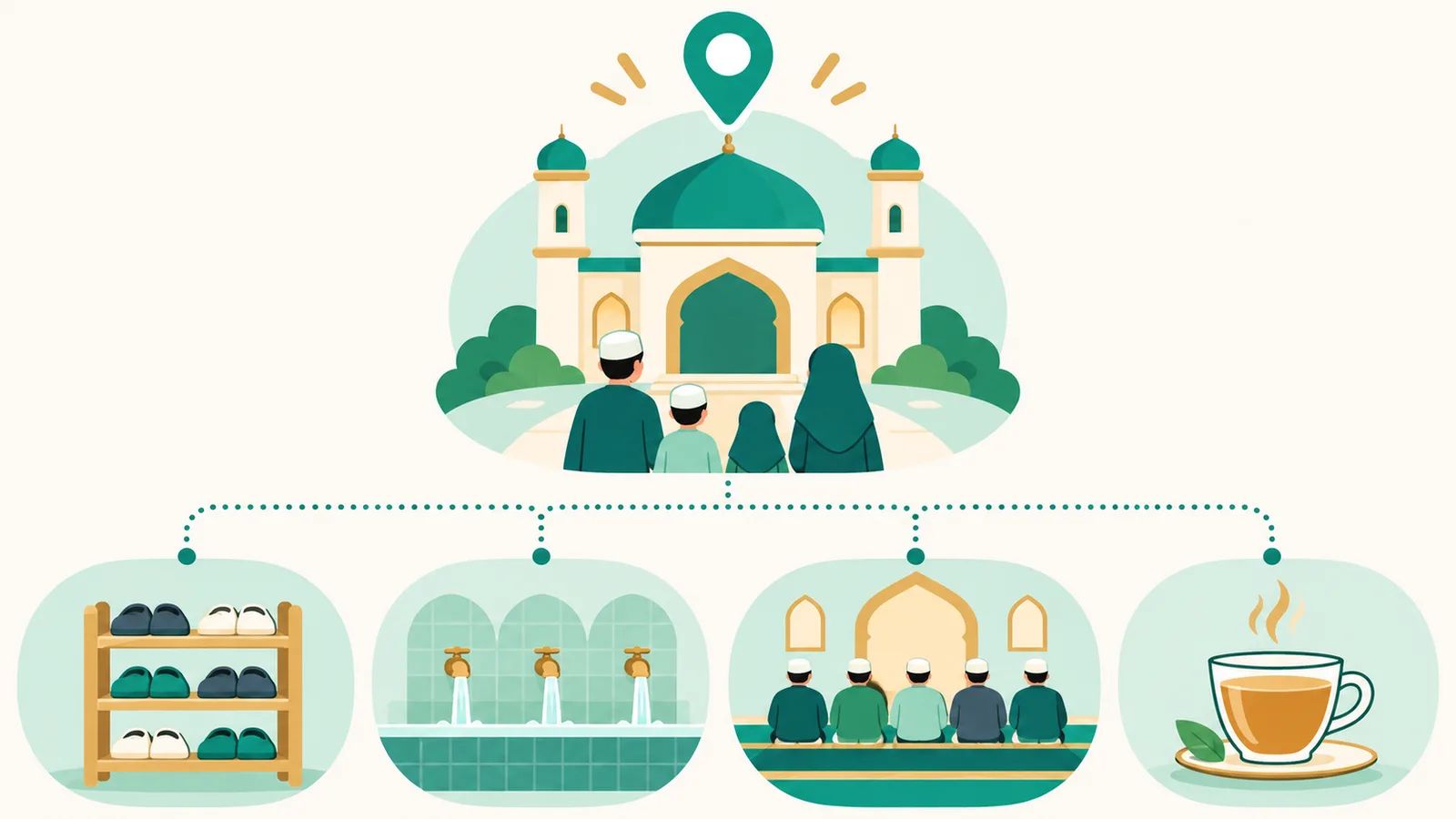
Shoes off. At the entrance there are racks for shoes; the prayer hall is carpeted and kept clean.
Modest dress. Wear loose, clean clothes. Men should cover at least from the navel to the knees; women usually cover their hair and wear loose clothing covering the arms and legs. If you are a woman who does not yet wear a headscarf, bring a scarf for the visit — no one expects you to have everything figured out.
Separate spaces. Men and women usually pray in separate rows or areas, and many mosques have a separate women’s entrance. Women are fully entitled to come to the mosque; the Prophet ﷺ said: do not stop the women servants of God from going to the mosques of God (Sahih al-Bukhari 900).
Washing areas. There are places to make wudu before prayer. If you are not sure how, see How to Make Wudu — or just ask; people are usually happy to show you.
On entering. It is a beautiful practice to pray two short units of prayer before sitting down (Sahih al-Bukhari 444). If you do not know how yet, it is fine to simply sit quietly.
During congregational prayer. One person, the imam, leads, and everyone follows his movements in straight rows. If you are new, stand next to someone and follow along; that is how many people learn. See How to Pray for the basics.
Friday prayer
The most important weekly gathering is the Friday midday prayer (Jumu’ah), when a short sermon is followed by the prayer. The Qur’an calls believers to leave their business and attend it (62:9). For men it is an obligation; women are welcome to attend. It is a great time to meet people — stay a few minutes afterwards and introduce yourself.
If you make a mistake
You will probably do something “wrong” at some point: stand in the wrong place, move at the wrong time, forget a word. Do not let that keep you away. The Prophet ﷺ was remarkably gentle even with a desert Arab who did something far worse in his mosque:
Narrated Abu Huraira: A Bedouin stood up and started making water in the mosque. The people caught him but the Prophet (ﷺ) ordered them to leave him and to pour a bucket or a tumbler of water over the place where he had passed the urine. The Prophet (ﷺ) then said, "You have been sent to make things easy and not to make them difficult
Couldn't load — please try again.
Most Muslims remember their own first steps and will help you kindly. If you ever meet harshness, remember that it reflects that person, not Islam — and look for kinder company.
When there is no mosque nearby
Not everyone lives near a mosque. You can pray anywhere clean; the Prophet ﷺ said that the earth has been made a place of prayer for his followers (Sahih al-Bukhari 335). Meanwhile, look for online classes and new-Muslim support groups, connect with Muslims in a nearby town, and visit a mosque when you can. See Your First Weeks as a Muslim for more ways to stay connected.
A home for your faith
A mosque is not a club with rules for insiders. It is God’s house, and you belong there as much as anyone. Take the first step, say hello, and let the community help carry you. Many new Muslims find that the friendships they make there become some of the most precious in their lives.
Key takeaways
- Mosques are houses of God, open to men and women, new Muslims and visitors.
- Look for a mosque with new-Muslim classes, English-language talks or a welcoming team.
- Simple etiquette — shoes off, modest dress, a quiet voice — is all you need.
- Praying in congregation brings great reward and real friendship.