العربية
 Español
 Français
 中文
 हिन्दी
Islam and Judaism: Common Ground

A Jewish visitor to a mosque, or a Muslim visitor to a synagogue, often has the same experience: a surprising sense of familiarity. The greeting shalom and the greeting salam come from the same root. Prayers are said in two sister languages, Hebrew and Arabic. And in both places, the central belief is the same: God is one.
Children of Abraham
Jews trace their family line through Abraham’s son Isaac and his grandson Jacob (Israel). Muslims honour Isaac and Jacob too, and also remember Abraham’s elder son Ishmael, through whom the Prophet Muhammad ﷺ descended. The Qur’an teaches Muslims to believe in all of them, and in everything God revealed to Moses:
قُلْ ءَامَنَّا بِٱللَّهِ وَمَآ أُنزِلَ عَلَيْنَا وَمَآ أُنزِلَ عَلَىٰٓ إِبْرَٰهِيمَ وَإِسْمَٰعِيلَ وَإِسْحَٰقَ وَيَعْقُوبَ وَٱلْأَسْبَاطِ وَمَآ أُوتِىَ مُوسَىٰ وَعِيسَىٰ وَٱلنَّبِيُّونَ مِن رَّبِّهِمْ لَا نُفَرِّقُ بَيْنَ أَحَدٍۢ مِّنْهُمْ وَنَحْنُ لَهُۥ مُسْلِمُونَ ﴿٨٤﴾ Say, "We have believed in Allah and in what was revealed to us and what was revealed to Abraham, Ishmael, Isaac, Jacob, and the Descendants, and in what was given to Moses and Jesus and to the prophets from their Lord. We make no distinction between any of them, and we are Muslims [submitting] to Him."
Couldn't load — please try again.
For Muslims, Abraham (peace be upon him) is the model of pure faith — the man who turned away from idols to worship the one God alone. Jews remember him in the same way. Read more in Abraham in Islam.
One God, without compromise
The heart of Jewish faith is the Shema, recited morning and evening: “Hear, O Israel: The LORD our God is one LORD” (Deuteronomy 6:4, KJV). Muslims hear in those words the very essence of their own creed. In the Qur’an, when God first called Moses beside the fire he had seen in the valley, His message was the same:
وَأَنَا ٱخْتَرْتُكَ فَٱسْتَمِعْ لِمَا يُوحَىٰٓ ﴿١٣﴾ إِنَّنِىٓ أَنَا ٱللَّهُ لَآ إِلَٰهَ إِلَّآ أَنَا۠ فَٱعْبُدْنِى وَأَقِمِ ٱلصَّلَوٰةَ لِذِكْرِىٓ ﴿١٤﴾ 13And I have chosen you, so listen to what is revealed [to you]. 14Indeed, I am Allah. There is no deity except Me, so worship Me and establish prayer for My remembrance.
Couldn't load — please try again.
Neither faith makes images of God, and both treat the worship of anything besides Him as the gravest of wrongs. Islam and Judaism are often described as the two most strictly monotheistic of the world’s major religions.
Moses, the prophet the Qur’an mentions most
Moses (peace be upon him) is mentioned by name in the Qur’an more often than any other prophet. His story — his birth and rescue, his stand before Pharaoh, the parting of the sea, the giving of the law — is told again and again. The Qur’an gives him a unique honour:
وَرُسُلًۭا قَدْ قَصَصْنَٰهُمْ عَلَيْكَ مِن قَبْلُ وَرُسُلًۭا لَّمْ نَقْصُصْهُمْ عَلَيْكَ ۚ وَكَلَّمَ ٱللَّهُ مُوسَىٰ تَكْلِيمًۭا ﴿١٦٤﴾ And [We sent] messengers about whom We have related [their stories] to you before and messengers about whom We have not related to you. And Allah spoke to Moses with [direct] speech.
Couldn't load — please try again.
The Prophet Muhammad ﷺ shared this love for Moses. When he arrived in Medina and found the Jewish community fasting on the day God saved the Israelites from Pharaoh, he responded like this:
Narrated Ibn `Abbas: The Prophet (ﷺ) came to Medina and saw the Jews fasting on the day of Ashura. He asked them about that. They replied, "This is a good day, the day on which Allah rescued Bani Israel from their enemy. So, Moses fasted this day." The Prophet (ﷺ) said, "We have more claim over Moses than you." So, the Prophet fasted on that day and ordered (the Muslims) to fast (on that day)
Couldn't load — please try again.
To this day, many Muslims fast on that day, called Ashura, in remembrance of Moses. See more in Moses in Islam.
A life shaped by sacred law
Both faiths teach that serving God is not only a matter of belief but of daily practice. Jewish law is called halakha, “the way to walk”; Islamic law is sharia, originally “the path to water”. Both cover worship, family life, business ethics and food.
- Food. Both forbid pork (Leviticus 11:7; Qur’an 2:173), forbid consuming blood, and require animals to be slaughtered in a particular, humane way while God’s name is remembered. The Qur’an even states that the food of the People of the Scripture is lawful for Muslims (Qur’an 5:5); scholars discuss the details of how this applies today.
- Prayer. Observant Jews pray at set times each day; Muslims pray five set prayers. Both faiths bow before God, and the earliest Muslims at first prayed facing Jerusalem.
- Charity and justice. Tzedakah and zakat both teach that giving to the poor is a duty, not just a kindness.
- Family and modesty. Both value marriage, modest dress and the circumcision of boys.
Honest differences
Respect means being clear about where we differ. Judaism still awaits the Messiah, while Islam teaches that Jesus was the Messiah — though not divine. Judaism does not accept Muhammad ﷺ as a prophet, while Muslims believe he is the last of the prophets, sent to all humanity. Muslims believe God revealed the Torah to Moses as guidance and light (Qur’an 5:44), and that the Qur’an is His final revelation. And while the Qur’an honours the Children of Israel as a people God favoured (Qur’an 2:47), it teaches that the most noble person before God is simply the most righteous, whatever their lineage (Qur’an 49:13).
Beyond today’s headlines
For many people, the relationship between Muslims and Jews is defined by modern politics. History tells a richer story. For long centuries Jews and Muslims lived, traded and studied side by side; the great Jewish philosopher Maimonides wrote many of his works in Arabic. Islam forbids hatred and injustice towards anyone because of who they are:
يَٰٓأَيُّهَا ٱلَّذِينَ ءَامَنُوا۟ كُونُوا۟ قَوَّٰمِينَ لِلَّهِ شُهَدَآءَ بِٱلْقِسْطِ ۖ وَلَا يَجْرِمَنَّكُمْ شَنَـَٔانُ قَوْمٍ عَلَىٰٓ أَلَّا تَعْدِلُوا۟ ۚ ٱعْدِلُوا۟ هُوَ أَقْرَبُ لِلتَّقْوَىٰ ۖ وَٱتَّقُوا۟ ٱللَّهَ ۚ إِنَّ ٱللَّهَ خَبِيرٌۢ بِمَا تَعْمَلُونَ ﴿٨﴾ O you who have believed, be persistently standing firm for Allah, witnesses in justice, and do not let the hatred of a people prevent you from being just. Be just; that is nearer to righteousness. And fear Allah; indeed, Allah is Acquainted with what you do.
Couldn't load — please try again.
The Prophet ﷺ himself once stood up out of respect as a funeral passed. When told it was the funeral of a Jewish man, his answer was simple:
…A funeral procession passed in front of the Prophet (ﷺ) and he stood up. When he was told that it was the coffin of a Jew, he said, “Is it not a living being (soul)?…
Couldn't load — please try again.
Muslims and Jews are, in a real sense, family — children of Abraham who pray to the God of Abraham. We hope this page helps you see that common ground, and invites you to read further about the one message all the prophets brought.
Key takeaways
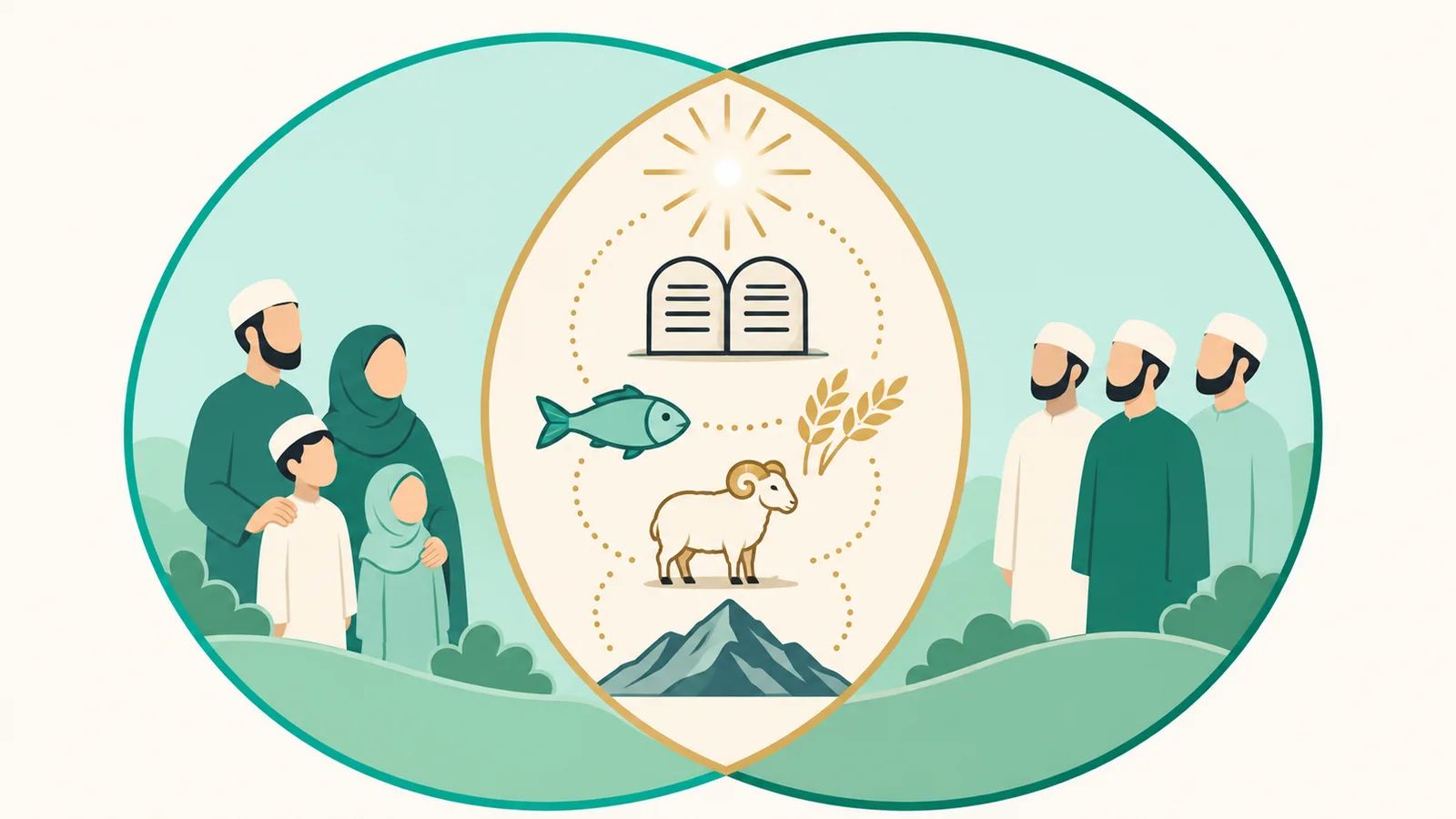
- Both faiths teach strict monotheism — one God, with no partners and no images.
- Muslims and Jews both look to Abraham as their forefather, through Ishmael and Isaac.
- Moses is mentioned by name in the Qur'an more than any other prophet.
- Both religions live by a sacred law covering worship, food, family and ethics.