العربية
 Español
 Français
 中文
 हिन्दी
Fasting in Ramadan: Why Muslims Fast for a Month

For one month every year, the rhythm of Muslim life changes. Families rise before dawn to share a quiet meal, go through the day without eating or drinking, and gather at sunset to break the fast together, often with neighbours and strangers. Mosques fill late into the night. Many Muslims will tell you, without irony, that it is the month they look forward to most.
What the fast involves
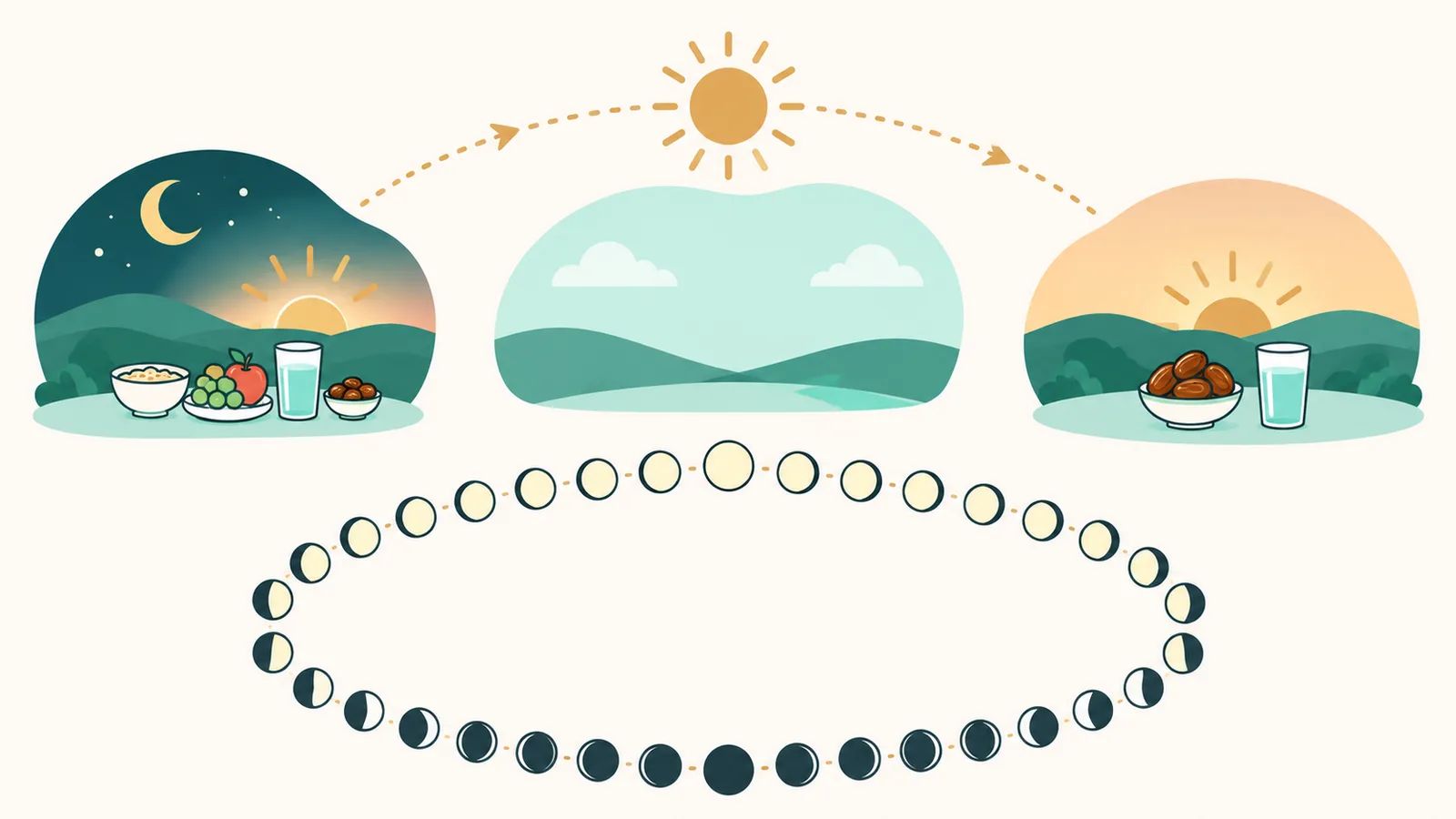
Ramadan is the ninth month of the Islamic lunar calendar, so it moves about eleven days earlier each year and passes through every season over a lifetime. Fasting in this month — sawm in Arabic — is one of the Five Pillars of Islam, and Muslims of every school agree on its essentials.
From the first light of dawn until sunset, a fasting person does not eat, drink or have marital relations. Before dawn, families eat a meal called suhur; at sunset, they break the fast with a meal called iftar, traditionally beginning with dates and water. The Qur’an explains why this particular month was chosen:
شَهْرُ رَمَضَانَ ٱلَّذِىٓ أُنزِلَ فِيهِ ٱلْقُرْءَانُ هُدًۭى لِّلنَّاسِ وَبَيِّنَٰتٍۢ مِّنَ ٱلْهُدَىٰ وَٱلْفُرْقَانِ ۚ فَمَن شَهِدَ مِنكُمُ ٱلشَّهْرَ فَلْيَصُمْهُ ۖ وَمَن كَانَ مَرِيضًا أَوْ عَلَىٰ سَفَرٍۢ فَعِدَّةٌۭ مِّنْ أَيَّامٍ أُخَرَ ۗ يُرِيدُ ٱللَّهُ بِكُمُ ٱلْيُسْرَ وَلَا يُرِيدُ بِكُمُ ٱلْعُسْرَ وَلِتُكْمِلُوا۟ ٱلْعِدَّةَ وَلِتُكَبِّرُوا۟ ٱللَّهَ عَلَىٰ مَا هَدَىٰكُمْ وَلَعَلَّكُمْ تَشْكُرُونَ ﴿١٨٥﴾ The month of Ramadhan [is that] in which was revealed the Qur'an, a guidance for the people and clear proofs of guidance and criterion. So whoever sights [the new moon of] the month, let him fast it; and whoever is ill or on a journey - then an equal number of other days. Allah intends for you ease and does not intend for you hardship and [wants] for you to complete the period and to glorify Allah for that [to] which He has guided you; and perhaps you will be grateful.
Couldn't load — please try again.
The verse names the month, the duty and its exemptions in one breath — and then it adds a line that shapes the whole practice: God intends ease for you, not hardship.
Who is excused
The fast is required of adult Muslims who are healthy and settled. Islam does not ask people to harm themselves in the name of worship. By clear agreement:
- Children are not required to fast, though many enjoy trying for part of a day.
- People who are ill or travelling may break the fast and make up the days later, as the verse above states.
- Women who are menstruating or recovering from childbirth do not fast, and make up the missed days afterwards.
- The elderly and the chronically ill who cannot fast at all instead feed a person in need for each day missed.
Scholars differ on some details — for example, how pregnant and breastfeeding women who are excused should make up the fast — and Muslims follow the guidance of their trusted scholars. See Where Muslims Differ, and Why It’s Okay.
More than going hungry
If fasting were only about food, it would be a diet. The Prophet ﷺ made it clear that a fast without a change of behaviour misses the point:
Narrated Abu Huraira: The Prophet (ﷺ) said, "Whoever does not give up forged speech and evil actions, Allah is not in need of his leaving his food and drink (i.e. Allah will not accept his fasting)
Couldn't load — please try again.
A fasting Muslim is meant to guard their tongue, hold back their temper and avoid harming others. Feeling hunger for a few hours each day also opens the heart to those who feel it without choice. The Prophet ﷺ himself, already known for his generosity, became even more generous in this month:
Narrated Ibn 'Abbas: Allah's Messenger (ﷺ) was the most generous of all the people, and he used to reach the peak in generosity in the month of Ramadan when Gabriel met him. Gabriel used to meet him every night of Ramadan to teach him the Qur'an. Allah's Messenger (ﷺ) was the most generous person, even more generous than the strong uncontrollable wind (in readiness and haste to do charitable deeds)
Couldn't load — please try again.
Many Muslims give a large part of their yearly charity in Ramadan, and before the festival at its end every household that can afford it gives a small, fixed gift of food for the poor, known as zakat al-fitr, so that no one is left out of the celebration.
A month of the Qur’an
Ramadan is, above all, the month in which the Qur’an was first revealed. Muslims try to read or listen to the whole Qur’an during the month, and many mosques hold long night prayers in which a portion is recited each night. In the last ten nights, Muslims seek Laylat al-Qadr, the Night of Decree, which the Qur’an describes as better than a thousand months (Qur’an 97:3). You can learn more about the book itself in What Is the Qur’an?
A fresh start
At its heart, Ramadan is a month of mercy and new beginnings. The Prophet ﷺ promised:
Narrated Abu Huraira: Allah's Messenger (ﷺ) said, "Whoever observes fasts during the month of Ramadan out of sincere faith, and hoping to attain Allah's rewards, then all his past sins will be forgiven
Couldn't load — please try again.
He also spoke of the simple joys the fast brings:
…There are two pleasures for the fasting person, one at the time of breaking his fast, and the other at the time when he will meet his Lord; then he will be pleased because of his fasting…
Couldn't load — please try again.
Anyone who has shared an iftar knows the first of these joys well: the hush as the sun sets, the first sip of water, the warmth of a table shared after a long day. The month ends with Eid al-Fitr, a festival of prayer, family, new clothes and gifts for children.
You are welcome at the table
Many mosques and Muslim families open their doors to guests during Ramadan, and sharing an iftar is one of the best ways to understand what this month means. If you are a new Muslim facing your first fast, Your First Ramadan offers gentle, practical advice. Fasting is a duty — but, as Muslims who keep it will tell you, it is also a gift.
Key takeaways
- Fasting in Ramadan is the fourth pillar of Islam and is agreed upon by all Muslims.
- The fast runs from dawn to sunset; the nights are for eating, prayer and family.
- The ill, travellers and others for whom fasting would be harmful are excused.
- The real goal is a changed heart — honest speech, generosity and closeness to God.