العربية
 Español
 Français
 中文
 हिन्दी
What Does Islam Say About Terrorism?

If you have ever felt afraid after a terrorist attack carried out in Islam’s name, that fear is understandable — and so is the question that follows it. Here is the answer without hedging: terrorism is forbidden in Islam. Not discouraged, not “complicated”. Forbidden.
The sanctity of human life
The Qur’an’s teaching on taking a life is among its most quoted passages:
مِنْ أَجْلِ ذَٰلِكَ كَتَبْنَا عَلَىٰ بَنِىٓ إِسْرَٰٓءِيلَ أَنَّهُۥ مَن قَتَلَ نَفْسًۢا بِغَيْرِ نَفْسٍ أَوْ فَسَادٍۢ فِى ٱلْأَرْضِ فَكَأَنَّمَا قَتَلَ ٱلنَّاسَ جَمِيعًۭا وَمَنْ أَحْيَاهَا فَكَأَنَّمَآ أَحْيَا ٱلنَّاسَ جَمِيعًۭا ۚ وَلَقَدْ جَآءَتْهُمْ رُسُلُنَا بِٱلْبَيِّنَٰتِ ثُمَّ إِنَّ كَثِيرًۭا مِّنْهُم بَعْدَ ذَٰلِكَ فِى ٱلْأَرْضِ لَمُسْرِفُونَ ﴿٣٢﴾ Because of that, We decreed upon the Children of Israel that whoever kills a soul unless for a soul or for corruption [done] in the land - it is as if he had slain mankind entirely. And whoever saves one - it is as if he had saved mankind entirely. And our messengers had certainly come to them with clear proofs. Then indeed many of them, [even] after that, throughout the land, were transgressors.
Couldn't load — please try again.
The only exceptions it names — a life for a life, or serious corruption in the land — are matters for lawful courts, not for individuals deciding who deserves to die. Elsewhere the Qur’an lists killing among the things God has forbidden:
۞ قُلْ تَعَالَوْا۟ أَتْلُ مَا حَرَّمَ رَبُّكُمْ عَلَيْكُمْ ۖ أَلَّا تُشْرِكُوا۟ بِهِۦ شَيْـًۭٔا ۖ وَبِٱلْوَٰلِدَيْنِ إِحْسَٰنًۭا ۖ وَلَا تَقْتُلُوٓا۟ أَوْلَٰدَكُم مِّنْ إِمْلَٰقٍۢ ۖ نَّحْنُ نَرْزُقُكُمْ وَإِيَّاهُمْ ۖ وَلَا تَقْرَبُوا۟ ٱلْفَوَٰحِشَ مَا ظَهَرَ مِنْهَا وَمَا بَطَنَ ۖ وَلَا تَقْتُلُوا۟ ٱلنَّفْسَ ٱلَّتِى حَرَّمَ ٱللَّهُ إِلَّا بِٱلْحَقِّ ۚ ذَٰلِكُمْ وَصَّىٰكُم بِهِۦ لَعَلَّكُمْ تَعْقِلُونَ ﴿١٥١﴾ Say, "Come, I will recite what your Lord has prohibited to you. [He commands] that you not associate anything with Him, and to parents, good treatment, and do not kill your children out of poverty; We will provide for you and them. And do not approach immoralities - what is apparent of them and what is concealed. And do not kill the soul which Allah has forbidden [to be killed] except by [legal] right. This has He instructed you that you may use reason."
Couldn't load — please try again.
The exception for taking a life by legal right again refers to justice administered through a lawful process. Nothing in it permits a person or group to appoint themselves judge and executioner. The Qur’an also forbids people to kill themselves (Qur’an 4:29), and the Prophet ﷺ warned that a believer remains in a safe state with his religion as long as he does not shed blood unlawfully (Bukhari 6862).
Even in war, innocents are off-limits
Terrorism deliberately targets civilians. Islam forbids that even in a lawful war between armies. After a woman was found killed during one of the Prophet’s campaigns:
Narrated Ibn `Umar: During some of the Ghazawat of Allah's Messenger (ﷺ) a woman was found killed, so Allah's Messenger (ﷺ) forbade the killing of women and children
Couldn't load — please try again.
On another occasion he sent an urgent message to his commander:
…They are round a woman who has been killed. He said: This is not one with whom fighting should have taken place. Khalid ibn al-Walid was in charge of the van; so he sent a man and said: Tell Khalid not to kill a woman or a hired servant…
Couldn't load — please try again.
He also told his commanders not to break promises, not to mutilate and not to kill children (Muslim 4521). If these rules bind a lawful army on a battlefield, there is no room at all for attacking shoppers, commuters, worshippers or schoolchildren.
Protecting people under a pledge of safety
Islam gives special protection to non-Muslims who live among Muslims or enter their lands under a pledge or agreement of safety — called a mu’ahad. The Prophet ﷺ said:
Narrated `Abdullah bin `Amr: The Prophet (ﷺ) said, "Whoever killed a person having a treaty with the Muslims, shall not smell the smell of Paradise though its smell is perceived from a distance of forty years
Couldn't load — please try again.
Many contemporary scholars explain that the same principle works in both directions: Muslims who live in or visit another country do so under an agreement — a visa, a residence permit, citizenship — and are bound to honour it. Betraying that trust through violence is treachery, which Islam forbids.
The Prophet ﷺ also spoke directly about people who attack indiscriminately:
…Whoso attacks my Ummah (indiscriminately) killing the righteous and the wicked of them, sparing not (even) those staunch in faith and fulfilling not his promise made with those who have been given a pledge of security - he has nothing to do with me and I have nothing to do with him…
Couldn't load — please try again.
Terrorism breaks Islamic principles at every step
Beyond the killing itself, terrorism violates several other basic teachings. It punishes people for what others have done, while the Qur’an insists that no one bears the burden of another’s wrong (Qur’an 6:164). It betrays trust and breaks agreements, which Islam treats as serious sins. And it answers grievance with cruelty, while the Qur’an tells believers to repel evil with what is better, so that an enemy may even become a close friend (Qur’an 41:34). Real grievances — and some are real — never justify harming the innocent.
Why do some people commit terror in Islam’s name?
Honesty requires admitting that some terrorists sincerely claim to act for Islam. Their reasons are usually a mix of political anger, manipulation by recruiters, ignorance of the religion, and the habit of cherry-picking verses while ignoring their context and the scholars who explain them.
This is not new. Within a few decades of the Prophet’s death, a group known as the Khawarij declared other Muslims unbelievers and killed them, believing themselves the only true believers. Mainstream Muslim scholarship has condemned their path ever since, and modern scholars have drawn the comparison with today’s extremist groups. In 2014, for example, more than a hundred Muslim scholars from around the world signed an open letter refuting, point by point, the claims of the group calling itself the “Islamic State”.
The common misunderstanding
A common assumption is that Muslims are silent about terrorism, or quietly approve of it. In reality, Muslim scholars, organisations and ordinary believers have condemned these attacks again and again — and a great many of the victims of extremist groups have themselves been Muslims, killed in their own mosques, markets and homes.
Islam is judged by its sources, not by those who betray them. Those sources call saving one life like saving all of humanity. To understand how Islam does regulate war, read What is jihad, really? and Does Islam promote violence?
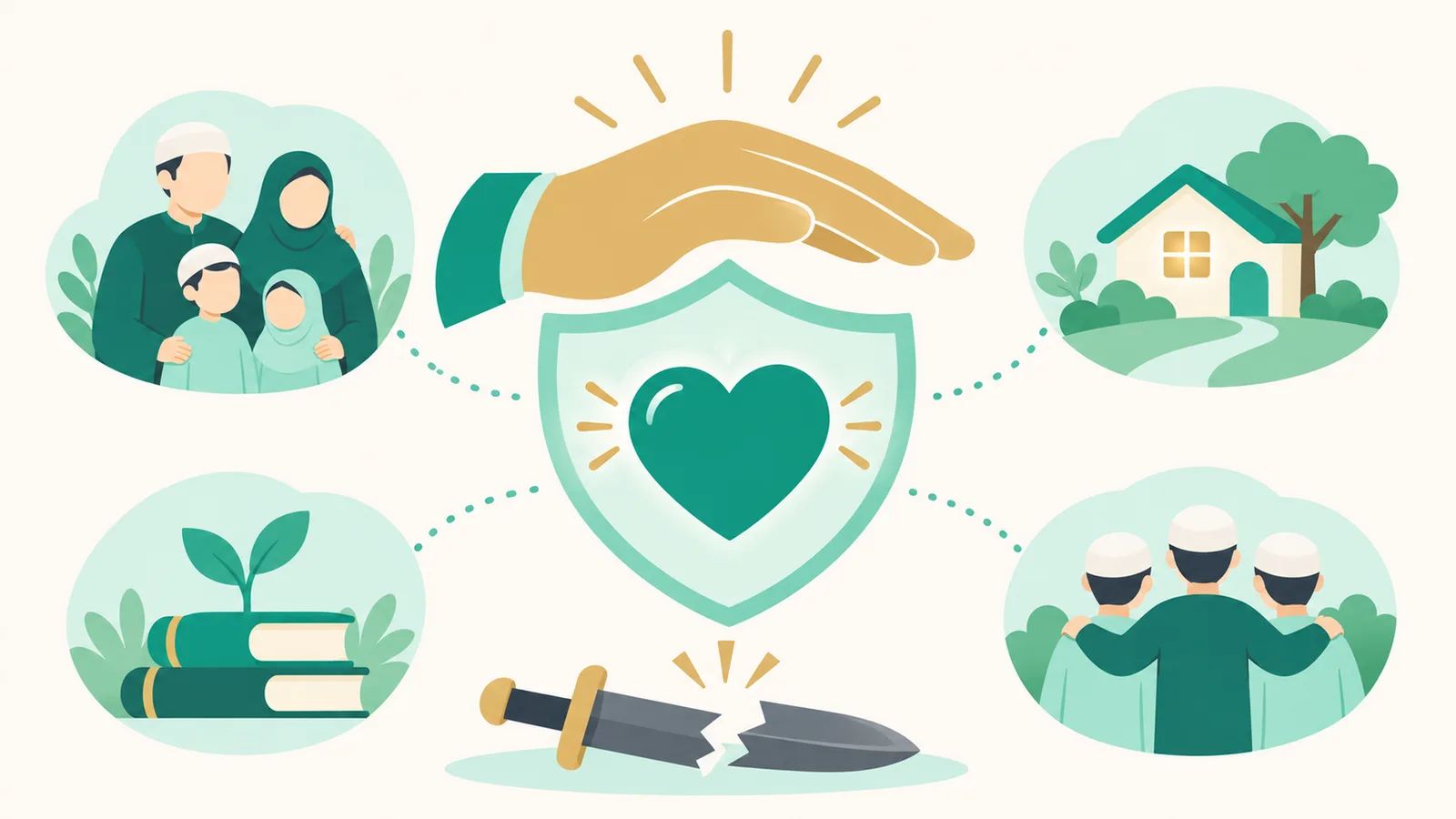
Key takeaways
- Killing an innocent person is one of the gravest sins in Islam.
- Even in a lawful war, women, children and non-combatants are protected.
- Non-Muslims living under a pledge of safety are protected by the Prophet's own warning.
- The Prophet ﷺ disowned anyone who attacks people indiscriminately.
- Muslim scholars across the world have condemned terrorist groups and their ideas.