العربية
 Español
 Français
 中文
 हिन्दी
Should Islam Be Judged by What Muslims Do?
Most people meet Islam through Muslims: a colleague, a neighbour, a news story. That is natural. But it raises a fair question. If a Muslim behaves badly, or a Muslim-majority country is unjust, does that tell us what Islam is?
Two different things
There is an important difference between a religion and its followers. A religion is defined by its sources. Islam’s sources are the Qur’an and the authentic teaching and example of the Prophet ﷺ, known as the Sunnah. Muslims are the people who try, with more or less success, to live by them.
This is not a special pleading for Islam. We apply the same standard everywhere. A doctor who harms patients does not prove that medicine is harmful; he proves that he has betrayed medicine. A Christian who acts cruelly does not show that Christ taught cruelty. Fair-minded people judge a teaching by what it teaches, and judge people by how closely they follow it.
Islam judges Muslims, too
Islam does not ask outsiders to excuse Muslims’ faults. The Qur’an is often harshest on believers who fail to live up to their words:
يَٰٓأَيُّهَا ٱلَّذِينَ ءَامَنُوا۟ لِمَ تَقُولُونَ مَا لَا تَفْعَلُونَ ﴿٢﴾ كَبُرَ مَقْتًا عِندَ ٱللَّهِ أَن تَقُولُوا۟ مَا لَا تَفْعَلُونَ ﴿٣﴾ 2O you who have believed, why do you say what you do not do? 3Great is hatred in the sight of Allah that you say what you do not do.
Couldn't load — please try again.
The Prophet ﷺ defined a Muslim not by name or birth but by conduct:
Narrated 'Abdullah bin 'Amr: The Prophet (ﷺ) said, "A Muslim is the one who avoids harming Muslims with his tongue and hands. And a Muhajir (emigrant) is the one who gives up (abandons) all what Allah has forbidden
Couldn't load — please try again.
By this standard, someone who harms others with his tongue or hands is failing as a Muslim, whatever he calls himself. The Qur’an also commands justice even towards people one dislikes (Qur’an 5:8). A Muslim who is unjust to a non-Muslim is breaking his own religion, not following it.
Culture is not the same as religion
Many practices that people associate with Islam come from local culture, tribal custom or politics. Some are harmless; others directly contradict Islamic teaching.
Take forced marriage. In some communities, daughters have been pressured into marriages they did not want, and this is sometimes blamed on Islam. Yet when a woman came to the Prophet ﷺ because her father had married her to a man she did not want, he annulled the marriage (Bukhari 5138). Islamic law requires the consent of the bride.
The same is true of so-called “honour” killings, which Islam treats as murder; of denying women their inheritance, which the Qur’an guarantees; and of racism between ethnic groups, which the Prophet ﷺ condemned (see racism and equality in Islam). When Muslims do these things, they are following culture against their faith. The reverse is also true: much that is beautiful in Muslim cultures, from hospitality to care for elderly parents, grows directly from Islamic teaching. Culture is not the enemy; it simply has to be measured against the sources.
Muslims are human
None of this means Muslims claim to be better than anyone else. Islam expects its followers to stumble. What matters is turning back to God:
Anas narrated that the Prophet (ﷺ) said:"Every son of Adam sins, and the best of the sinners are the repentant
Couldn't load — please try again.
So when you meet a Muslim who is rude, dishonest or hypocritical, you have met a human being who needs to repent, as every human being does. When you meet one who is generous, patient and honest, you have seen the religion at work. Both are real, but only one of them reflects what Islam teaches.
The common misunderstanding
The common misunderstanding runs in two directions. Some people judge Islam by the worst things done by Muslims, especially those that make the news. Others assume that whatever a Muslim-majority government or a loud preacher does must be “real Islam”. In both cases the fair test is the same: compare the action with the sources. Where they match, credit the religion; where they do not, hold the people responsible.
That is the standard Muslims ask for, and the standard Islam applies to Muslims themselves. If you want to see what the sources actually teach, a good place to start is What is Islam?, followed by good character in Islam and common myths about Islam.
Key takeaways
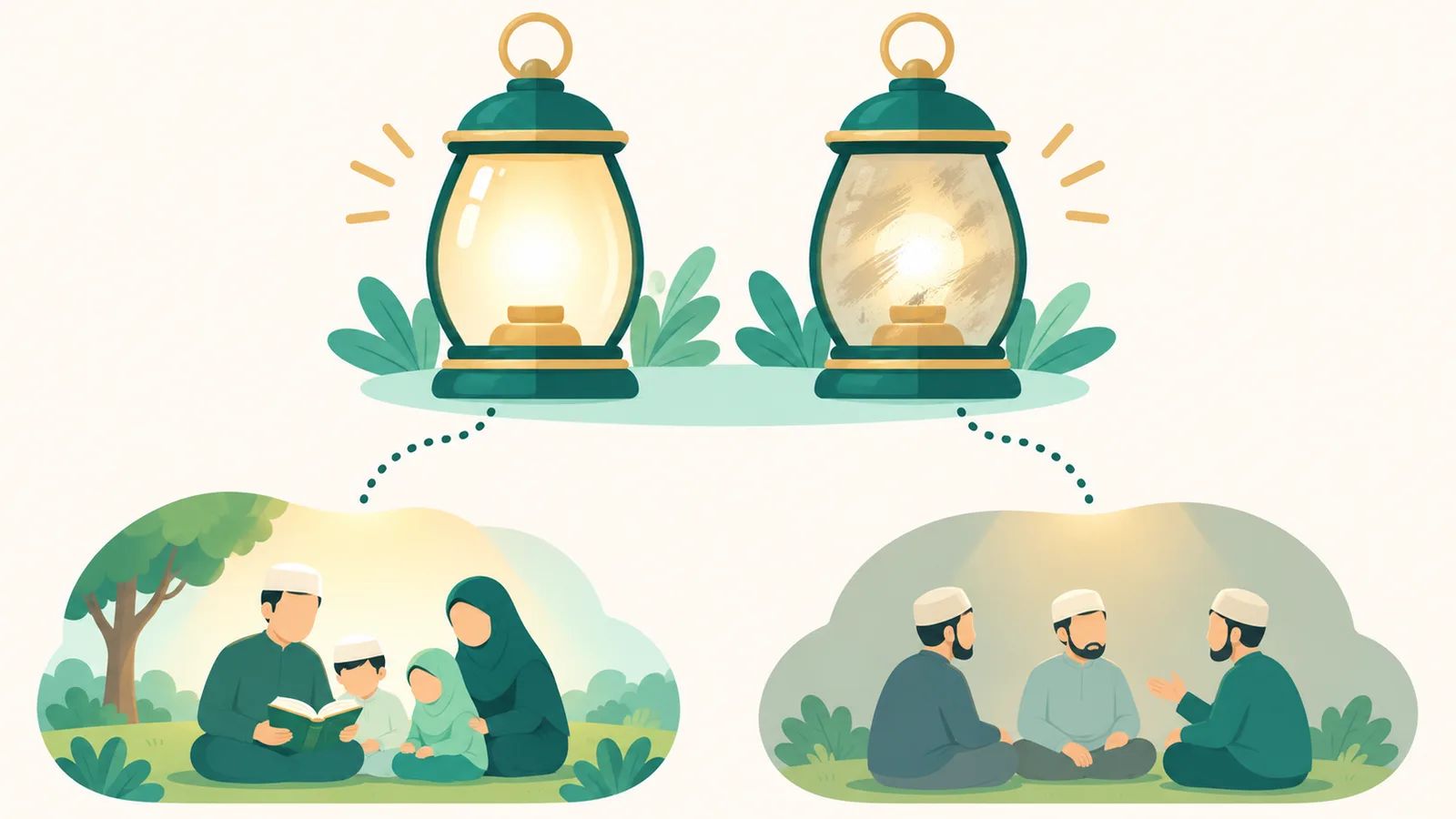
- Islam is defined by the Qur'an and the authentic Sunnah, not by the conduct of any individual or country.
- The Qur'an itself condemns believers who say one thing and do another.
- Some practices blamed on Islam, such as forced marriage or "honour" violence, are forbidden by it.
- Muslims are not perfect; Islam expects them to fall short and to repent.
- The fair test is to compare what Muslims do with what their own sources teach.