العربية
 Español
 Français
 中文
 हिन्दी
What Does Islam Say About Racism and Equality?
Racism is one of the oldest and most stubborn human failings. Every generation finds new ways to divide people by colour, tribe or nationality. Islam confronts this directly, with a teaching that is simple to state and demanding to live.
One human family
The Qur’an reminds all people that they share the same origin, and explains why they were made different:
يَٰٓأَيُّهَا ٱلنَّاسُ إِنَّا خَلَقْنَٰكُم مِّن ذَكَرٍۢ وَأُنثَىٰ وَجَعَلْنَٰكُمْ شُعُوبًۭا وَقَبَآئِلَ لِتَعَارَفُوٓا۟ ۚ إِنَّ أَكْرَمَكُمْ عِندَ ٱللَّهِ أَتْقَىٰكُمْ ۚ إِنَّ ٱللَّهَ عَلِيمٌ خَبِيرٌۭ ﴿١٣﴾ O mankind, indeed We have created you from male and female and made you peoples and tribes that you may know one another. Indeed, the most noble of you in the sight of Allah is the most righteous of you. Indeed, Allah is Knowing and Acquainted.
Couldn't load — please try again.
Notice three things. The verse is addressed to all of humanity, not just Muslims. It says our differences exist so that we may come to know each other — to meet, learn and connect, not to compete. And it gives only one measure of honour: righteousness, taqwa, a quality of the heart that no one can see in a face or a passport.
Diversity as a sign of God
The Qur’an goes further. It does not merely tolerate human differences; it celebrates them as part of God’s design:
وَمِنْ ءَايَٰتِهِۦ خَلْقُ ٱلسَّمَٰوَٰتِ وَٱلْأَرْضِ وَٱخْتِلَٰفُ أَلْسِنَتِكُمْ وَأَلْوَٰنِكُمْ ۚ إِنَّ فِى ذَٰلِكَ لَءَايَٰتٍۢ لِّلْعَٰلِمِينَ ﴿٢٢﴾ And of His signs is the creation of the heavens and the earth and the diversity of your languages and your colors. Indeed in that are signs for those of knowledge.
Couldn't load — please try again.
In this verse, the variety of human languages and colours sits beside the creation of the heavens and the earth as evidence of God’s power and wisdom. To despise someone for their colour is, in effect, to despise a sign of God.
God looks at the heart
The Prophet ﷺ taught that God’s way of judging people is completely different from ours:
Abu Huraira reported Allah's Messenger (ﷺ) as saying:Verily Allah does not look to your faces and your wealth but He looks to your heart and to your deeds
Couldn't load — please try again.
Appearance, wealth and background — the very things racism is built on — are exactly what God does not look at.
Pride in ancestry is a relic of ignorance
Arabia before Islam was proud of lineage and tribe. Islam named this pride for what it was: part of jahiliyyah, the “age of ignorance”. The Prophet ﷺ said:
…Allah, Most High, has removed from you the pride of the pre-Islamic period and its boasting in ancestors. One is only a pious believer or a miserable sinner. You are sons of Adam, and Adam came from dust.…
Couldn't load — please try again.
He applied this even to his closest Companions. When Abu Dharr, a devoted early Muslim, insulted a man by mocking his mother, the Prophet ﷺ rebuked him sharply:
…Did you abuse him by calling his mother with bad names You still have some characteristics of ignorance.…
Couldn't load — please try again.
Abu Dharr took the lesson to heart: from then on he dressed the man who served him in the same kind of clothing he wore himself.
The story of Bilal
Bilal ibn Rabah was an African man enslaved in Mecca. When he became Muslim, his master tortured him in the desert heat, but he would not give up his faith. He was freed by Abu Bakr, the Prophet’s closest friend, and went on to become one of the most beloved Companions.
When the Muslim community needed someone to call people to prayer, the Prophet ﷺ chose Bilal (Sahih al-Bukhari 604). His voice became the first adhan, the call to prayer that is still heard five times a day around the world. Years later, Umar — by then the leader of the Muslim community — would speak of him with remarkable respect:
Narrated Jabir bin `Abdullah: `Umar used to say, "Abu Bakr is our chief, and he manumitted our chief," meaning Bilal
Couldn't load — please try again.
A man who had once been enslaved was honoured as a master by the head of the Muslim state.
Equality you can see
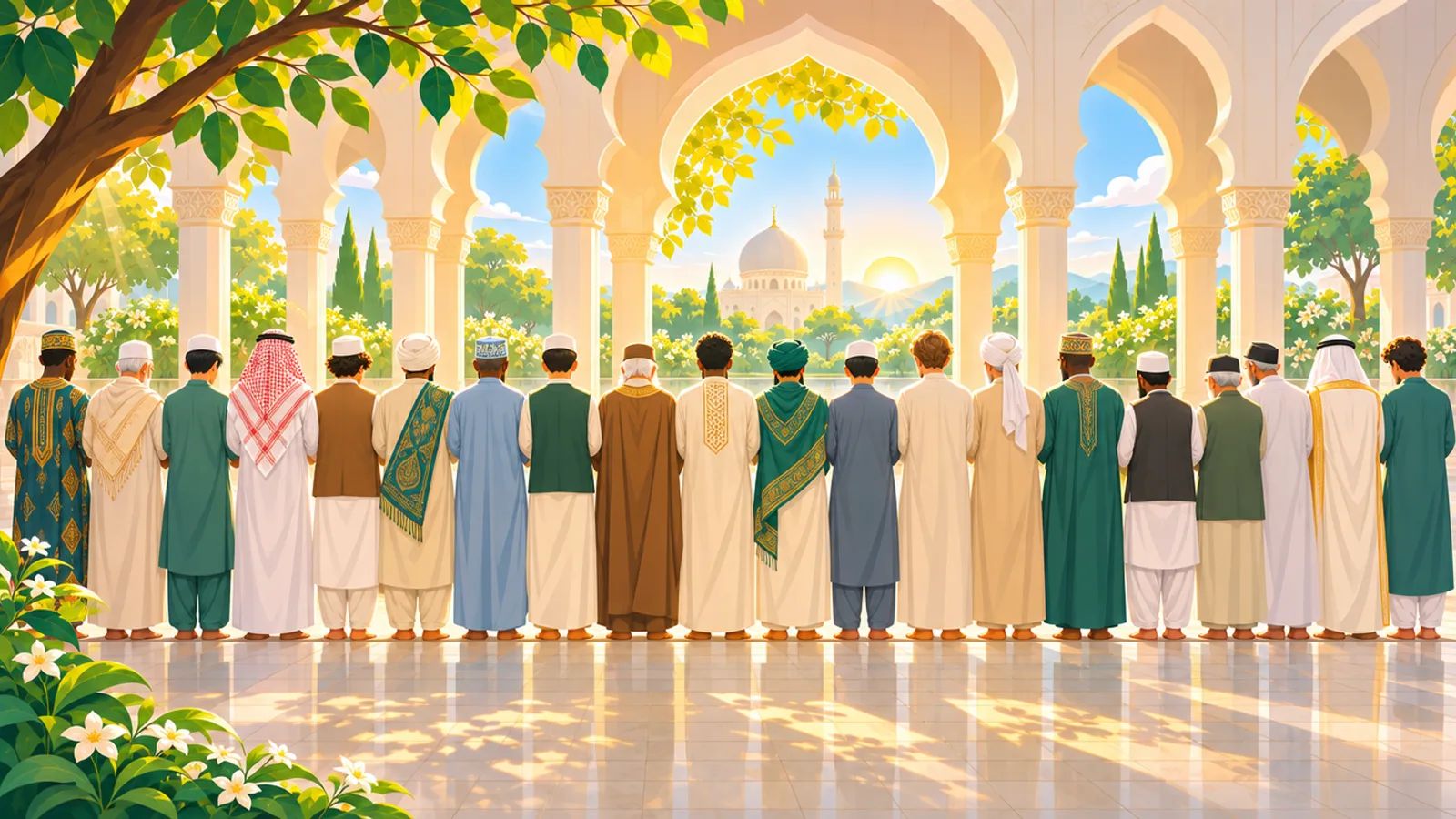
Islam builds equality into its worship. In the mosque, people stand shoulder to shoulder in rows, rich beside poor, Black beside white, with no reserved seats. At the Hajj pilgrimage in Mecca, millions of people from every nation wear the same simple white garments. Many visitors have described this as the most powerful experience of human equality they have ever seen.
Muslims are not immune
It would be dishonest to pretend that Muslims are free of racism. Prejudice exists in Muslim communities, as it does everywhere. But when it appears, it is a betrayal of Islam, not an expression of it — and the sources above give every Muslim the tools to challenge it.
A closing thought
Islam’s answer to racism is not only a rule but a way of seeing: every face you meet is a sign of God, and every person is your brother or sister in Adam. To read more, see human rights in Islam or justice in Islam.
Key takeaways
- All people descend from Adam and Eve and form one human family.
- Different colours and languages are signs of God, to be appreciated, not ranked.
- The only distinction that matters to God is righteousness.
- The Prophet ﷺ called racial and tribal pride a remnant of ignorance.
- Bilal, a formerly enslaved African, became one of the most honoured Companions.