العربية
 Español
 Français
 中文
 हिन्दी
Did Islam Spread by the Sword?

“Islam was spread by the sword” is one of the oldest claims made about the religion. Like most slogans, it contains a piece of history and leaves out most of the rest. To answer it fairly, we need to separate two questions that are often blurred together: did Muslim states expand by war, and were people forced to become Muslim?
The honest starting point: there were conquests
Within a century of the Prophet Muhammad’s ﷺ death, Muslim rule stretched from Spain to Central Asia. Much of that expansion happened through war against the Byzantine and Persian empires, which were themselves the great military powers of the age. Later Muslim dynasties, like the Ottomans and the Mughals, also expanded by conquest. Nothing is gained by denying this, and Muslims should not.
But ruling a land is not the same as converting its people. The question is not whether Muslim armies existed, but whether the faith itself was imposed on people at the point of a sword.
What the Qur’an and the Prophet ﷺ taught
The Qur’an’s instruction for spreading the faith is invitation, not force:
ٱدْعُ إِلَىٰ سَبِيلِ رَبِّكَ بِٱلْحِكْمَةِ وَٱلْمَوْعِظَةِ ٱلْحَسَنَةِ ۖ وَجَٰدِلْهُم بِٱلَّتِى هِىَ أَحْسَنُ ۚ إِنَّ رَبَّكَ هُوَ أَعْلَمُ بِمَن ضَلَّ عَن سَبِيلِهِۦ ۖ وَهُوَ أَعْلَمُ بِٱلْمُهْتَدِينَ ﴿١٢٥﴾ Invite to the way of your Lord with wisdom and good instruction, and argue with them in a way that is best. Indeed, your Lord is most knowing of who has strayed from His way, and He is most knowing of who is [rightly] guided.
Couldn't load — please try again.
And it states the principle in one of its most quoted lines:
لَآ إِكْرَاهَ فِى ٱلدِّينِ ۖ قَد تَّبَيَّنَ ٱلرُّشْدُ مِنَ ٱلْغَىِّ ۚ فَمَن يَكْفُرْ بِٱلطَّٰغُوتِ وَيُؤْمِنۢ بِٱللَّهِ فَقَدِ ٱسْتَمْسَكَ بِٱلْعُرْوَةِ ٱلْوُثْقَىٰ لَا ٱنفِصَامَ لَهَا ۗ وَٱللَّهُ سَمِيعٌ عَلِيمٌ ﴿٢٥٦﴾ There shall be no compulsion in [acceptance of] the religion. The right course has become clear from the wrong. So whoever disbelieves in Taghut and believes in Allah has grasped the most trustworthy handhold with no break in it. And Allah is Hearing and Knowing.
Couldn't load — please try again.
The Prophet ﷺ followed this. When the companions captured Thumamah ibn Uthal, a chief of an enemy tribe, the Prophet ﷺ spoke to him for three days and then freed him without any condition. What happened next is striking:
…“Release Thumama.” So he (i.e. Thumama) went to a garden of date-palm trees near to the Mosque, took a bath and then entered the Mosque and said, “I testify that None has the right to be worshipped except Allah, and also testify that Muhammad is His Apostle!…
Couldn't load — please try again.
His faith came after his freedom, not as its price.
When the Prophet ﷺ sent out armies, his instructions show what conquest meant in law. Commanders were to offer the enemy Islam; if they declined, they could keep their own religion under Muslim protection in return for a tax called jizya; only if both were refused would fighting continue (Muslim 4521). The same instructions forbade breaking promises, mutilating the dead and killing children. A people who submitted to Muslim rule kept their faith. Becoming Muslim was never the condition of peace.
What history shows
The historical record fits this far better than the slogan does:
- Conversion was slow. In lands such as Egypt, Syria, Iraq and Iran, Christians, Jews and Zoroastrians remained large parts of the population for generations after Muslim rule began, and in some regions for centuries. Ancient churches and Jewish communities survive across the Middle East today.
- Some rulers discouraged conversion. Because non-Muslims paid the jizya, mass conversion reduced state income. Some early governors kept taxing converts as if they had not converted, a policy the caliph Umar ibn Abd al-Aziz reversed. A state bent on forced conversion would hardly do this.
- India stayed largely Hindu. Muslim dynasties ruled much of the Indian subcontinent for centuries, yet most of its people never became Muslim.
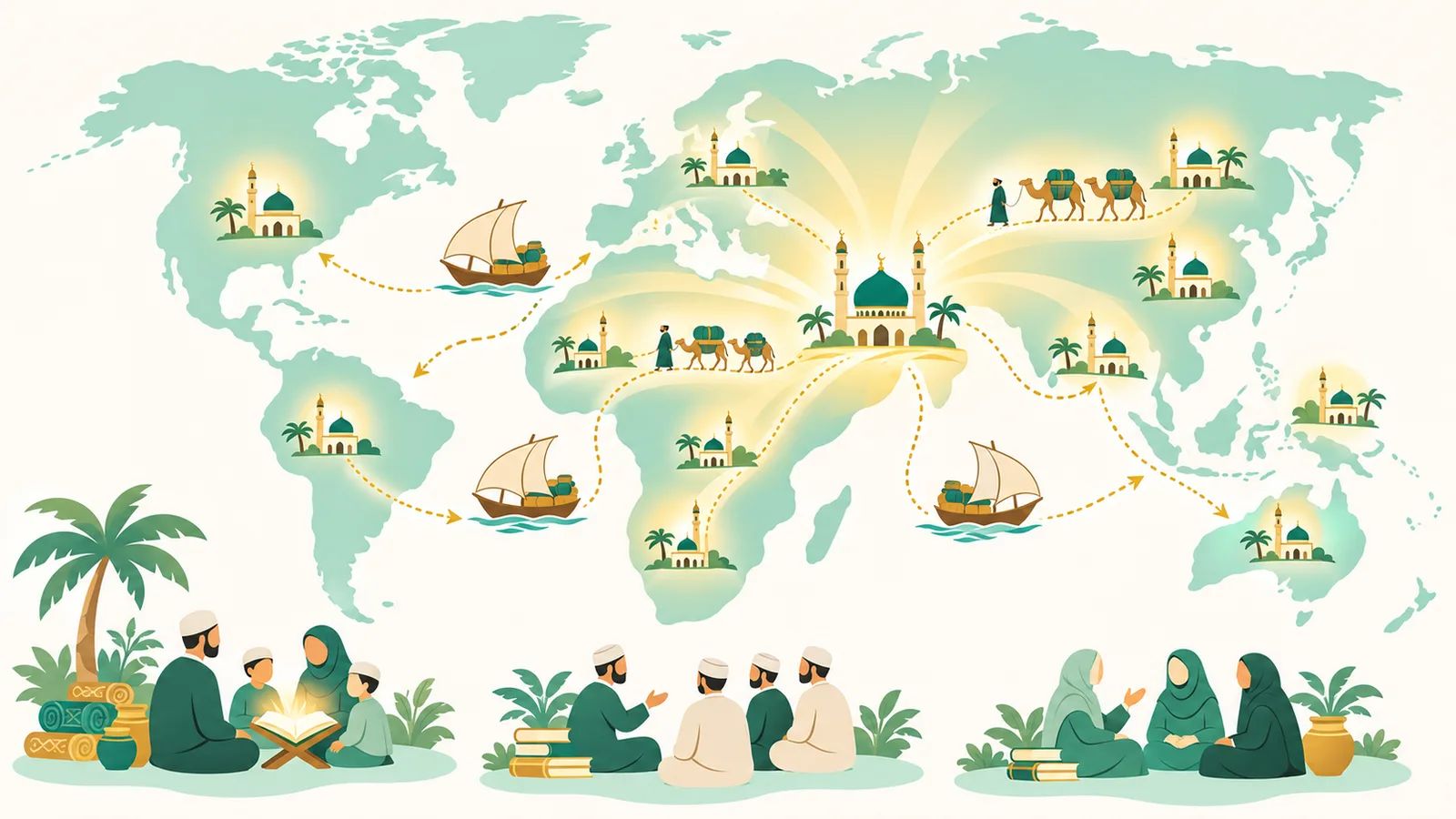
- The largest Muslim populations were never conquered. Islam reached Indonesia, today the country with the most Muslims, and much of East and West Africa mainly through merchants, scholars and intermarriage.
- Conquerors converted to the faith of the conquered. The Mongols destroyed Baghdad in 1258, yet within a few generations many of their rulers had embraced Islam.
None of this means every ruler behaved well. History records episodes of pressure and even forced conversion, such as under the Almohad dynasty in twelfth-century North Africa and Spain. But these were departures from Islamic law, not applications of it. Classical jurists held, for example, that a Jew or Christian living under Muslim protection who was forced to declare Islam was not to be counted a Muslim, since faith is a matter of the heart.
Why people did embrace Islam
People had many reasons to become Muslim: the simplicity of its belief in one God, the equality of believers in prayer, the example of Muslim neighbours, scholars and traders, and the appeal of a faith that asks people to think. Some converted for social or economic advantage, as happens with every majority religion. The pattern of slow, uneven and largely peaceful change across very different societies is hard to explain by coercion alone.
The common misunderstanding
The misunderstanding is to treat the spread of Muslim rule and the spread of Islamic faith as the same thing. The first sometimes came through war, like the expansion of every empire in history. The second came through people choosing it, often long after the armies had gone, and in many places without any army at all. For more on the principle behind this, see why no one may be forced to become Muslim, and for Islam’s rules of war, does Islam promote violence?
Islam today is followed by nearly a quarter of humanity, many of whom live in lands that no Muslim army ever conquered. Faith of that kind has to be chosen. You are invited to look at it the same way: freely, and with an open mind.
Key takeaways
- Early Muslim states did expand by conquest; that is a historical fact, not a myth.
- Conquest brought territory under Muslim rule, but Islamic law did not allow people to be forced into the faith.
- In many conquered lands, Muslims remained a minority for generations, sometimes for centuries.
- Islam reached Indonesia, much of Africa and Central Asia largely through trade, scholarship and example.
- There were rulers who broke the rule, and Muslim scholarship judges them by it, not the other way round.