العربية
 Español
 Français
 中文
 हिन्दी
Angels in Islam: Who They Are and What They Do

Many people grow up with a picture of angels from paintings and greeting cards: chubby children with little wings, or gentle figures watching from the clouds. Islam’s picture of angels is both more serious and more comforting — and it is part of the core of Muslim belief.
Part of the faith
Belief in angels is the second of the six articles of faith, alongside belief in God, His books, His messengers, the Last Day and His decree. See The Six Articles of Faith. Muslims believe angels are real, even though we cannot normally see them — just as many real things lie beyond our senses.
Created from light
The Prophet Muhammad ﷺ explained that angels, jinn and human beings were each created from a different origin:
A'isha reported that Allah's Messenger (ﷺ) said:The Angels were born out of light and the Jinns were born out of the spark of fire and Adam was born as he has been defined (in the Qur'an) for you (i. e. he is fashioned out of clay)
Couldn't load — please try again.
The Qur’an describes angels as God’s messengers, with wings, in forms and numbers that God alone fully knows:
ٱلْحَمْدُ لِلَّهِ فَاطِرِ ٱلسَّمَٰوَٰتِ وَٱلْأَرْضِ جَاعِلِ ٱلْمَلَٰٓئِكَةِ رُسُلًا أُو۟لِىٓ أَجْنِحَةٍۢ مَّثْنَىٰ وَثُلَٰثَ وَرُبَٰعَ ۚ يَزِيدُ فِى ٱلْخَلْقِ مَا يَشَآءُ ۚ إِنَّ ٱللَّهَ عَلَىٰ كُلِّ شَىْءٍۢ قَدِيرٌۭ ﴿١﴾ [All] praise is [due] to Allah, Creator of the heavens and the earth, [who] made the angels messengers having wings, two or three or four. He increases in creation what He wills. Indeed, Allah is over all things competent.
Couldn't load — please try again.
Angels do not eat, drink, marry or grow old. Unlike humans and jinn, they do not have the freedom to rebel: they are wholly devoted to God’s worship and His commands.
وَلَهُۥ مَن فِى ٱلسَّمَٰوَٰتِ وَٱلْأَرْضِ ۚ وَمَنْ عِندَهُۥ لَا يَسْتَكْبِرُونَ عَنْ عِبَادَتِهِۦ وَلَا يَسْتَحْسِرُونَ ﴿١٩﴾ يُسَبِّحُونَ ٱلَّيْلَ وَٱلنَّهَارَ لَا يَفْتُرُونَ ﴿٢٠﴾ 19To Him belongs whoever is in the heavens and the earth. And those near Him are not prevented by arrogance from His worship, nor do they tire. 20They exalt [Him] night and day [and] do not slacken.
Couldn't load — please try again.
What angels do
The Qur’an and the Sunnah mention many tasks that God has given the angels. Here are a few of the best known.
Bringing revelation
The angel Gabriel (Jibril) carried God’s messages to the prophets. He brought the Qur’an to Muhammad ﷺ:
قُلْ مَن كَانَ عَدُوًّۭا لِّجِبْرِيلَ فَإِنَّهُۥ نَزَّلَهُۥ عَلَىٰ قَلْبِكَ بِإِذْنِ ٱللَّهِ مُصَدِّقًۭا لِّمَا بَيْنَ يَدَيْهِ وَهُدًۭى وَبُشْرَىٰ لِلْمُؤْمِنِينَ ﴿٩٧﴾ Say, "Whoever is an enemy to Gabriel - it is [none but] he who has brought the Qur'an down upon your heart, [O Muhammad], by permission of Allah, confirming that which was before it and as guidance and good tidings for the believers."
Couldn't load — please try again.
Recording our deeds
Every person has angels who write down what they say and do, good and bad. This is not meant to frighten but to remind us that nothing is wasted — not even a kind word.
إِذْ يَتَلَقَّى ٱلْمُتَلَقِّيَانِ عَنِ ٱلْيَمِينِ وَعَنِ ٱلشِّمَالِ قَعِيدٌۭ ﴿١٧﴾ مَّا يَلْفِظُ مِن قَوْلٍ إِلَّا لَدَيْهِ رَقِيبٌ عَتِيدٌۭ ﴿١٨﴾ 17When the two receivers receive, seated on the right and on the left. 18Man does not utter any word except that with him is an observer prepared [to record].
Couldn't load — please try again.
Protecting and praying
- Guarding people. The Qur’an speaks of angels who take turns guarding each person by God’s command (Qur’an 13:11).
- Praying for believers. The angels who carry God’s Throne ask Him to forgive those who believe and turn to Him (Qur’an 40:7). Imagine: beings who never sin, praying for those who do.
- Other duties. The Qur’an and the Sunnah also mention angels who take souls at death, and an angel who will blow the trumpet announcing the Day of Resurrection.
What angels are not
Islam is careful to keep angels in their place, as honoured servants of God:
- Not divine. Angels are created beings. Muslims do not pray to them or ask them for help in place of God; that would break tawhid, the oneness of God. See Tawhid: The Oneness of God.
- Not God’s children. Some people in ancient Arabia called the angels “daughters of God”. The Qur’an firmly rejects this: they are servants, not offspring.
- Not fallen. In Islam, Satan (Iblis) is not a fallen angel. The Qur’an says he was one of the jinn — beings with free will, like humans — who refused God’s command out of pride (Qur’an 18:50).
Why it matters in daily life
Believing in angels changes how a Muslim lives. It is a reminder that we are never truly alone or unobserved: angels record our deeds, which encourages honesty even when no one else is watching. It is also a source of comfort. The same angels who record our mistakes also pray for our forgiveness, and they surround people who gather to remember God and learn about Him.
Muslims end each prayer by turning their heads to the right and to the left and greeting with peace — a greeting that, in the view of some scholars, includes the angels as well as the people beside them.
Learning more
Angels are one part of a bigger picture of the unseen world that the Qur’an describes. To see where they fit, read What Every Muslim Believes, and to learn about the day when the record angels keep will be opened, read The Day of Judgment.
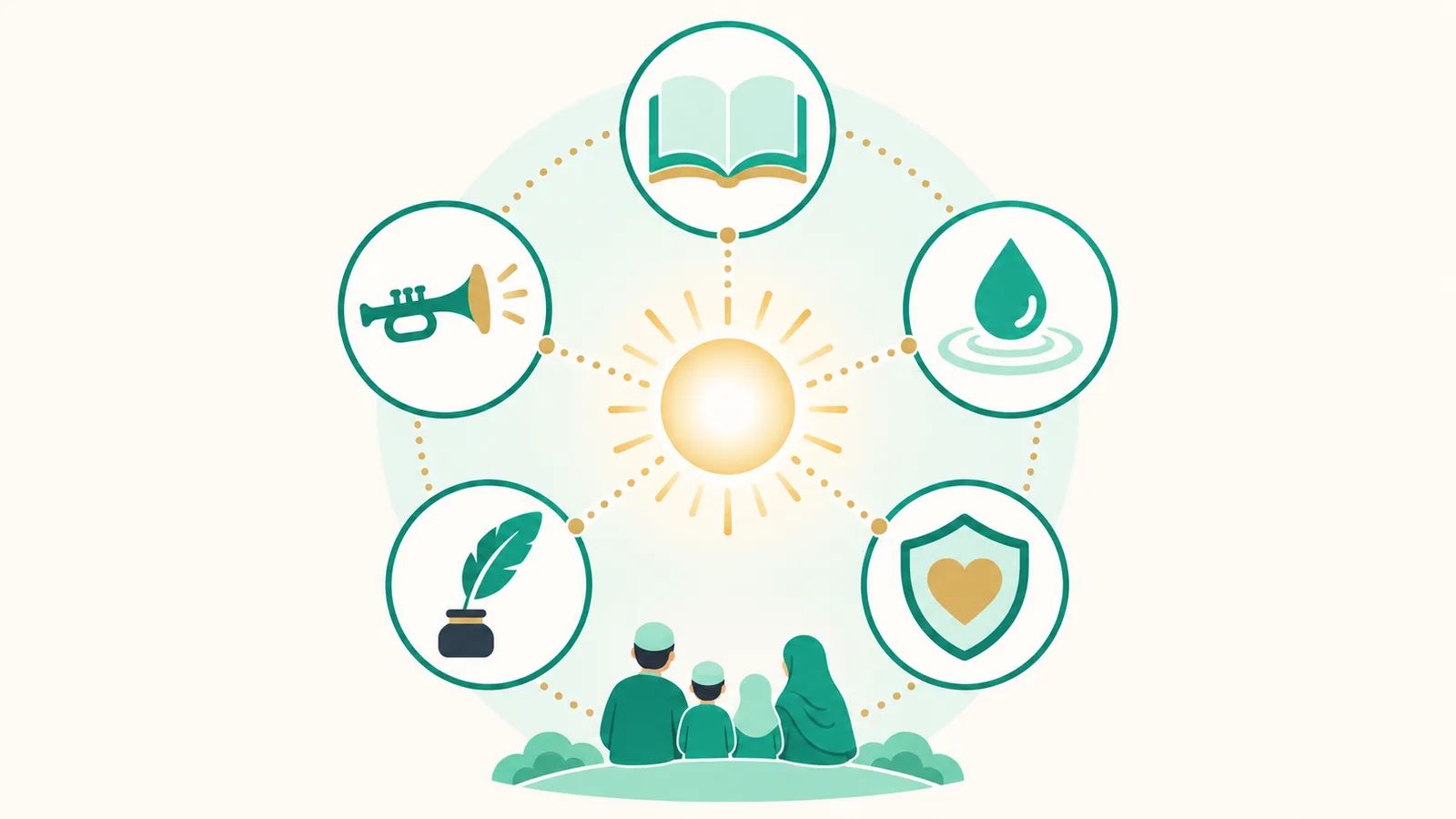
Key takeaways
- Angels are real but unseen beings, created from light, who always obey God.
- Gabriel brought revelation to the prophets, including the Qur'an to Muhammad ﷺ.
- Angels record every person's words and deeds, and some guard and pray for people.
- Angels are not God's children, not divine, and not to be worshipped.
- Satan (Iblis) is not a fallen angel in Islam; he is from the jinn.