العربية
 Español
 Français
 中文
 हिन्दी
Paradise and Hell in Islam

Some people imagine that religious talk about heaven and hell is either a bribe or a threat. Islam speaks about both openly, but with a very particular balance — one that leaves a person neither careless nor hopeless. This article explains that balance.
Paradise: beyond imagination
The Qur’an describes Paradise (Jannah, literally “the garden”) in vivid language: gardens with rivers flowing beneath them, peace, reunion with loved ones, and no more pain, fear, illness or sorrow. But it also makes clear that these words only hint at the reality. God says, in a hadith the Prophet ﷺ narrated:
Narrated Abu Huraira: Allah's Messenger (ﷺ) said, "Allah said, "I have prepared for My Pious slaves things which have never been seen by an eye, or heard by an ear, or imagined by a human being." If you wish, you can recite this Verse from the Holy Qur'an:--"No soul knows what is kept hidden for them, of joy as a reward for what they used to do
Couldn't load — please try again.
For Muslims, the greatest joy of Paradise is not any physical pleasure but being close to God, pleased with Him and He pleased with them. Paradise is a gift of His mercy: good deeds matter, but no one enters it by their deeds alone without God’s grace.
Hell: an honest warning
The Qur’an also speaks plainly about Hell (Jahannam): a place of real punishment for those who knowingly reject the truth and persist in serious wrongdoing. Islam does not hide this or soften it. But it is important to understand why it is mentioned.
A doctor who warns you about a dangerous illness is not being cruel; he is trying to save you. In the same way, Muslims see the warnings of the Qur’an as a mercy — a warning given while there is still time to change course. And the door to change stays open until the very end of a person’s life.
Hope and fear, held together
Islam asks believers to keep two feelings in balance, like the two wings of a bird. Too much fear leads to despair; too much hope leads to carelessness. The Qur’an places them side by side:
۞ نَبِّئْ عِبَادِىٓ أَنِّىٓ أَنَا ٱلْغَفُورُ ٱلرَّحِيمُ ﴿٤٩﴾ وَأَنَّ عَذَابِى هُوَ ٱلْعَذَابُ ٱلْأَلِيمُ ﴿٥٠﴾ 49[O Muhammad], inform My servants that it is I who am the Forgiving, the Merciful. 50And that it is My punishment which is the painful punishment.
Couldn't load — please try again.
Notice the order: forgiveness and mercy come first. The Prophet ﷺ described just how vast God’s mercy is — and how both hope and fear follow from it:
Narrated Abu Huraira: I heard Allah's Messenger (ﷺ) saying, Verily Allah created Mercy. The day He created it, He made it into one hundred parts. He withheld with Him ninety-nine parts, and sent its one part to all His creatures. Had the non-believer known of all the Mercy which is in the Hands of Allah, he would not lose hope of entering Paradise, and had the believer known of all the punishment which is present with Allah, he would not consider himself safe from the Hell-Fire
Couldn't load — please try again.
Think of all the love between parents and children, all the kindness between people — even the gentleness of animals with their young. Muslims understand all of it to come from that single part of mercy. The other ninety-nine parts God has kept with Himself.
A God who wrongs no one
People often ask: “Is it fair for anyone to be punished forever?” Islam answers by insisting on God’s perfect justice. He does not wrong anyone by even an atom’s weight, and He multiplies every good deed (Qur’an 4:40). He does not punish people for a message that never reached them (Qur’an 17:15). And He knows every person’s circumstances, struggles and opportunities far better than we do.
Even for those who enter Hell, God’s mercy does not stop. The Prophet ﷺ said:
…When the people of Paradise have entered Paradise, and the people of the Fire have entered the Fire, Allah will say. 'Take out (of the Fire) whoever has got faith equal to a mustard seed in his heart.'…
Couldn't load — please try again.
Who goes where?
Muslims believe that Paradise is promised to those who believe in God and do good, and that God alone knows each person’s heart and final state. That is why Muslims are taught not to declare any particular individual as destined for Hell. Questions about people who never heard Islam properly, or good people of other faiths, are explored in Can Good Non-Muslims Go to Heaven? On some details of these questions scholars have offered different views — see Where Muslims Differ.
An invitation, not a threat
At heart, the Islamic teaching on Paradise and Hell is an invitation: there is a home of peace waiting, built by a merciful God, and the way to it is open to everyone who turns to Him. If you would like to read more, The Day of Judgment explains what comes before, and Why Is Islam Called a Religion of Mercy? shows how mercy shapes the whole faith.
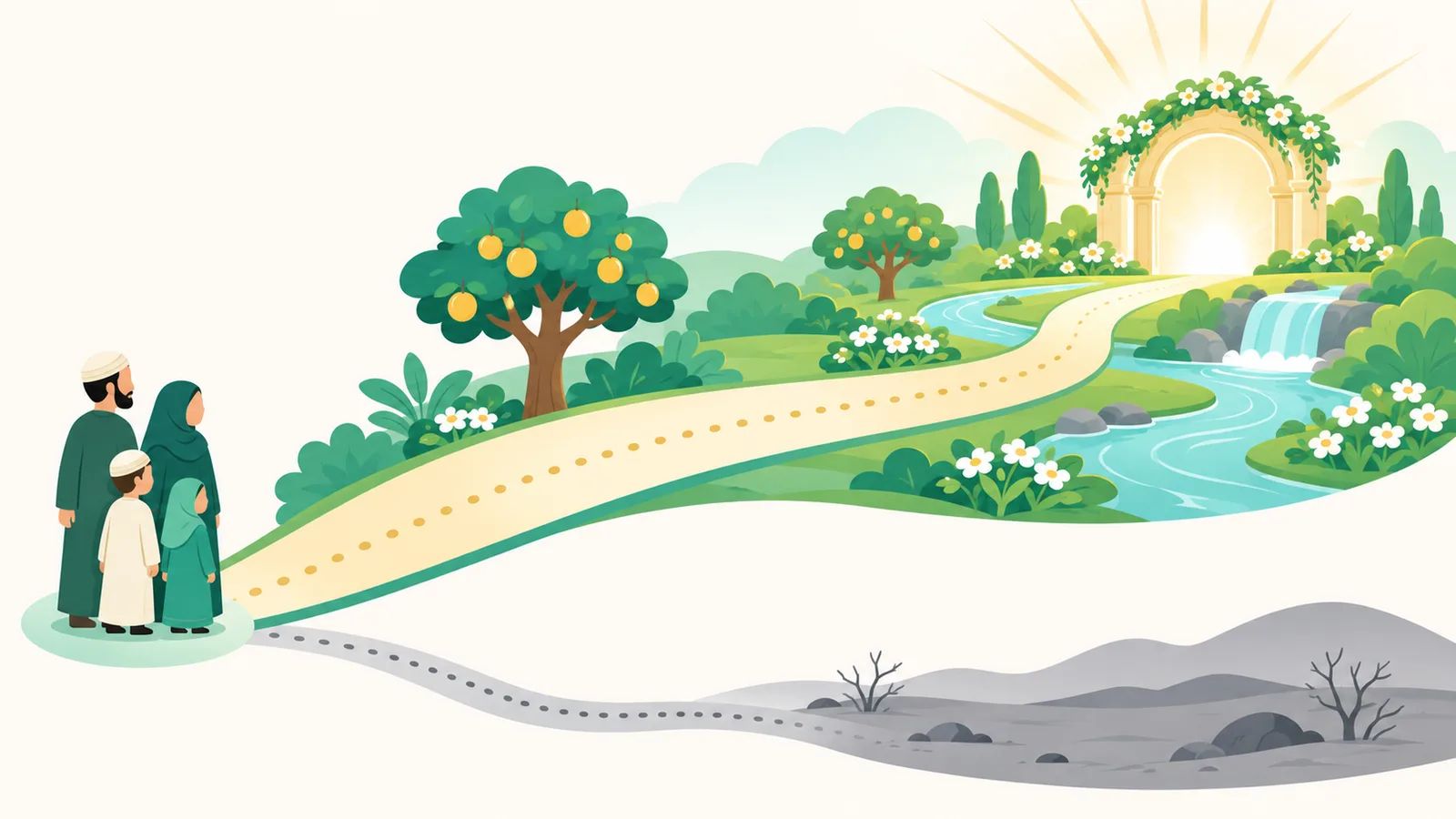
Key takeaways
- Paradise is a real, eternal home whose joys are beyond anything we can imagine.
- Hell is real too — the Qur'an speaks of it honestly, as a warning given out of mercy.
- Muslims are taught to balance hope in God's mercy with fear of His justice.
- God's mercy outweighs His anger, and He wrongs no one even by an atom's weight.
- Only God decides who enters Paradise; Muslims do not pronounce judgement on individuals.