العربية
 Español
 Français
 中文
 हिन्दी
The Life of Prophet Muhammad ﷺ: A Short Biography
Few lives in history are recorded in as much detail as that of Muhammad ﷺ. His companions remembered how he spoke, prayed, laughed, treated his family and dealt with his enemies, and passed it on with great care. Here is his story in brief.
An orphan in Makkah
Muhammad ﷺ was born in Makkah, a trading town in the Arabian desert, around the year 570 CE. His father died before he was born, and his mother when he was still a small child. He was raised first by his grandfather and then by his uncle Abu Talib.
He worked as a shepherd and later as a merchant. People came to know him as al-Amin — the Trustworthy — and would leave their valuables in his care. At around twenty-five he married Khadijah, a respected businesswoman who admired his honesty. Their marriage was one of deep love, and she was the first person to believe in his message.
Makkah at that time was home to the Kaaba, the house of worship built by Abraham and Ishmael, but it had become filled with idols. Muhammad ﷺ never worshipped them. As he approached forty, he often withdrew to a cave called Hira on a mountain outside the city to reflect and worship alone.
The first revelation
In the year 610 CE, during one of these retreats, the angel Gabriel came to him and commanded him to read. Muhammad ﷺ, who could not read or write, said that he could not. After the angel pressed him three times, he received the first verses of the Qur’an:
ٱقْرَأْ بِٱسْمِ رَبِّكَ ٱلَّذِى خَلَقَ ﴿١﴾ خَلَقَ ٱلْإِنسَٰنَ مِنْ عَلَقٍ ﴿٢﴾ ٱقْرَأْ وَرَبُّكَ ٱلْأَكْرَمُ ﴿٣﴾ ٱلَّذِى عَلَّمَ بِٱلْقَلَمِ ﴿٤﴾ عَلَّمَ ٱلْإِنسَٰنَ مَا لَمْ يَعْلَمْ ﴿٥﴾ 1Recite in the name of your Lord who created - 2Created man from a clinging substance. 3Recite, and your Lord is the most Generous - 4Who taught by the pen - 5Taught man that which he knew not.
Couldn't load — please try again.
He went home shaking and asked his family to cover him. When he told Khadijah he feared for himself, she comforted him with words that describe the man she knew:
…Never! By Allah, Allah will never disgrace you. You keep good relations with your kith and kin, help the poor and the destitute, serve your guests generously and assist the deserving calamity-afflicted ones.…
Couldn't load — please try again.
She took him to her cousin Waraqa, an elderly Christian scholar, who recognised that the same angel who had come to Moses had now come to him.
Years of persecution
For about thirteen years, Muhammad ﷺ called the people of Makkah to worship the One God, to stop burying baby girls, to care for orphans and the poor, and to treat slaves and the weak with dignity. The powerful leaders of the city saw this as a threat. His followers were mocked, boycotted and tortured; some were killed.
Some Muslims fled across the Red Sea to Abyssinia (Ethiopia), where a just Christian king, the Negus, gave them protection. Years later, when that king died, the Prophet ﷺ led a funeral prayer for him and called him a pious man (Sahih al-Bukhari 3877).
The hardest period came when Khadijah and Abu Talib both died. Seeking support, the Prophet ﷺ travelled to the town of Ta’if, but its leaders rejected him and he left in deep sorrow. On the way, God sent the Angel of the Mountains, offering to crush the people who had rejected him. His reply shows the heart of his mission:
…No but I hope that Allah will let them beget children who will worship Allah Alone, and will worship None besides Him…
Couldn't load — please try again.
A new home in Madinah
In 622 CE, after learning of a plot to kill him, the Prophet ﷺ migrated with his companions to the town of Yathrib, which became known as Madinah, “the City” of the Prophet. This journey, the Hijrah, is so important that the Islamic calendar begins from it.
In Madinah he built a simple mosque of palm trunks and mud brick, joined the emigrants and the people of Madinah as brothers, and set out agreements for living alongside the town’s other communities, including its Jewish tribes. He was now a leader as well as a prophet — but he lived simply and, as his wife Aisha described, kept busy serving his family at home (Sahih al-Bukhari 676).
These years also brought conflict, as the leaders of Makkah repeatedly attacked the young community. Eventually, a peace treaty was signed. When Makkah later broke it, the Prophet ﷺ entered the city in 630 CE with an army, almost without bloodshed, and forgave the very people who had persecuted him for years. The idols around the Kaaba were removed, and the House of Abraham was dedicated again to the worship of God alone.
His character
When Aisha was asked about his character, she answered that his character was the Qur’an — he lived what it taught (Sunan Abi Dawud 1342). The Qur’an itself praises him directly:
وَإِنَّكَ لَعَلَىٰ خُلُقٍ عَظِيمٍۢ ﴿٤﴾ And indeed, you are of a great moral character.
Couldn't load — please try again.
He was gentle with children, visited the sick, stood up for the poor, joked kindly with his companions and forgave easily. The Qur’an describes his mission as a mercy to the worlds (Qur’an 21:107). You can read more about him in Who Was Prophet Muhammad ﷺ?
The farewell
In 632 CE, the Prophet ﷺ performed his only Hajj pilgrimage, with a vast crowd of believers. During those days he addressed the crowds in what became known as the Farewell Sermon, reminding them of the sanctity of every human life:
…No doubt! Your blood, your properties, and your honor are sacred to one another like the sanctity of this day of yours, in this (sacred) town (Mecca) of yours, in this month of yours.…
Couldn't load — please try again.
A few months later he fell ill and passed away in Madinah, in the home of his wife Aisha, at around sixty-three years of age. He left behind little wealth but a message that now guides nearly a quarter of humanity.
Muslims do not worship Muhammad ﷺ; they love him, follow his example and send blessings upon him, believing him to be the final messenger in the line of Abraham, Moses and Jesus. If his story has moved you, a good next step is to read what the Qur’an is — the message he lived to deliver.
Key takeaways
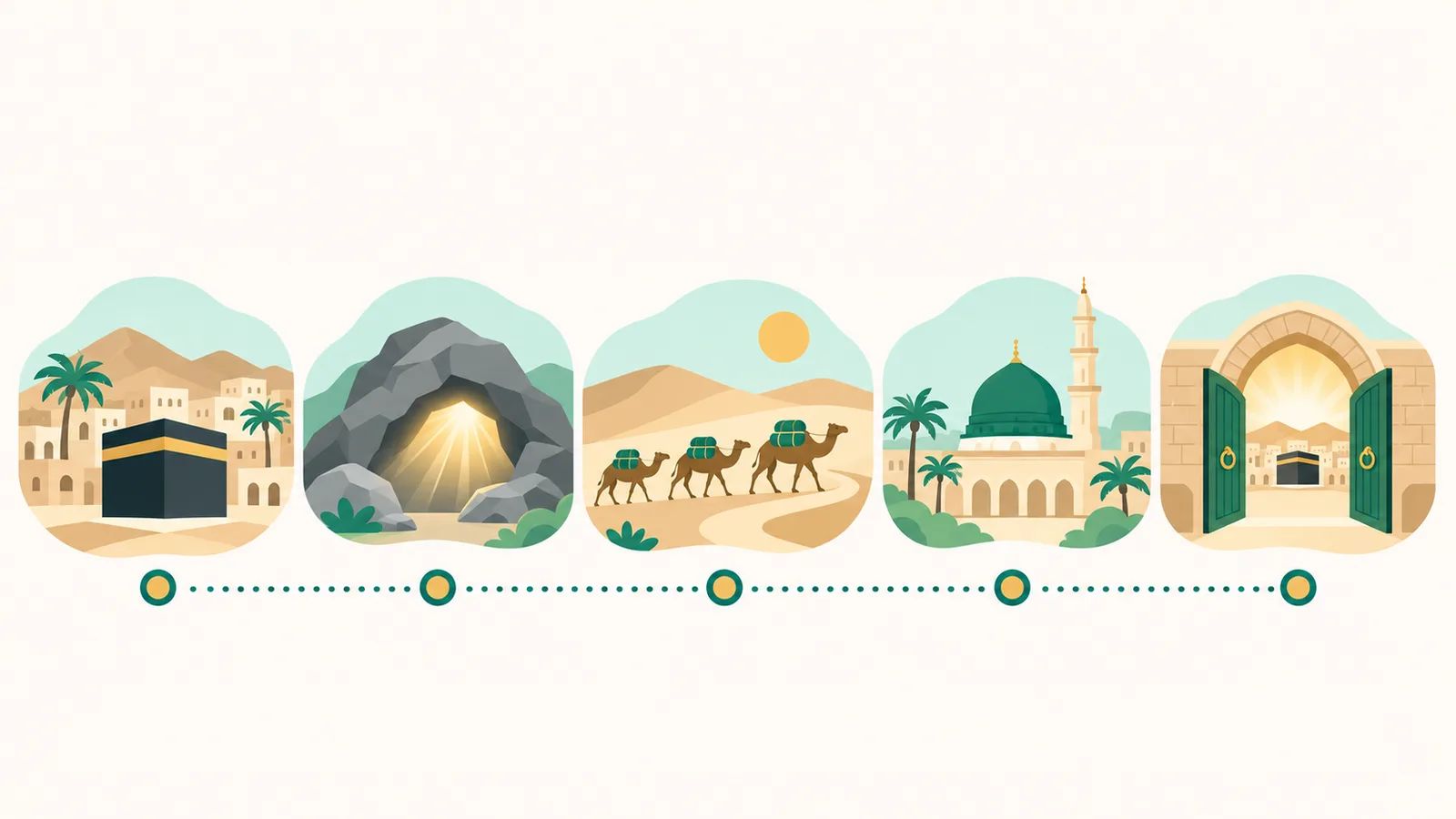
- Muhammad ﷺ grew up an orphan in Makkah and was known for his honesty long before prophethood.
- At about forty, he received the first words of the Qur'an in the cave of Hira.
- He and his followers endured years of persecution but answered with patience and mercy.
- In Madinah he built a community based on faith, justice and brotherhood.
- Muslims see his life as the best example of how to live the message of God.