العربية
 Español
 Français
 中文
 हिन्दी
What Is the Meaning of Life? An Islamic View

At around the age of fifty, the great novelist Leo Tolstoy had fame, wealth and a loving family — and fell into despair. In his Confession he describes being haunted by a simple question: is there any meaning in my life that death will not destroy? Many people today ask the same thing, often quietly, at three in the morning. This article compares the main answers people give, and explains the Islamic one.
Three ways to answer
Broadly, there are three answers to the question “what is the meaning of life?”
1. There is none. Some thinkers conclude that the universe is indifferent and life has no meaning beyond what happens to it. This view is honest about its starting point, but very hard to live. Almost no one can truly believe that love, justice and sacrifice are empty.
2. We create our own. Existentialist writers such as Jean-Paul Sartre and Albert Camus argued that, since the universe gives no meaning, we must give our lives meaning through our choices. There is something true here: meaning does involve commitment. But a meaning I invent can be anything at all — including selfish or cruel — and it lasts only as long as I do.
3. It is given. Meaning comes from the One who made us, as the meaning of a letter comes from its writer. This is the answer of Islam, and of many religious traditions. It means we do not have to manufacture meaning; we have to discover it and live up to it.
The Qur’an insists that creation is not an accident or a game:
وَمَا خَلَقْنَا ٱلسَّمَآءَ وَٱلْأَرْضَ وَمَا بَيْنَهُمَا بَٰطِلًۭا ۚ ذَٰلِكَ ظَنُّ ٱلَّذِينَ كَفَرُوا۟ ۚ فَوَيْلٌۭ لِّلَّذِينَ كَفَرُوا۟ مِنَ ٱلنَّارِ ﴿٢٧﴾ And We did not create the heaven and the earth and that between them aimlessly. That is the assumption of those who disbelieve, so woe to those who disbelieve from the Fire.
Couldn't load — please try again.
Meaning in ordinary life
Islam’s basic answer — that we were created to know and worship God, and that life is a test — is explained in The Purpose of Life. What is worth adding here is how wide Islam’s idea of worship is. It is not only prayer and fasting. The Prophet Muhammad ﷺ told his companions, who worried that the wealthy could do more good than they could:
…In every declaration of the glorification of Allah (i. e. saying Subhan Allah) there is a Sadaqa, and every Takbir (i. e. saying Allah-O-Akbar) is a sadaqa, and every praise of His (saying al-Hamdu Lillah) is a Sadaqa and every declaration that He is One (La illha ill-Allah) is a sadaqa, and enjoining of good is a sadaqa, and forbidding of that which is evil is a Sadaqa, and in man's sexual Intercourse (with his wife, ) there is a Sadaqa…
Couldn't load — please try again.
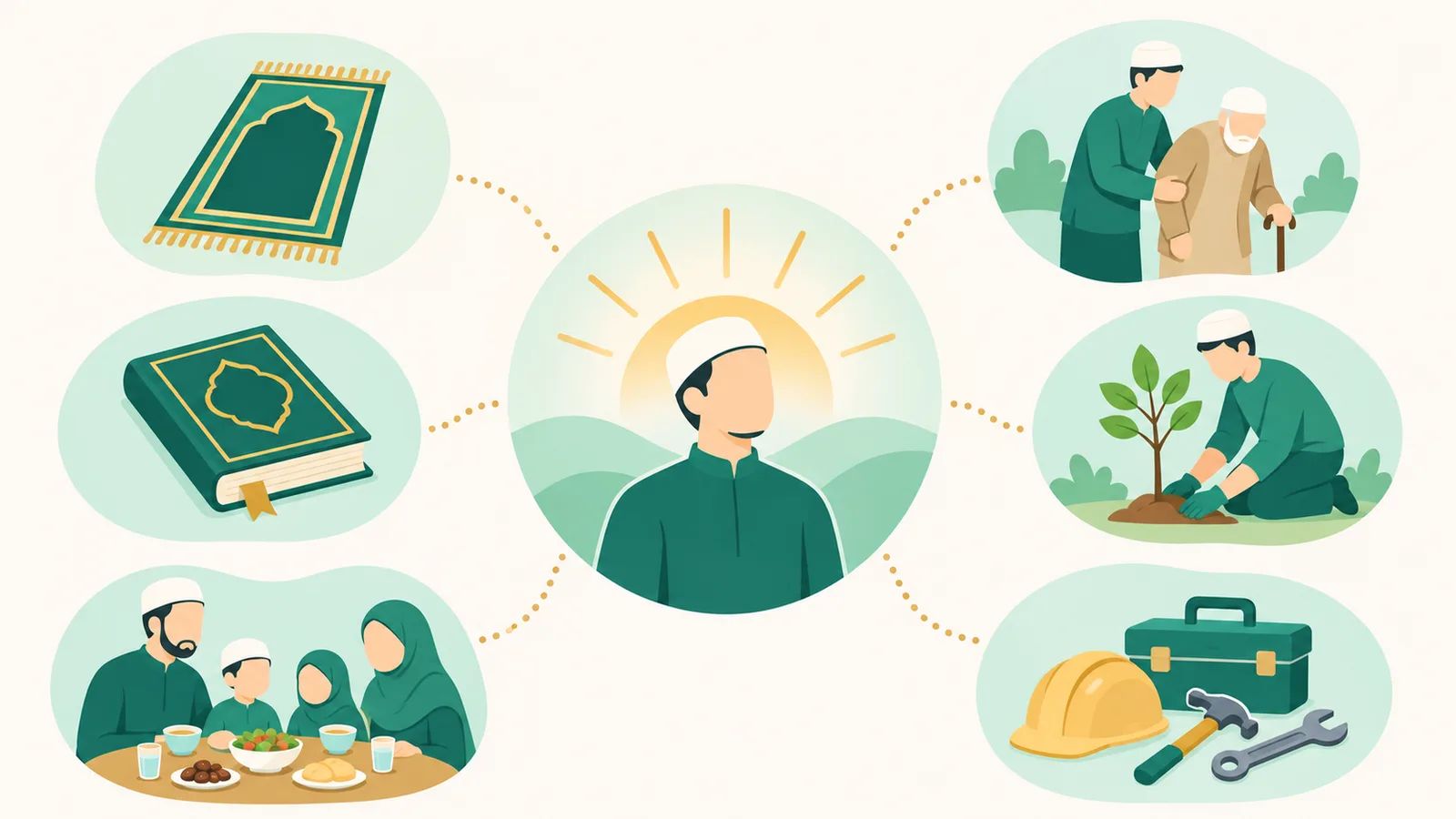
Sadaqa means charity. Even remembering God, speaking up for what is right, and loving one’s spouse become acts of worship when done with the right intention. Earning an honest living, caring for parents, smiling at a stranger — all of it counts. A Muslim is taught to see their whole life, not just a part of it, as offered to God:
قُلْ إِنَّ صَلَاتِى وَنُسُكِى وَمَحْيَاىَ وَمَمَاتِى لِلَّهِ رَبِّ ٱلْعَٰلَمِينَ ﴿١٦٢﴾ لَا شَرِيكَ لَهُۥ ۖ وَبِذَٰلِكَ أُمِرْتُ وَأَنَا۠ أَوَّلُ ٱلْمُسْلِمِينَ ﴿١٦٣﴾ 162Say, "Indeed, my prayer, my rites of sacrifice, my living and my dying are for Allah, Lord of the worlds. 163No partner has He. And this I have been commanded, and I am the first [among you] of the Muslims."
Couldn't load — please try again.
So meaning is not reserved for monks, heroes or geniuses. A cleaner who works honestly and treats people kindly lives a life as meaningful, in God’s eyes, as a famous scholar.
A good life now
Some people fear that religion postpones happiness until after death. The Qur’an promises something in this life too:
مَنْ عَمِلَ صَٰلِحًۭا مِّن ذَكَرٍ أَوْ أُنثَىٰ وَهُوَ مُؤْمِنٌۭ فَلَنُحْيِيَنَّهُۥ حَيَوٰةًۭ طَيِّبَةًۭ ۖ وَلَنَجْزِيَنَّهُمْ أَجْرَهُم بِأَحْسَنِ مَا كَانُوا۟ يَعْمَلُونَ ﴿٩٧﴾ Whoever does righteousness, whether male or female, while he is a believer - We will surely cause him to live a good life, and We will surely give them their reward [in the Hereafter] according to the best of what they used to do.
Couldn't load — please try again.
Muslims understand this good life not as constant pleasure or wealth, but as contentment, peace of heart and a sense of direction — the calm of knowing why you are here and where you are going. Meaning and happiness are not the same thing, but they are close companions.
Meaning that survives death
Tolstoy’s question was about death: does anything I do last? Self-made meaning struggles here, because it ends with the self. In Islam, a life’s meaning is not erased by death. Every deed is recorded and will be met again (see What Happens After Death?), and the Qur’an reminds us what truly lasts:
ٱلْمَالُ وَٱلْبَنُونَ زِينَةُ ٱلْحَيَوٰةِ ٱلدُّنْيَا ۖ وَٱلْبَٰقِيَٰتُ ٱلصَّٰلِحَٰتُ خَيْرٌ عِندَ رَبِّكَ ثَوَابًۭا وَخَيْرٌ أَمَلًۭا ﴿٤٦﴾ Wealth and children are [but] adornment of the worldly life. But the enduring good deeds are better to your Lord for reward and better for [one's] hope.
Couldn't load — please try again.
Wealth and children are blessings, but enduring good deeds are what remain. A kind word, a helped neighbour, a lesson taught — these are not lost in the vastness of time. They are kept by the One who does not forget.
A closing thought
If you have ever felt that life must mean more than it seems to, Islam would say that feeling is not a trick of the mind but a clue. You were made on purpose, by a God who knows you, and the small faithful choices of your ordinary days matter more than you think. You might like to continue with Does God Exist? or Can We Be Good Without God?
Key takeaways
- There are three broad answers to life's meaning — none, self-made, or given by a Creator; Islam holds the third.
- In Islam, meaning is not reserved for heroes or saints; ordinary good deeds become worship.
- Faith promises a good life now, not only a reward later.
- Good deeds can outlive us, so a meaningful life is not erased by death.