العربية
 Español
 Français
 中文
 हिन्दी
Do Science and Belief in God Conflict?

Many people grow up with a simple story: religion and science have always been at war, and science is winning. Historians of science today generally regard that story as far too simple — and it fits Islamic history especially poorly. This article looks at the deeper question underneath: does what science discovers leave any room for God?
What science does — and what it does not do
Science is a powerful method. It observes nature, proposes explanations, tests them, and keeps the ones that survive. To do this, scientists look for natural causes; that is how experiments work. But this is a method, not a conclusion. A scientist studying a chemical reaction does not need to mention God, just as a mechanic does not need to mention the engineer who designed the car. Neither proves that there is no engineer.
Some of the most important questions lie outside what experiments can test:
- Why is there a universe at all, rather than nothing?
- Why does nature follow laws, and why can those laws be written in mathematics?
- Why are our minds able to understand the universe in the first place?
- What is right and wrong, and what is a human life for?
Even the claim that “only science gives real knowledge” cannot itself be proved by a scientific experiment. Science is one of humanity’s great gifts — but it is not the whole of human knowledge.
Laws need explaining too
When we explain how something works, we sometimes feel that we have explained it away. But knowing how a printing press works does not tell you who wrote the book. In the same way, gravity and chemistry describe how the universe behaves; they do not explain why such laws exist, or why they are so reliable that we can predict an eclipse centuries in advance.
Islam teaches that causes in nature are real — fire really burns, medicine really heals — but that they are created and sustained by God. The regularity of nature is, in a sense, God’s faithfulness. The Qur’an even invites people to inspect creation and look for flaws:
ٱلَّذِى خَلَقَ سَبْعَ سَمَٰوَٰتٍۢ طِبَاقًۭا ۖ مَّا تَرَىٰ فِى خَلْقِ ٱلرَّحْمَٰنِ مِن تَفَٰوُتٍۢ ۖ فَٱرْجِعِ ٱلْبَصَرَ هَلْ تَرَىٰ مِن فُطُورٍۢ ﴿٣﴾ ثُمَّ ٱرْجِعِ ٱلْبَصَرَ كَرَّتَيْنِ يَنقَلِبْ إِلَيْكَ ٱلْبَصَرُ خَاسِئًۭا وَهُوَ حَسِيرٌۭ ﴿٤﴾ 3[And] who created seven heavens in layers. You do not see in the creation of the Most Merciful any inconsistency. So return [your] vision [to the sky]; do you see any breaks? 4Then return [your] vision twice again. [Your] vision will return to you humbled while it is fatigued.
Couldn't load — please try again.
That is an invitation to look, test and look again — the very attitude that makes science possible. The Qur’an adds that real knowledge of creation leads to awe of its Creator:
وَمِنَ ٱلنَّاسِ وَٱلدَّوَآبِّ وَٱلْأَنْعَٰمِ مُخْتَلِفٌ أَلْوَٰنُهُۥ كَذَٰلِكَ ۗ إِنَّمَا يَخْشَى ٱللَّهَ مِنْ عِبَادِهِ ٱلْعُلَمَٰٓؤُا۟ ۗ إِنَّ ٱللَّهَ عَزِيزٌ غَفُورٌ ﴿٢٨﴾ And among people and moving creatures and grazing livestock are various colors similarly. Only those fear Allah, from among His servants, who have knowledge. Indeed, Allah is Exalted in Might and Forgiving.
Couldn't load — please try again.
Revelation is not a science textbook
Islam does not ask the Qur’an to do the work of a laboratory. A striking example comes from the life of the Prophet Muhammad ﷺ. He once suggested to farmers in Medina that they need not pollinate their date palms by hand. They followed his suggestion, and the harvest was poor. His response was remarkable:
Anas reported that Allah's Messenger (ﷺ) happened to pass by the people who had been busy in grafting the trees. Thereupon he said:If you were not to do it, it might be good for you. (So they abandoned this practice) and there was a decline in the yield. He (the Holy Prophet) happened to pass by them (and said): What has gone wrong with your trees? They said: You said so and so. Thereupon he said: You have better knowledge (of a technical skill) in the affairs of the world
Couldn't load — please try again.
Muslim scholars took from this that the Prophet’s ﷺ guidance in matters of faith and morality is binding, while practical, technical knowledge is to be learned by experience and experiment. This is one reason medieval Muslim civilisation produced so many astronomers, physicians and mathematicians — a story told in Is Islam Compatible With Science?, which also explains why we are cautious about so-called “scientific miracles”.
What about the Big Bang and evolution?
Most cosmologists accept that our universe began in a hot, dense state about 13.8 billion years ago. Muslims generally find this easy to welcome: the Qur’an describes the heavens and the earth as created by God over six days (Qur’an 7:54) — a word many Muslims understand as stages or periods rather than 24-hour days — and a universe with a beginning fits naturally with a Creator (see Does God Exist?).
Biological evolution is discussed more carefully. Muslim scholars and scientists hold a range of views on how to relate it to the Qur’an. What they share is the core: God is the Creator of all life, nothing happens outside His knowledge and will, and human beings — beginning with Adam (peace be upon him) — were created by God with honour and purpose. The traditional understanding, held by most scholars, is that Adam was created directly by God, as the Qur’an describes. Where views differ, the difference is explained in Where Muslims Differ.
Humility on both sides
The best scientists are humble: every theory can be revised by new evidence. The Qur’an asks the same humility of believers, reminding us how small our knowledge is:
وَيَسْـَٔلُونَكَ عَنِ ٱلرُّوحِ ۖ قُلِ ٱلرُّوحُ مِنْ أَمْرِ رَبِّى وَمَآ أُوتِيتُم مِّنَ ٱلْعِلْمِ إِلَّا قَلِيلًۭا ﴿٨٥﴾ And they ask you, [O Muhammad], about the soul. Say, "The soul is of the affair of my Lord. And mankind have not been given of knowledge except a little."
Couldn't load — please try again.
That humility cuts both ways. Believers should not build their faith on gaps in current science, which may later be filled. And science should not be asked to answer questions about meaning and morality that it was never designed to answer.
A closing thought
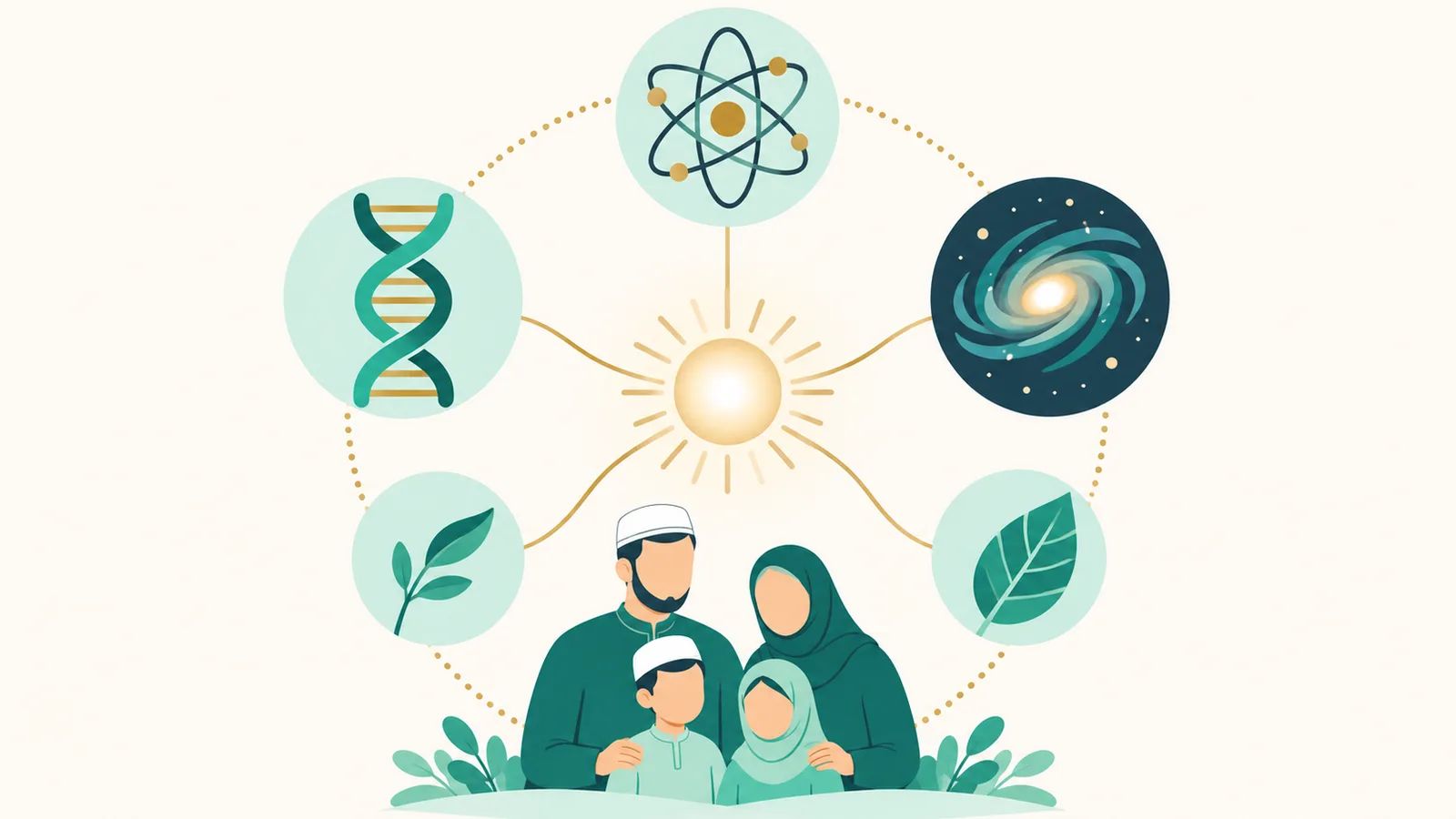
For Muslims, studying the universe is not a threat to faith but a way of reading God’s signs. Every new discovery — from the inner life of a cell to the edge of the observable universe — is another page in a book whose Author invites us to keep reading. If this question matters to you, you may also want to explore What Is the Meaning of Life?
Key takeaways
- Science studies how nature works; questions of why anything exists and what it is for lie beyond its method.
- Explaining a process does not remove the need for a Maker — Islam sees natural laws as God's ways in creation.
- The Prophet ﷺ distinguished revelation from practical, worldly expertise.
- Muslims hold a range of views on some scientific questions, but agree that God is the Creator of all.
- Humility suits both the scientist and the believer.