العربية
 Español
 Français
 中文
 हिन्दी
The Five Daily Prayers: Meaning, Times and Purpose

Imagine pausing five times a day — whatever you are doing — to step away from your work, your screen and your worries, and stand quietly before the One who made you. For Muslims all over the world, this is not an imagined exercise. It is simply how every day is built.
This page explains the meaning behind the five daily prayers, when they take place, and why Muslims hold on to them so tightly. If you want the practical, step-by-step guide, see How to Pray.
A duty at fixed times
The Arabic word for the ritual prayer is salah, which carries the sense of connection. It is the second of the Five Pillars of Islam, and every school and community of Muslims agrees that the five daily prayers are obligatory for every adult Muslim who is able. The Qur’an speaks of prayer as a duty bound to specific times:
فَإِذَا قَضَيْتُمُ ٱلصَّلَوٰةَ فَٱذْكُرُوا۟ ٱللَّهَ قِيَٰمًۭا وَقُعُودًۭا وَعَلَىٰ جُنُوبِكُمْ ۚ فَإِذَا ٱطْمَأْنَنتُمْ فَأَقِيمُوا۟ ٱلصَّلَوٰةَ ۚ إِنَّ ٱلصَّلَوٰةَ كَانَتْ عَلَى ٱلْمُؤْمِنِينَ كِتَٰبًۭا مَّوْقُوتًۭا ﴿١٠٣﴾ And when you have completed the prayer, remember Allah standing, sitting, or [lying] on your sides. But when you become secure, re-establish [regular] prayer. Indeed, prayer has been decreed upon the believers a decree of specified times.
Couldn't load — please try again.
Muslim tradition explains how this number came to be. During the Night Journey, the miraculous night on which the Prophet ﷺ was taken up through the heavens, fifty daily prayers were first enjoined. At the Prophet’s repeated request the number was reduced, until God said:
…These are five prayers and they are all (equal to) fifty (in reward) for My Word does not change.…
Couldn't load — please try again.
Muslims see mercy in this: five prayers that fit into a human day, carrying the reward of fifty.
The five prayer times
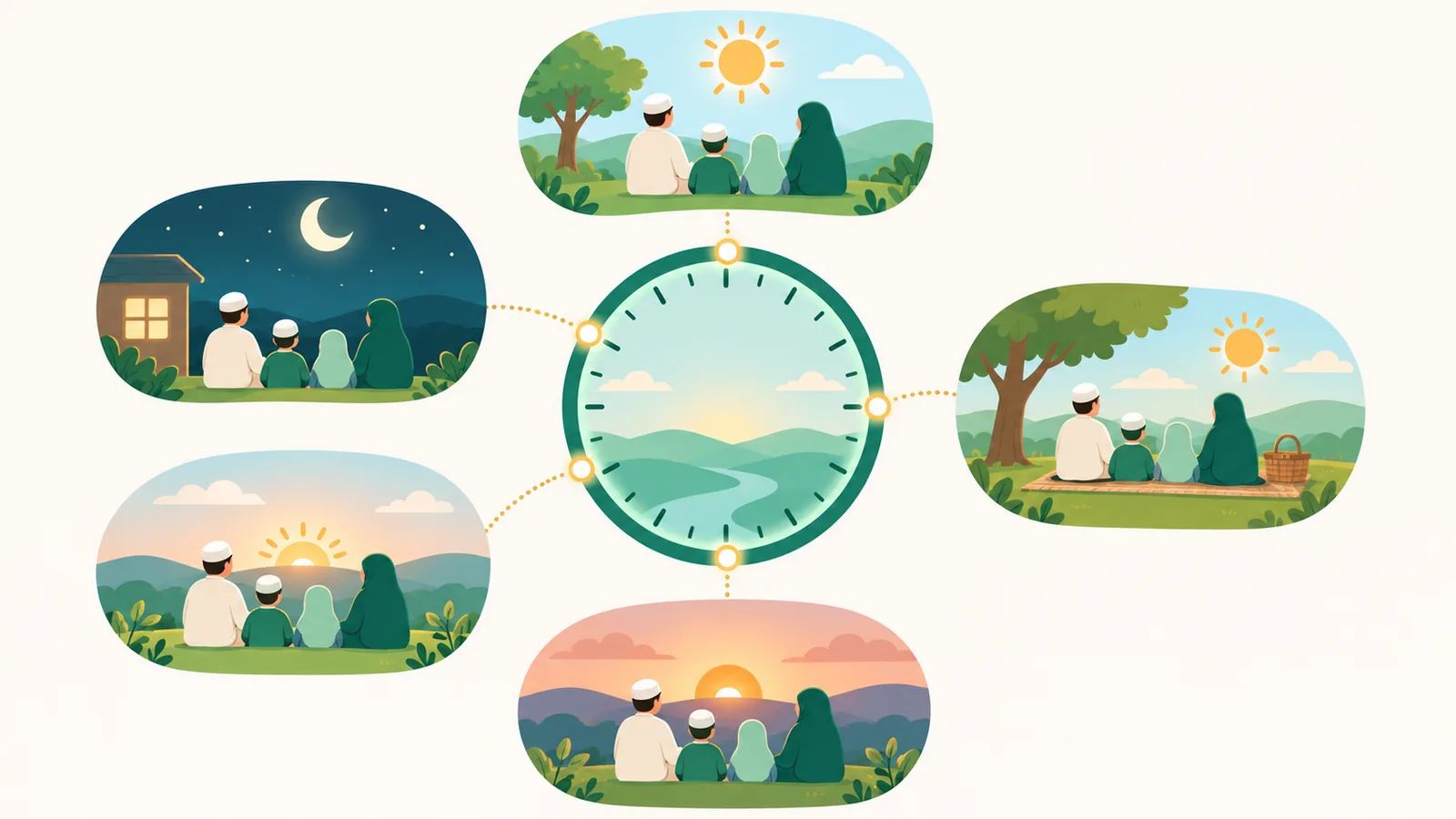
The prayers follow the sun, so their exact clock times change through the year and from place to place. Muslims usually check a local timetable or an app.
| Prayer | Arabic name | When it is prayed | Units (rak’ahs) |
|---|---|---|---|
| Dawn prayer | Fajr | From first light until just before sunrise | 2 |
| Midday prayer | Dhuhr | After the sun passes its highest point | 4 |
| Afternoon prayer | Asr | In the later afternoon | 4 |
| Sunset prayer | Maghrib | Just after the sun has set | 3 |
| Night prayer | Isha | Once darkness has fully fallen | 4 |
Each prayer has a window of time rather than a single moment, and it is best prayed early in its window. Before each one, Muslims are called by the adhan, the call to prayer, and prepare with wudu, a simple washing of the hands, face, arms and feet. Scholars differ on some fine details — for example, exactly when the afternoon window begins, or when prayers may be combined while travelling — but the five prayers themselves are not in question. See Where Muslims Differ, and Why It’s Okay.
The Qur’an also mentions the prayers in relation to the day’s natural markers:
وَأَقِمِ ٱلصَّلَوٰةَ طَرَفَىِ ٱلنَّهَارِ وَزُلَفًۭا مِّنَ ٱلَّيْلِ ۚ إِنَّ ٱلْحَسَنَٰتِ يُذْهِبْنَ ٱلسَّيِّـَٔاتِ ۚ ذَٰلِكَ ذِكْرَىٰ لِلذَّٰكِرِينَ ﴿١١٤﴾ And establish prayer at the two ends of the day and at the approach of the night. Indeed, good deeds do away with misdeeds. That is a reminder for those who remember.
Couldn't load — please try again.
How to pray, in brief
Here is the shape of the prayer in a few simple steps. The full, gentle walkthrough — with every word to say — is in How to Pray, and the washing is explained step by step in How to Make Wudu.
First, wudu (the washing before prayer). With the intention of purifying yourself, wash your hands, rinse your mouth and nose, wash your face, wash your arms up to the elbows (right, then left), wipe over your head and ears with wet hands, and wash your feet up to the ankles.
Then the prayer itself:
- Face the direction of the Kaaba in Makkah (the qiblah) and intend in your heart the prayer you are about to pray.
- Raise your hands and say Allahu Akbar (“God is greatest”) to begin.
- Standing, recite the opening chapter of the Qur’an, Al-Fatihah, and then a short passage if you know one.
- Bow with your back straight and your hands on your knees (ruku’), saying Subhana Rabbiyal-‘Adhim (“Glory be to my Lord, the Most Great”).
- Rise and stand up straight again.
- Go down into prostration (sujud) — forehead, nose, palms, knees and toes on the ground — saying Subhana Rabbiyal-A’la (“Glory be to my Lord, the Most High”).
- Sit up briefly, then prostrate a second time.
Together these movements make one unit, a rak’ah. You repeat them for the number of units shown in the table above. After every second unit, and at the very end, you sit and recite the tashahhud (a short testimony of faith); then you finish by turning your head to the right and then to the left, saying As-salamu ‘alaykum wa rahmatullah (“Peace and God’s mercy be upon you”).
No new Muslim is expected to know all of this on the first day. Begin with what you can, and learn step by step.
A daily cleansing
Everyone makes mistakes over the course of a day — an impatient word, a careless thought, a missed kindness. The Prophet ﷺ described the prayers as a way of washing these away, using an image his companions would never forget:
…That is the example of the five prayers with which Allah blots out (annuls) evil deeds…
Couldn't load — please try again.
In the full narration he first asks: if a river ran past your door and you bathed in it five times a day, would any dirt remain on you? His companions answered that none would. Prayer, in other words, is not meant to be performed by perfect people. It is meant for ordinary people who need to come back to God again and again.
Closest to God
The physical movements of prayer — standing, bowing, prostrating with the forehead on the ground — are not empty gestures. They are a language of the body that says what words alone cannot: humility, gratitude and trust. The moment of prostration, when a person places the highest part of their body on the lowest place, is described as the moment of greatest closeness:
Abu Huraira reported:The Messenger of Allah (ﷺ) said: The nearest a servant comes to his Lord is when he is prostrating himself, so make supplication (in this state)
Couldn't load — please try again.
This is why Muslims often make their most personal requests to God while in prostration, in any language they wish.
Rest for the soul
From the outside, praying five times a day can look demanding. From the inside, many Muslims describe it the opposite way: as a series of breathing spaces that stop the day from swallowing them. The Prophet ﷺ himself spoke of prayer as relief rather than duty. When the time for prayer came, he would say to Bilal, who gave the call to prayer:
…O Bilal, call iqamah for prayer: give us comfort by it…
Couldn't load — please try again.
Five times a day, a Muslim leaves the noise of the world for a few minutes, remembers why they are alive, and returns calmer. Over a lifetime, that adds up to a heart that is anchored. We explore this sense of purpose further in The Purpose of Life.
An open invitation
You do not need to be Muslim to visit a mosque and quietly watch a prayer; most mosques warmly welcome respectful visitors. Seeing people of every colour and background stand shoulder to shoulder in straight rows, bowing together to one God, often says more than any explanation. If you would like to understand the words and movements themselves, How to Pray walks through them gently, step by step.
Key takeaways
- The five daily prayers (salah) are the second pillar of Islam and are agreed upon by all Muslims.
- Each prayer has a time window tied to the movement of the sun, from dawn to night.
- The Prophet ﷺ compared the five prayers to bathing in a river five times a day.
- Prayer is described as rest and comfort for the soul, not a chore to be rushed.