العربية
 Español
 Français
 中文
 हिन्दी
Hajj: The Journey of a Lifetime
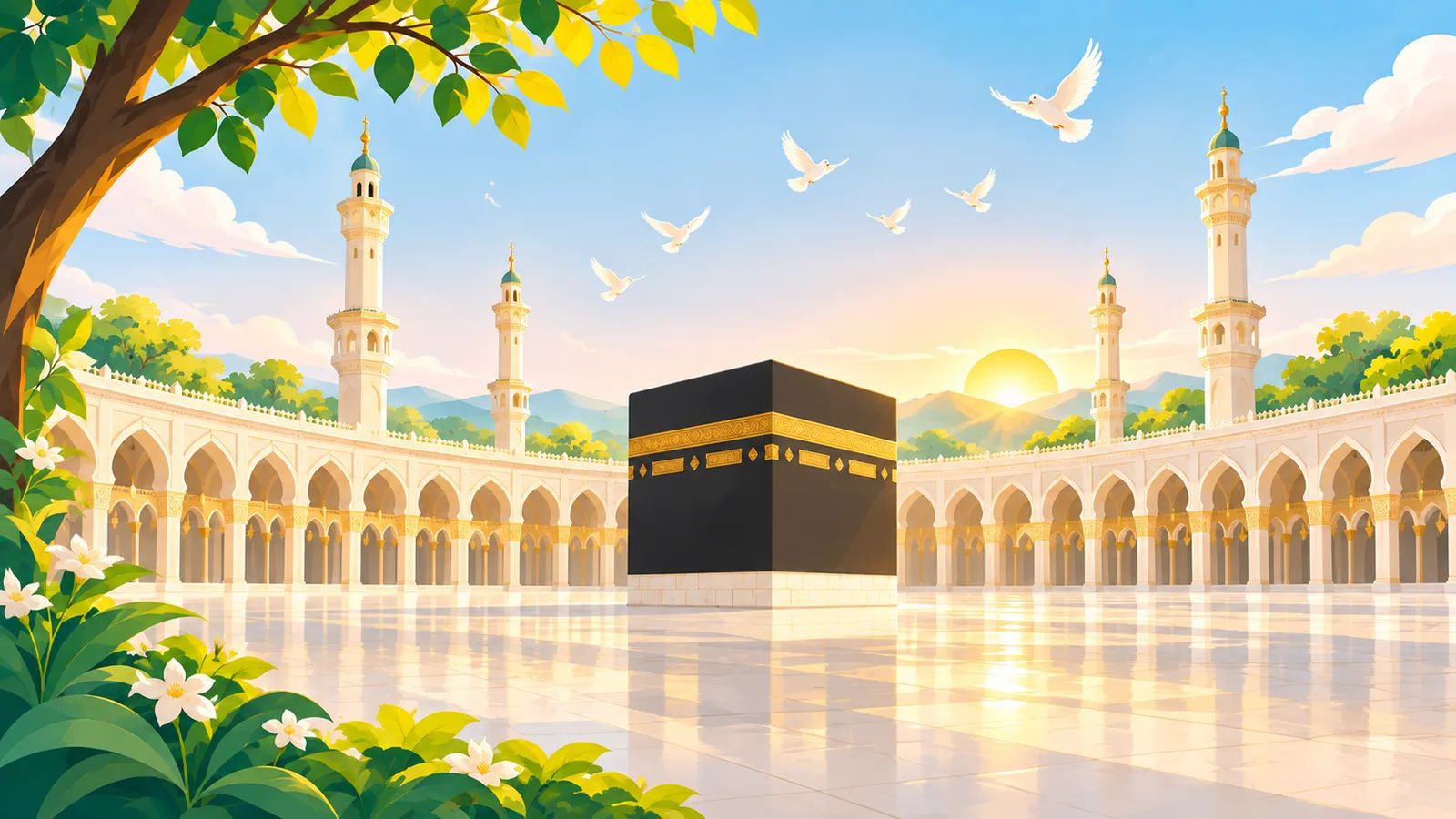
Every year, in the same few days, millions of people from every corner of the earth converge on one valley in Arabia. They speak hundreds of languages and come from every walk of life, yet they are dressed almost identically and are saying the same words. Many have saved for decades for this moment. For a Muslim, there is no journey quite like it.
A duty once in a lifetime
Hajj is the fifth of the Five Pillars of Islam. All Muslims agree that it is required once in a lifetime of every adult Muslim who is physically able and can afford it without leaving their family in need. Those who cannot go are not blamed; God does not ask of anyone more than they can bear.
Hajj takes place in the Islamic month of Dhul-Hijjah, during days fixed by the lunar calendar. A shorter pilgrimage, called umrah, can be made at any time of year, but it does not replace the Hajj.
Abraham’s call
The story of Hajj begins long before Muhammad ﷺ. Muslims believe that Abraham (peace be upon him) and his son Ishmael built the Kaaba in Mecca as a house for the worship of the one God (Qur’an 2:127). The Qur’an calls it the first house of worship established for humanity:
إِنَّ أَوَّلَ بَيْتٍۢ وُضِعَ لِلنَّاسِ لَلَّذِى بِبَكَّةَ مُبَارَكًۭا وَهُدًۭى لِّلْعَٰلَمِينَ ﴿٩٦﴾ Indeed, the first House [of worship] established for mankind was that at Makkah - blessed and a guidance for the worlds.
Couldn't load — please try again.
God then commanded Abraham to invite people to come:
وَأَذِّن فِى ٱلنَّاسِ بِٱلْحَجِّ يَأْتُوكَ رِجَالًۭا وَعَلَىٰ كُلِّ ضَامِرٍۢ يَأْتِينَ مِن كُلِّ فَجٍّ عَمِيقٍۢ ﴿٢٧﴾ And proclaim to the people the Hajj [pilgrimage]; they will come to you on foot and on every lean camel; they will come from every distant pass -
Couldn't load — please try again.
Muslims see every pilgrim, arriving by plane, bus or on foot, as an answer to that ancient call. Many of the rites retrace the footsteps of Abraham’s family. Pilgrims walk seven times between the two small hills of Safa and Marwah (Qur’an 2:158), as Hagar did when she searched desperately for water for her baby Ishmael (Bukhari 3364) — a mother’s trust in God made part of worship forever. You can read more about Abraham in Prophet Abraham.
The rites, in brief
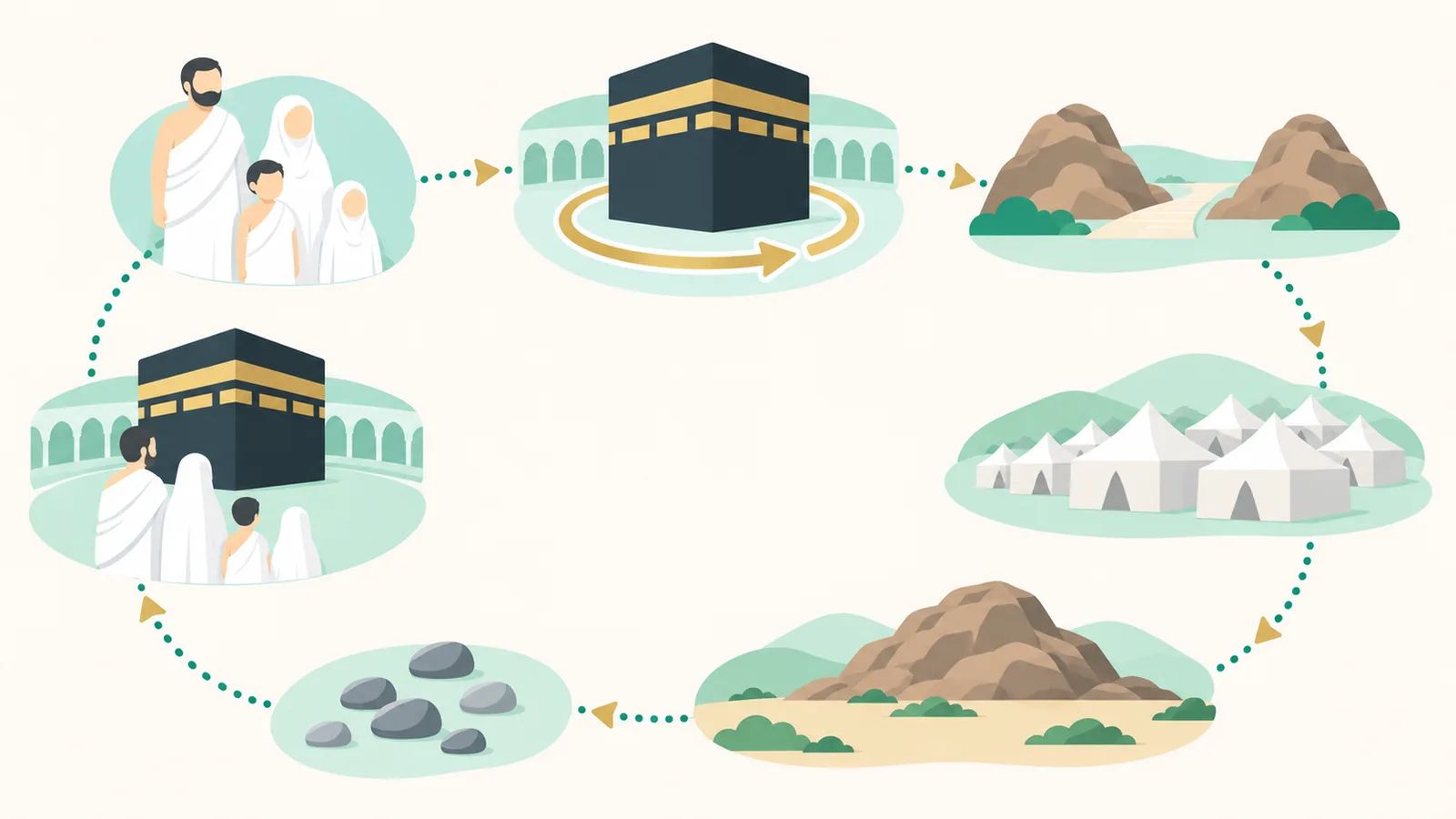
The details of Hajj fill whole books, but its main stages are agreed upon by all Muslims:
- Ihram. Before reaching Mecca, pilgrims enter a state of consecration called ihram. Men wear two plain white sheets; women wear simple, modest clothing. Arguments, obscenity, hunting and other prohibited acts are set aside.
- Tawaf. Pilgrims walk seven times around the Kaaba, praising God.
- Arafah. On the ninth day of the month, pilgrims stand on the plain of Arafah from midday to sunset, praying and seeking forgiveness. This day is the heart of Hajj.
- Muzdalifah and Mina. Pilgrims spend the night under the open sky, then throw small pebbles at stone pillars, a symbol of rejecting evil that Muslim tradition links to Abraham.
- Sacrifice and Eid. Most pilgrims offer an animal sacrifice, and its meat is shared, especially with the poor, while Muslims worldwide celebrate Eid al-Adha.
Scholars differ on a number of finer points of how the rites are carried out, and pilgrims follow the guidance of their trusted scholars. See Where Muslims Differ, and Why It’s Okay.
Throughout the journey, pilgrims repeat the talbiyah, the words the Prophet ﷺ himself used:
Narrated `Abdullah bin `Umar: The Talbiya of Allah's Messenger (ﷺ) was : 'Labbaika Allahumma labbaik, Labbaika la sharika Laka labbaik, Inna-l-hamda wan-ni'mata Laka walmulk, La sharika Laka' (I respond to Your call O Allah, I respond to Your call, and I am obedient to Your orders, You have no partner, I respond to Your call All the praises and blessings are for You, All the sovereignty is for You, And You have no partners with You)
Couldn't load — please try again.
The Qur’an describes the spirit in which Hajj should be made — no quarrelling, no wrongdoing, and remembering that the best provision for any journey is God-consciousness:
ٱلْحَجُّ أَشْهُرٌۭ مَّعْلُومَٰتٌۭ ۚ فَمَن فَرَضَ فِيهِنَّ ٱلْحَجَّ فَلَا رَفَثَ وَلَا فُسُوقَ وَلَا جِدَالَ فِى ٱلْحَجِّ ۗ وَمَا تَفْعَلُوا۟ مِنْ خَيْرٍۢ يَعْلَمْهُ ٱللَّهُ ۗ وَتَزَوَّدُوا۟ فَإِنَّ خَيْرَ ٱلزَّادِ ٱلتَّقْوَىٰ ۚ وَٱتَّقُونِ يَٰٓأُو۟لِى ٱلْأَلْبَٰبِ ﴿١٩٧﴾ Hajj is [during] well-known months, so whoever has made Hajj obligatory upon himself therein [by entering the state of ihram], there is [to be for him] no sexual relations and no disobedience and no disputing during Hajj. And whatever good you do - Allah knows it. And take provisions, but indeed, the best provision is fear of Allah. And fear Me, O you of understanding.
Couldn't load — please try again.
All equal before God
The white garments of ihram are often compared to a burial shroud. In them, a king and a labourer cannot be told apart. Black, white, Arab and non-Arab stand shoulder to shoulder, reminding everyone of the Qur’an’s teaching that the noblest person in God’s sight is the most righteous, not the richest or the best-born (Qur’an 49:13). Many pilgrims return home changed by this experience of a human family without barriers. It is also worth noting that Muslims do not worship the Kaaba itself; they worship God alone, and the Kaaba is simply the direction all prayer faces. See Do Muslims Worship the Kaaba?
At his own final Hajj, the Prophet ﷺ addressed the gathered pilgrims and declared the sanctity of every person:
…Your blood, property and honor are sacred to one another (i.e. Muslims) like the sanctity of this day of yours, in this month of yours and in this city of yours.…
Couldn't load — please try again.
Coming home reborn
Above all, Hajj is a journey of repentance. The Prophet ﷺ promised:
Narrated Abu Huraira: The Prophet (ﷺ) said, "Whoever performs Hajj for Allah's pleasure and does not have sexual relations with his wife, and does not do evil or sins then he will return (after Hajj free from all sins) as if he were born anew
Couldn't load — please try again.
Pilgrims return home with tired feet, empty pockets and a clean slate. Many describe it as the most important journey of their lives — not because of the distance travelled, but because of the distance their hearts moved closer to God. For those who have not yet been, the longing to go is itself part of the faith. And for anyone curious about Islam, Hajj offers a powerful picture of what it means: one God, one human family, and a door of mercy that is always open.
Key takeaways
- Hajj is the fifth pillar of Islam, required once in a lifetime of those who are able.
- Its rites recall Abraham, his wife Hagar and their son Ishmael (peace be upon them).
- Pilgrims wear simple, identical clothing, so rich and poor stand as equals.
- The Prophet ﷺ taught that a sincere Hajj returns a person as pure as a newborn.