العربية
 Español
 Français
 中文
 हिन्दी
Joseph (Yusuf): The Most Beautiful of Stories

Most stories in the Qur’an are told in short scenes scattered across many chapters. Joseph’s story is different. It is told from beginning to end in a single chapter, Surah Yusuf, almost like a novel — with a dream, a jealous plot, a prison, a palace and a family reunion. Jewish and Christian readers who know the account in Genesis will find themselves on familiar ground, with some touching differences along the way.
A dream and a warning
The chapter introduces itself in a striking way:
نَحْنُ نَقُصُّ عَلَيْكَ أَحْسَنَ ٱلْقَصَصِ بِمَآ أَوْحَيْنَآ إِلَيْكَ هَٰذَا ٱلْقُرْءَانَ وَإِن كُنتَ مِن قَبْلِهِۦ لَمِنَ ٱلْغَٰفِلِينَ ﴿٣﴾ إِذْ قَالَ يُوسُفُ لِأَبِيهِ يَٰٓأَبَتِ إِنِّى رَأَيْتُ أَحَدَ عَشَرَ كَوْكَبًۭا وَٱلشَّمْسَ وَٱلْقَمَرَ رَأَيْتُهُمْ لِى سَٰجِدِينَ ﴿٤﴾ 3We relate to you, [O Muhammad], the best of stories in what We have revealed to you of this Qur'an although you were, before it, among the unaware. 4[Of these stories mention] when Joseph said to his father, "O my father, indeed I have seen [in a dream] eleven stars and the sun and the moon; I saw them prostrating to me."
Couldn't load — please try again.
Joseph (peace be upon him) was the son of the prophet Jacob, who loved him dearly. Jacob understood that the dream meant something great, and he warned Joseph not to tell his brothers, fearing their jealousy (Qur’an 12:5). The Prophet Muhammad ﷺ described Joseph’s noble family line:
Narrated Ibn `Umar: The Prophet (ﷺ) said, "The honorable, the son of the honorable, the son of the honorable, the son of the honorable, (was) Joseph, the son of Jacob, the son of Isaac, the son of Abraham
Couldn't load — please try again.
The well, and a father’s beautiful patience
The brothers’ jealousy grew until they plotted against him. They threw Joseph into the bottom of a well, and even then God reassured the boy that one day he would remind them of what they had done (Qur’an 12:15). They returned to their father with Joseph’s shirt stained with false blood. Jacob’s response is one of the most quoted lines in the Qur’an:
وَجَآءُو عَلَىٰ قَمِيصِهِۦ بِدَمٍۢ كَذِبٍۢ ۚ قَالَ بَلْ سَوَّلَتْ لَكُمْ أَنفُسُكُمْ أَمْرًۭا ۖ فَصَبْرٌۭ جَمِيلٌۭ ۖ وَٱللَّهُ ٱلْمُسْتَعَانُ عَلَىٰ مَا تَصِفُونَ ﴿١٨﴾ And they brought upon his shirt false blood. [Jacob] said, "Rather, your souls have enticed you to something, so patience is most fitting. And Allah is the one sought for help against that which you describe."
Couldn't load — please try again.
Sabrun jamil — “beautiful patience” — has become a phrase Muslims say in times of loss. It means patience without complaint to people, while pouring one’s heart out to God. Years later, still grieving, Jacob would say that he complained of his sorrow only to God, and he told his sons never to despair of God’s mercy (Qur’an 12:86-87).
Slavery, temptation and prison
Travellers pulled Joseph from the well and sold him cheaply in Egypt. The man who bought him told his wife to treat him kindly, and Joseph grew up in their household (Qur’an 12:20-21). As a young man he faced a severe test: the wife of his master tried to seduce him. He refused, sought refuge in God, and would not betray the man who had been good to him (Qur’an 12:23). When the pressure continued, he made a remarkable prayer:
قَالَ رَبِّ ٱلسِّجْنُ أَحَبُّ إِلَىَّ مِمَّا يَدْعُونَنِىٓ إِلَيْهِ ۖ وَإِلَّا تَصْرِفْ عَنِّى كَيْدَهُنَّ أَصْبُ إِلَيْهِنَّ وَأَكُن مِّنَ ٱلْجَٰهِلِينَ ﴿٣٣﴾ He said, "My Lord, prison is more to my liking than that to which they invite me. And if You do not avert from me their plan, I might incline toward them and [thus] be of the ignorant."
Couldn't load — please try again.
Joseph chose prison over sin. Even there he did not stop doing good. Two fellow prisoners asked him to interpret their dreams, and before answering, he gently spoke to them about the One God, asking whether many separate lords were better than God, the One, the Prevailing (Qur’an 12:39). Even in a cell, he was a caller to faith.
From prison to the palace
Eventually the king of Egypt had a troubling dream of seven fat cows eaten by seven lean ones (Qur’an 12:43). No one could explain it — until Joseph was remembered. He interpreted it as seven years of plenty followed by seven years of famine, and advised how to store grain. Before leaving prison, he insisted that his innocence be publicly cleared. Then he asked to be put in charge of the storehouses of the land, saying he would be a knowing guardian (Qur’an 12:55). The boy in the well had become a trusted minister.
Forgiveness without blame
When the famine came, Joseph’s brothers travelled to Egypt for food, not recognising him. After several meetings, Joseph finally revealed who he was. His brothers, ashamed, admitted their wrongdoing. Joseph’s answer is the emotional climax of the chapter:
قَالَ لَا تَثْرِيبَ عَلَيْكُمُ ٱلْيَوْمَ ۖ يَغْفِرُ ٱللَّهُ لَكُمْ ۖ وَهُوَ أَرْحَمُ ٱلرَّٰحِمِينَ ﴿٩٢﴾ He said, "No blame will there be upon you today. Allah will forgive you; and He is the most merciful of the merciful."
Couldn't load — please try again.
No lecture, no revenge, no reminding them of the well. Readers of Genesis will recall Joseph’s similar words: “But as for you, ye thought evil against me; but God meant it unto good” (Genesis 50:20, KJV). In the Qur’an, Joseph then sends his shirt to his father, Jacob’s sight returns (Qur’an 12:93-96), and the whole family is reunited in Egypt. Joseph gives the credit to God, saying that his Lord is subtle in what He wills (Qur’an 12:100).
Muslims often recall that the Prophet Muhammad ﷺ showed the same generosity when he returned to Makkah in victory and forgave the people who had persecuted him for years.
What Joseph teaches
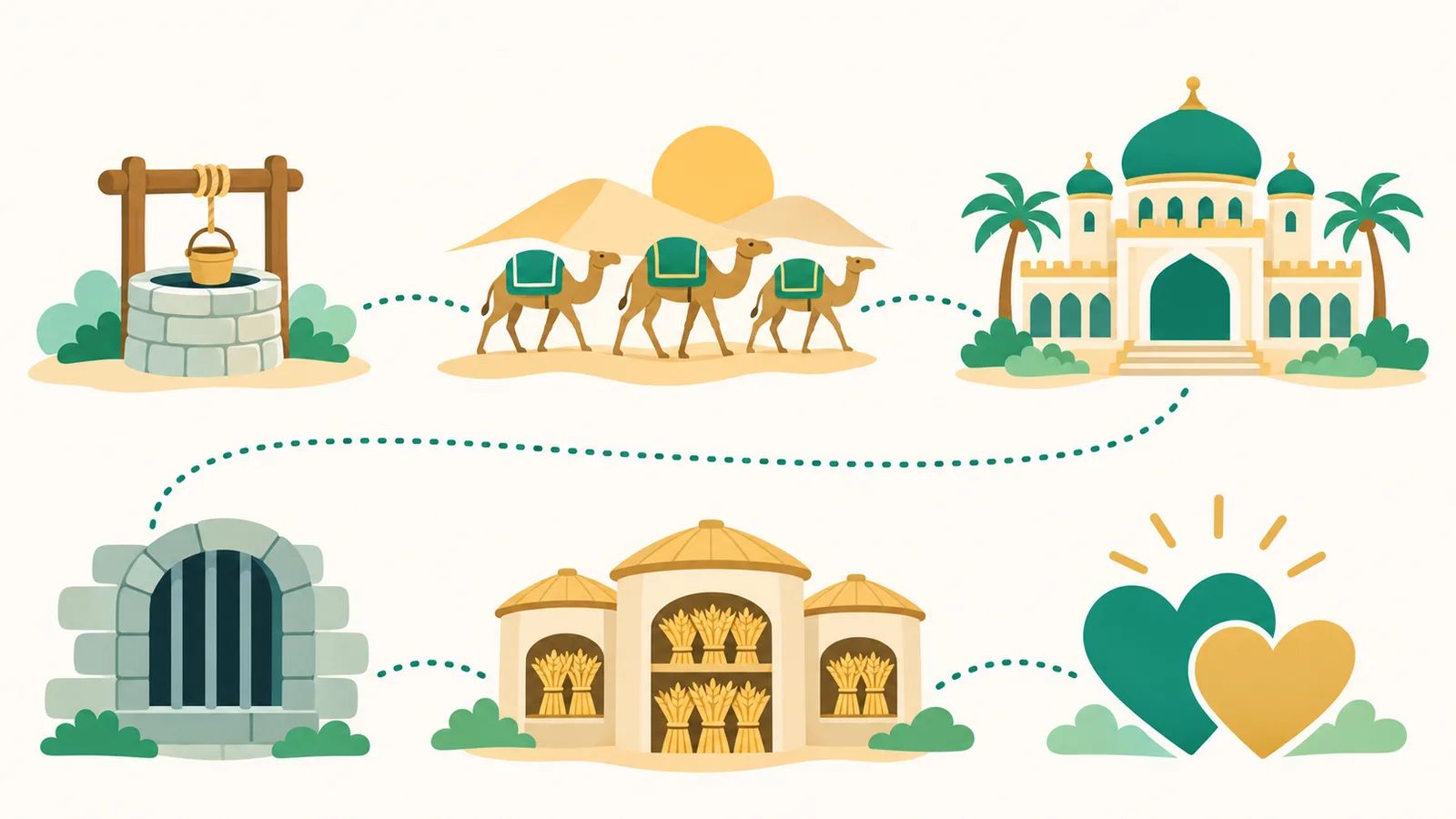
Surah Yusuf has comforted people for centuries because it shows how God’s plan works quietly through every painful chapter of a life. Betrayal led to Egypt, slavery led to a household, prison led to the palace, and the palace led to forgiveness and reunion. It teaches beautiful patience, integrity under pressure and forgiveness from a position of power. To learn more about the prophets, read The Prophets in Islam, or explore Joseph’s great-grandfather in Abraham, the Friend of God.
Key takeaways
- The Qur'an tells Joseph's whole story in one chapter, Surah Yusuf, and calls it the best of stories.
- Joseph stayed patient and chaste through betrayal, slavery and prison.
- His father Jacob models beautiful patience and never despairs of God's mercy.
- The story ends with Joseph forgiving his brothers without blame.