العربية
 Español
 Français
 中文
 हिन्दी
What Does Islam Say About Divorce?

No one marries hoping to divorce. Yet every honest religion and legal system has to answer a painful question: what happens when a marriage breaks down beyond repair? Islam’s answer tries to hold two things together — a strong commitment to keeping families intact, and a refusal to trap people in misery.
Marriage is meant to last
In Islam, marriage is a solemn covenant, built on affection and mercy (see marriage in Islam). So before divorce is even considered, the Qur’an asks couples to look for a way back. It addresses the families and the wider community directly:
وَإِنْ خِفْتُمْ شِقَاقَ بَيْنِهِمَا فَٱبْعَثُوا۟ حَكَمًۭا مِّنْ أَهْلِهِۦ وَحَكَمًۭا مِّنْ أَهْلِهَآ إِن يُرِيدَآ إِصْلَٰحًۭا يُوَفِّقِ ٱللَّهُ بَيْنَهُمَآ ۗ إِنَّ ٱللَّهَ كَانَ عَلِيمًا خَبِيرًۭا ﴿٣٥﴾ And if you fear dissension between the two, send an arbitrator from his people and an arbitrator from her people. If they both desire reconciliation, Allah will cause it between them. Indeed, Allah is ever Knowing and Acquainted [with all things].
Couldn't load — please try again.
Notice the balance: one arbitrator from his family, one from hers, and a promise that if both spouses genuinely want reconciliation, God will help them. The Prophet Muhammad ﷺ also asked husbands to look at the whole person rather than fixating on faults:
Abu Huraira (Allah be pleased with him) reported Allah's Messenger (ﷺ) as saying:A believing man should not hate a believing woman; if he dislikes one of her characteristics, he will be pleased with another
Couldn't load — please try again.
Many marriages that seem lost in a moment of anger can be saved by patience, good advice and fairness on both sides. A saying often quoted calls divorce the most disliked of permitted things; hadith scholars differ over its authenticity, but its spirit matches the Qur’an’s clear preference for reconciliation.
When divorce is allowed
Still, Islam does not pretend every marriage can be saved. Divorce is lawful, and no one is condemned for ending a marriage that has truly failed. The Qur’an’s key verse on divorce sums up its ethics in a single line:
ٱلطَّلَٰقُ مَرَّتَانِ ۖ فَإِمْسَاكٌۢ بِمَعْرُوفٍ أَوْ تَسْرِيحٌۢ بِإِحْسَٰنٍۢ ۗ وَلَا يَحِلُّ لَكُمْ أَن تَأْخُذُوا۟ مِمَّآ ءَاتَيْتُمُوهُنَّ شَيْـًٔا إِلَّآ أَن يَخَافَآ أَلَّا يُقِيمَا حُدُودَ ٱللَّهِ ۖ فَإِنْ خِفْتُمْ أَلَّا يُقِيمَا حُدُودَ ٱللَّهِ فَلَا جُنَاحَ عَلَيْهِمَا فِيمَا ٱفْتَدَتْ بِهِۦ ۗ تِلْكَ حُدُودُ ٱللَّهِ فَلَا تَعْتَدُوهَا ۚ وَمَن يَتَعَدَّ حُدُودَ ٱللَّهِ فَأُو۟لَٰٓئِكَ هُمُ ٱلظَّٰلِمُونَ ﴿٢٢٩﴾ Divorce is twice. Then, either keep [her] in an acceptable manner or release [her] with good treatment. And it is not lawful for you to take anything of what you have given them unless both fear that they will not be able to keep [within] the limits of Allah. But if you fear that they will not keep [within] the limits of Allah, then there is no blame upon either of them concerning that by which she ransoms herself. These are the limits of Allah, so do not transgress them. And whoever transgresses the limits of Allah - it is those who are the wrongdoers.
Couldn't load — please try again.
Either stay together on good terms, or part on good terms. There is no third option of keeping a spouse in limbo to hurt them; the Qur’an explicitly forbids holding on to a wife in order to harm her, and calls whoever does so a wrongdoer against himself (Qur’an 2:231). It also offers comfort to those who part: if they separate, God will provide for each of them from His abundance (Qur’an 4:130).
A process designed for second thoughts
Islamic divorce is not meant to be a single angry word. After a husband pronounces divorce, there is a waiting period (‘iddah) — for most women, three menstrual cycles (Qur’an 2:228) — during which the wife normally stays in the family home and is provided for (Qur’an 65:1 and 65:6). During this time the couple can reconcile without a new marriage contract. This can happen twice; only a third divorce ends the marriage in a way that cannot simply be undone (Qur’an 2:229-230). The whole structure gives time for tempers to cool and families to help.
How some of these rules apply — for example, what counts when a man pronounces divorce several times at once in anger — is an area where scholars differ, so anyone facing it should ask a qualified scholar. See where Muslims differ.
A wife’s way out: khul’
A common misconception is that only a Muslim man can end a marriage. In fact, a wife who cannot continue can ask for khul’, a separation in which she returns the marriage gift (mahr) she received. The classic example comes from the Prophet’s own time:
Narrated Ibn `Abbas: The wife of Thabit bin Qais came to the Prophet (ﷺ) and said, "O Allah's Messenger (ﷺ)! I do not blame Thabit for defects in his character or his religion, but I, being a Muslim, dislike to behave in un-Islamic manner (if I remain with him)." On that Allah's Messenger (ﷺ) said (to her), "Will you give back the garden which your husband has given you (as Mahr)?" She said, "Yes." Then the Prophet (ﷺ) said to Thabit, "O Thabit! Accept your garden, and divorce her once
Couldn't load — please try again.
She did not accuse her husband of any wrongdoing — she simply could not live with him and feared she would fail in her duties. The Prophet ﷺ did not lecture her or force her to stay; he arranged the separation. In addition, where a husband causes harm, fails to provide, or disappears, a wife can go to a judge, who can dissolve the marriage. The details of these procedures are worked out differently in different schools of Islamic law.
Dignity and rights after the marriage
Islam asks people to remember, even in a painful parting, that they once shared their lives. The Qur’an tells divorcing couples not to forget graciousness between them (Qur’an 2:237), and gives divorced women a right to fair provision:
وَلِلْمُطَلَّقَٰتِ مَتَٰعٌۢ بِٱلْمَعْرُوفِ ۖ حَقًّا عَلَى ٱلْمُتَّقِينَ ﴿٢٤١﴾ And for divorced women is a provision according to what is acceptable - a duty upon the righteous.
Couldn't load — please try again.
Children must continue to be cared for and provided for by both parents, and their wellbeing should never become a weapon. Spreading secrets, insulting a former spouse, or blocking contact out of spite all contradict the Qur’anic command to part with kindness.
The honest picture
It must be said plainly: some Muslims misuse divorce — men who divorce carelessly or in rage, or who refuse to release a wife who wants to leave, and communities that stigmatise divorced women. These are failures to live by Islam, not expressions of it. Several of the Prophet’s own companions, men and women, divorced and remarried without shame, and some of the most honoured women of early Islam had been married before.
A closing thought
Islam’s teaching on divorce is realistic and merciful: work hard to save the marriage, and if it cannot be saved, let each other go with dignity. If you would like to understand the relationship this teaching is meant to protect, read marriage in Islam or women in Islam.
Key takeaways
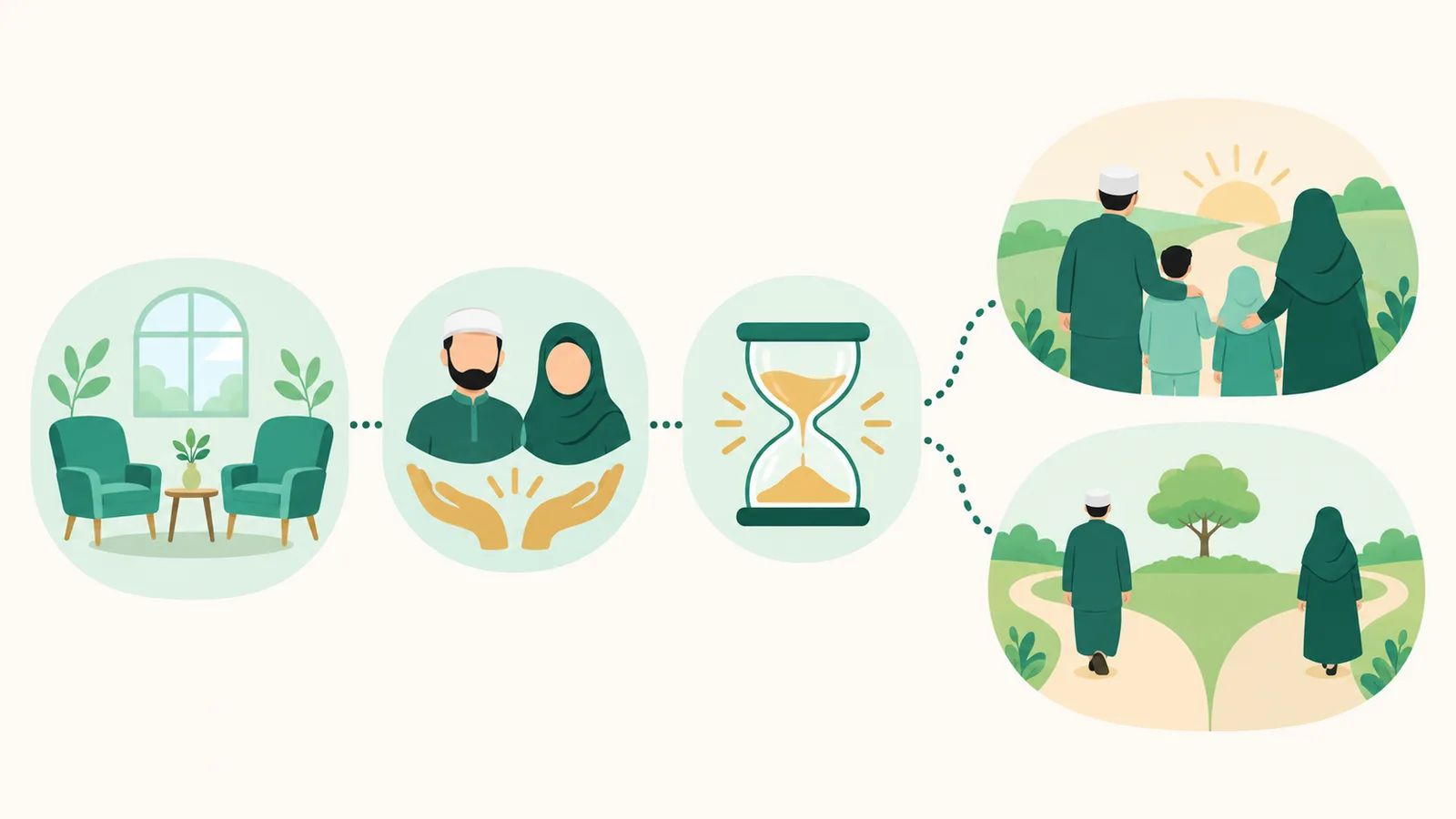
- Marriage is meant to last, and Islam asks couples to try hard to reconcile.
- Divorce is permitted when a marriage truly fails; no one is trapped.
- A wife can end a marriage through khul' or by going to a judge.
- The Qur'an commands kindness, fairness and financial rights after divorce.
- Misuse of divorce by some Muslims contradicts the Qur'an's spirit.