العربية
 Español
 Français
 中文
 हिन्दी
How Does Islam View Children?

Some of the most tender scenes in the life of the Prophet Muhammad ﷺ involve children: a grandchild riding on his back, a little girl carried in his arms during prayer, a group of boys he greeted on the street. For a man who led a community and carried the weight of revelation, he always seemed to have time for the smallest people in the room.
A gift and a trust
The Qur’an describes children as one of the joys of life (Qur’an 18:46), and teaches believers to pray for spouses and children who will be a comfort to their eyes (Qur’an 25:74). But a gift from God is also a trust (amanah). The Prophet ﷺ taught that everyone is a guardian responsible for those in their care, and that a man is a guardian of his family and a woman of her husband’s home (Sahih al-Bukhari 893). Raising a child well — feeding them, teaching them, protecting them and helping them to know God — is therefore an act of worship, and something parents will be asked about.
The Prophet’s tenderness
In seventh-century Arabia, it was not unusual for a proud man to think that showing affection to children was beneath him. The Prophet ﷺ challenged this directly:
Narrated Abu Huraira: Allah's Messenger (ﷺ) kissed Al-Hasan bin `Ali while Al-Aqra' bin H`Abis at-Tamim was sitting beside him. Al-Aqra said, "I have ten children and I have never kissed anyone of them," Allah's Messenger (ﷺ) cast a look at him and said, "Whoever is not merciful to others will not be treated mercifully
Couldn't load — please try again.
On another occasion, a Bedouin was surprised to see the Muslims kissing their children and admitted that his people did not. The Prophet ﷺ replied that he could not put mercy into a heart from which God had removed it (Sahih al-Bukhari 5998). Affection, in other words, is not softness to be embarrassed about; it is a sign of a living heart.
His mercy reached even into his prayer. He would pray while carrying his little granddaughter Umamah, putting her down when he prostrated and picking her up when he stood (Sahih al-Bukhari 516). And he said:
Narrated `Abdullah bin 'Abi Qatada: My father said, "The Prophet (ﷺ) said, 'When I stand for prayer, I intend to prolong it but on hearing the cries of a child, I cut it short, as I dislike to trouble the child's mother
Couldn't load — please try again.
The leader of the community shortened public worship so that a mother would not be distressed by her crying baby — a small detail that says a great deal.
Honouring daughters
Before Islam, some Arabs regarded the birth of a girl as a disgrace, and some even buried infant daughters alive. The Qur’an condemned this attitude in vivid terms (Qur’an 16:58-59) and warned that on the Day of Judgement, the buried girl herself will be asked for what sin she was killed:
وَإِذَا ٱلْمَوْءُۥدَةُ سُئِلَتْ ﴿٨﴾ بِأَىِّ ذَنۢبٍۢ قُتِلَتْ ﴿٩﴾ 8And when the girl [who was] buried alive is asked 9For what sin she was killed
Couldn't load — please try again.
The Prophet ﷺ went further, turning daughters from a “burden” into a path to salvation:
Narrated `Aisha: (the wife of the Prophet) A lady along with her two daughters came to me asking me (for some alms), but she found nothing with me except one date which I gave to her and she divided it between her two daughters, and then she got up and went away. Then the Prophet (ﷺ) came in and I informed him about this story. He said, "Whoever is in charge of (put to test by) these daughters and treats them generously, then they will act as a shield for him from the (Hell) Fire
Couldn't load — please try again.
The Qur’an also forbids killing children out of fear of poverty, reminding parents that God provides for them and for their children alike (Qur’an 17:31).
Fairness between children
Children notice unfairness quickly, and favouritism can poison a family for generations. When a companion of the Prophet wanted him to witness a gift given to just one of his sons, the Prophet ﷺ asked whether he had given the same to all his children. When the man said no, he told him to fear God and be just between his children, and the gift was returned (Sahih al-Bukhari 2587). Fairness in love, attention and gifts is part of a parent’s duty.
Raising children with mercy and guidance
Islam asks parents to combine warmth with responsibility. The Qur’an tells believers to protect themselves and their families from the Fire (Qur’an 66:6) — that is, to guide them gently towards faith and good character. This guidance is meant to be given with the same mercy the Prophet ﷺ showed: teaching by example, praising good behaviour, and never humiliating a child. The Prophet’s own household was described as a place where he served his family (Sahih al-Bukhari 676), and children learn far more from what they see than from what they are told.
Islam also gives children clear rights: a good name, care and provision, education, and protection from harm. Because the Prophet ﷺ disowned the conduct of anyone who does not show mercy to the young (Jami’ at-Tirmidhi 1920), cruelty to children has no place in an Islamic home.
A closing thought
The picture Islam paints of childhood is a warm one: children who are kissed, carried, greeted, treated fairly and taught to love God. To see how Islam extends this care to children who have lost a parent, read orphans in Islam, or see what children owe in return in parents in Islam.
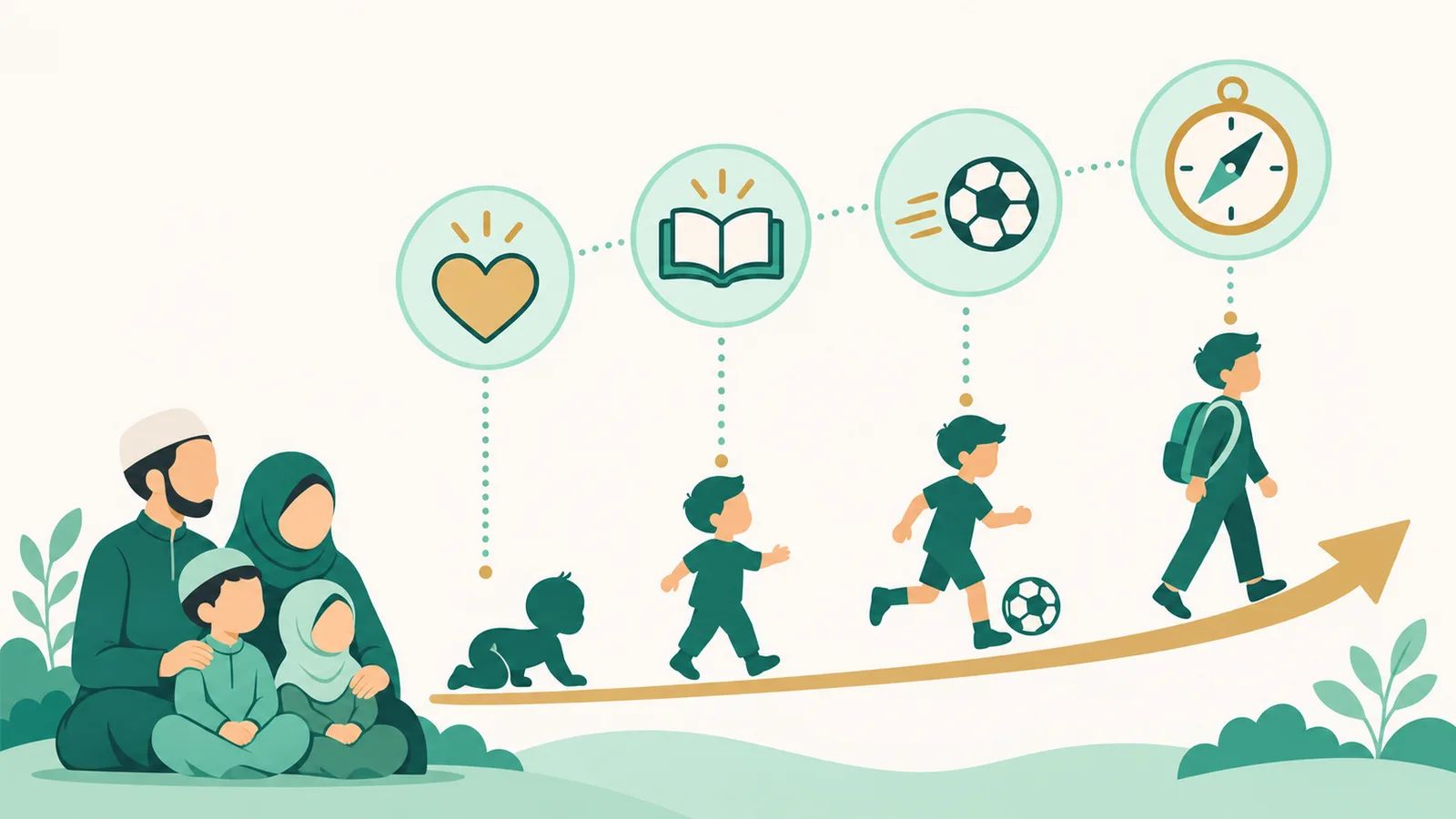
Key takeaways
- Children are a gift from God and a trust parents will answer for.
- The Prophet ﷺ openly kissed and showed affection to children.
- Daughters are honoured; Islam ended the practice of burying baby girls.
- Parents must be fair between their children, even in gifts.