العربية
 Español
 Français
 中文
 हिन्दी
Why Does Islam Put So Much Emphasis on Gratitude?

Psychologists today recommend keeping a gratitude journal: writing down a few good things each day to improve wellbeing. Islam built something similar into daily life fourteen centuries ago. A Muslim says alhamdulillah, meaning that all praise belongs to God, after eating, after sneezing, on waking up, when asked how they are, and in every unit of prayer. Gratitude is meant to become the background music of a believer’s life.
What shukr means
The Arabic word for gratitude, shukr, has three dimensions, as Muslim scholars have long explained: recognising a blessing in the heart, acknowledging it with the tongue, and using it in ways that please the One who gave it. Gratitude for good health means using it to do good; gratitude for wealth means sharing it; gratitude for knowledge means teaching it. The Qur’an captures this active sense when it tells the family of David to work in gratitude, adding that few of God’s servants are truly grateful (Qur’an 34:13).
The opposite of shukr is kufr — a word that means both ingratitude and disbelief. In the Qur’an, the two are closely connected: to deny the Giver is, at root, to be ungrateful for the gifts.
The promise of increase
One verse has become a kind of motto for Muslims:
وَإِذْ تَأَذَّنَ رَبُّكُمْ لَئِن شَكَرْتُمْ لَأَزِيدَنَّكُمْ ۖ وَلَئِن كَفَرْتُمْ إِنَّ عَذَابِى لَشَدِيدٌۭ ﴿٧﴾ And [remember] when your Lord proclaimed, 'If you are grateful, I will surely increase you [in favor]; but if you deny, indeed, My punishment is severe.' "
Couldn't load — please try again.
This is a promise, not just an encouragement. Gratitude opens the door to more blessing — more contentment, more goodness, often more provision — while ingratitude closes it. The Qur’an also makes clear that God does not need our thanks. When the Prophet Solomon (peace be upon him) saw a great blessing appear before him, he said it was a test of whether he would be grateful, and that whoever is grateful benefits only himself (Qur’an 27:40). Gratitude changes us.
Blessings too many to count
Gratitude begins with noticing. The Qur’an repeatedly invites people to look at the ordinary miracles we take for granted:
وَٱللَّهُ أَخْرَجَكُم مِّنۢ بُطُونِ أُمَّهَٰتِكُمْ لَا تَعْلَمُونَ شَيْـًۭٔا وَجَعَلَ لَكُمُ ٱلسَّمْعَ وَٱلْأَبْصَٰرَ وَٱلْأَفْـِٔدَةَ ۙ لَعَلَّكُمْ تَشْكُرُونَ ﴿٧٨﴾ And Allah has extracted you from the wombs of your mothers not knowing a thing, and He made for you hearing and vision and intellect that perhaps you would be grateful.
Couldn't load — please try again.
Hearing, sight and an understanding heart — gifts we had no part in earning. The Qur’an adds that if we tried to count God’s favours, we could never number them (Qur’an 16:18). Faith, in this sense, starts with paying attention. For more on the God to whom this gratitude is directed, see who is Allah?
The Prophet Muhammad ﷺ also gave a practical tip for keeping gratitude alive in a world of comparison:
Abu Huraira reported Allah's Messenger (ﷺ) as saying:Look at those who stand at a lower level than you but don't look at those who stand at a higher level than you, for that is better-suited that you do not disparage Allah's favors. In the chain narrated by Abu Mu'awiya's he said: Upon you
Couldn't load — please try again.
Social media trains us to look upward at people who seem to have more. This hadith trains us to look the other way — not to feel superior, but to see how much we have been given.
Gratitude in worship
Gratitude is the reason Muslims worship at all. The Qur’an asks believers to remember God so that He will remember them, and to be grateful and not deny Him (Qur’an 2:152). The Prophet ﷺ embodied this. He would stand in night prayer for so long that his feet became swollen, and when someone asked why he did this when God had already forgiven him, he answered:
Narrated Al-Mughira: The Prophet (ﷺ) used to offer night prayers till his feet became swollen. Somebody said, to him," "Allah has forgiven you, your faults of the past and those to follow." On that, he said, "Shouldn't I be a thankful slave of Allah)?
Couldn't load — please try again.
His worship came from thankfulness, not fear of falling short. Prayer, fasting and charity can all be seen in this light: not as payments to God, but as a grateful response to what He has already given.
Thanking people, too
Islam does not allow gratitude to God to become an excuse for ignoring the people through whom His gifts arrive. The Prophet ﷺ said:
Narrated Abu Hurayrah: The Prophet (ﷺ) said: He who does not thank the people is not thankful to Allah
Couldn't load — please try again.
A word of thanks to a parent, a teacher, a colleague, a shop assistant or a spouse is therefore part of a Muslim’s faith. The Qur’an even joins the two in a single command: be grateful to God and to your parents (Qur’an 31:14).
Gratitude and patience together
Gratitude in Islam does not depend on everything going well. The Prophet ﷺ described the believer as someone who thanks God in times of ease and is patient in times of hardship, so that both are good for him (Sahih Muslim 7500). A grateful heart can find something to be thankful for even on hard days, and a patient heart keeps hope alive until better days come. See patience in Islam for the other half of this picture.
A closing thought
Try a simple experiment: for one day, say alhamdulillah each time you notice something good — a meal, a kind word, a breath of fresh air. Many people find that gratitude does not just follow happiness; it creates it. To learn more about this everyday phrase, read Alhamdulillah.
Key takeaways
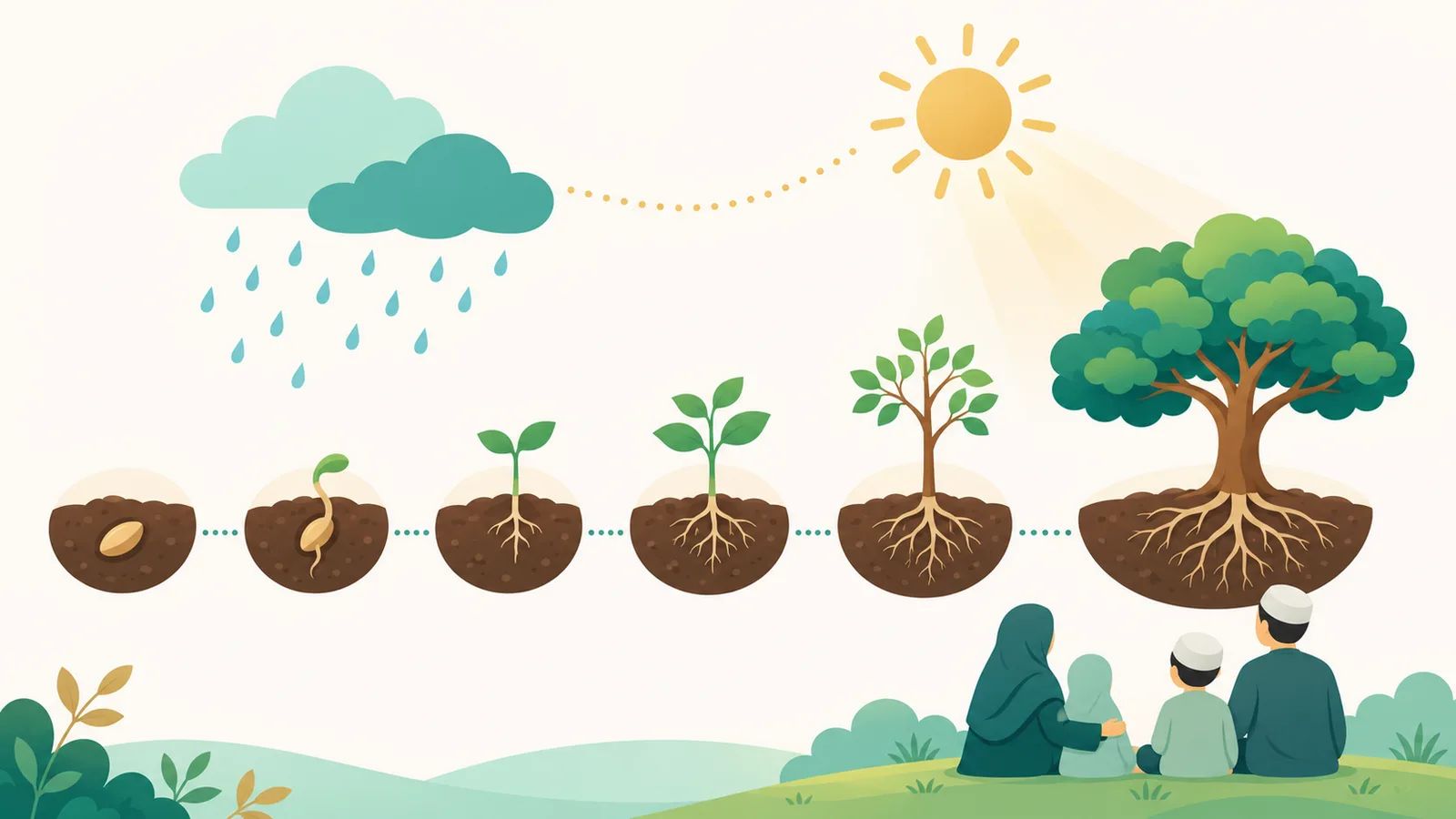
- Gratitude is expressed in the heart, on the tongue and through actions.
- God promises to increase those who are grateful.
- The blessings of God are too many to count.
- Whoever does not thank people has not truly thanked God.