العربية
 Español
 Français
 中文
 हिन्दी
The Qur'an Is God's Word, Preserved Unchanged
Most books are written first and read aloud later. The Qur’an was the other way round. It began as speech — recited by the Prophet Muhammad ﷺ to his companions, who learned it by heart and recited it back — and it has been passed on that way, mouth to ear, ever since. Alongside that living chain, it was also written down. This article explains what Muslims believe about the Qur’an and how, historically, it was preserved.
God’s own word
Muslims believe the Qur’an is not a book about God written by people, nor the Prophet’s own thoughts. It is God’s speech, delivered to Muhammad ﷺ through the angel Gabriel, in Arabic, over roughly twenty-three years. The Prophet ﷺ is understood as its messenger, not its author. You can read an introduction in What Is the Qur’an?
The Qur’an also contains a promise about its own future:
إِنَّا نَحْنُ نَزَّلْنَا ٱلذِّكْرَ وَإِنَّا لَهُۥ لَحَٰفِظُونَ ﴿٩﴾ Indeed, it is We who sent down the Qur'an and indeed, We will be its guardian.
Couldn't load — please try again.
Muslims of every school take this promise at face value: the Qur’an is protected by God, and it will not be lost or altered.
Preserved in hearts
From the beginning, the Qur’an was meant to be recited. Its name means “the recitation”. The Prophet ﷺ recited each new passage to his companions, they memorised it, and they recited it in their daily prayers. The Qur’an describes God Himself as taking responsibility for gathering it in the Prophet’s heart:
إِنَّ عَلَيْنَا جَمْعَهُۥ وَقُرْءَانَهُۥ ﴿١٧﴾ Indeed, upon Us is its collection [in your heart] and [to make possible] its recitation.
Couldn't load — please try again.
Memorising the Qur’an became, and has remained, one of the most honoured achievements in Muslim life. Today very large numbers of people around the world — many of them children, many of them not native Arabic speakers — know the entire text by heart. Every Ramadan, the whole Qur’an is recited aloud in mosques across the world, and a single slip is usually corrected by someone in the congregation. The Qur’an describes itself as made easy to remember:
وَلَقَدْ يَسَّرْنَا ٱلْقُرْءَانَ لِلذِّكْرِ فَهَلْ مِن مُّدَّكِرٍۢ ﴿١٧﴾ And We have certainly made the Qur'an easy for remembrance, so is there any who will remember?
Couldn't load — please try again.
Preserved in writing
Memory was not the only safeguard. During the Prophet’s lifetime, scribes wrote the revelation down on whatever materials were available — parchment, palm stalks, flat stones, bones. But these writings were not yet bound into one book, because new revelation was still arriving.
After the Prophet ﷺ died, many of the companions who knew the Qur’an by heart were killed in the Battle of Yamama. Umar ibn al-Khattab was worried that parts of the Qur’an might be lost if this continued, and urged the first caliph, Abu Bakr, to have it gathered into a single volume. Abu Bakr gave the task to Zayd ibn Thabit, one of the Prophet’s own scribes:
…You are a wise young man and we do not have any suspicion about you, and you used to write the Divine Inspiration for Allah's Messenger (ﷺ). So you should search for (the fragmentary scripts of) the Qur'an and collect it in one book.…
Couldn't load — please try again.
In the same report, Zayd describes gathering the text both from the written pieces and from people who knew it by heart, checking one against the other. The finished sheets were kept by Abu Bakr, then by Umar, and then by Umar’s daughter Hafsa, one of the Prophet’s wives.
Uthman’s standard copies
As Islam spread to new lands, people began reciting the Qur’an with differences in dialect and pronunciation, and some companions worried that this would lead to disputes. Around twenty years after the Prophet’s death, the third caliph, Uthman, had a committee led by Zayd copy Hafsa’s sheets into standard volumes and send them to the main cities:
…They did so, and when they had written many copies, `Uthman returned the original manuscripts to Hafsa. `Uthman sent to every Muslim province one copy of what they had copied…
Couldn't load — please try again.
The same report records that Uthman then ordered other written materials to be burned, so that people would not argue over private notes and partial copies. The companions, who had heard the Qur’an from the Prophet ﷺ themselves, accepted the standard text, and it is this text that Muslims recite today.
It is worth being precise here. Muslim scholars have always recorded a small number of recognised ways of reciting the Qur’an (called qira’at), each carefully traced back to the Prophet ﷺ. They differ mainly in pronunciation and in minor details of wording that do not change the Qur’an’s teaching. Scholars documented these openly rather than hiding them; they are part of the preserved text, not departures from it.
An invitation to reflect
The Qur’an does not ask to be accepted without thought. It invites its readers to examine it closely:
أَفَلَا يَتَدَبَّرُونَ ٱلْقُرْءَانَ ۚ وَلَوْ كَانَ مِنْ عِندِ غَيْرِ ٱللَّهِ لَوَجَدُوا۟ فِيهِ ٱخْتِلَٰفًۭا كَثِيرًۭا ﴿٨٢﴾ Then do they not reflect upon the Qur'an? If it had been from [any] other than Allah, they would have found within it much contradiction.
Couldn't load — please try again.
Some of the oldest surviving Qur’an manuscripts have been dated by modern methods to the first decades of Islam, and they match the text in use today. For Muslims, though, the deepest evidence is the unbroken chain of people who learned it from their teachers, who learned it from theirs, all the way back to the Prophet ﷺ.
Reading it for yourself
Whatever you conclude, the best way to understand the Qur’an is to read it. A good translation, read slowly with an open mind, is a fine place to start — and the verses quoted throughout this website are a small window into it. To continue, see What Is the Qur’an? or What Every Muslim Believes.
Key takeaways
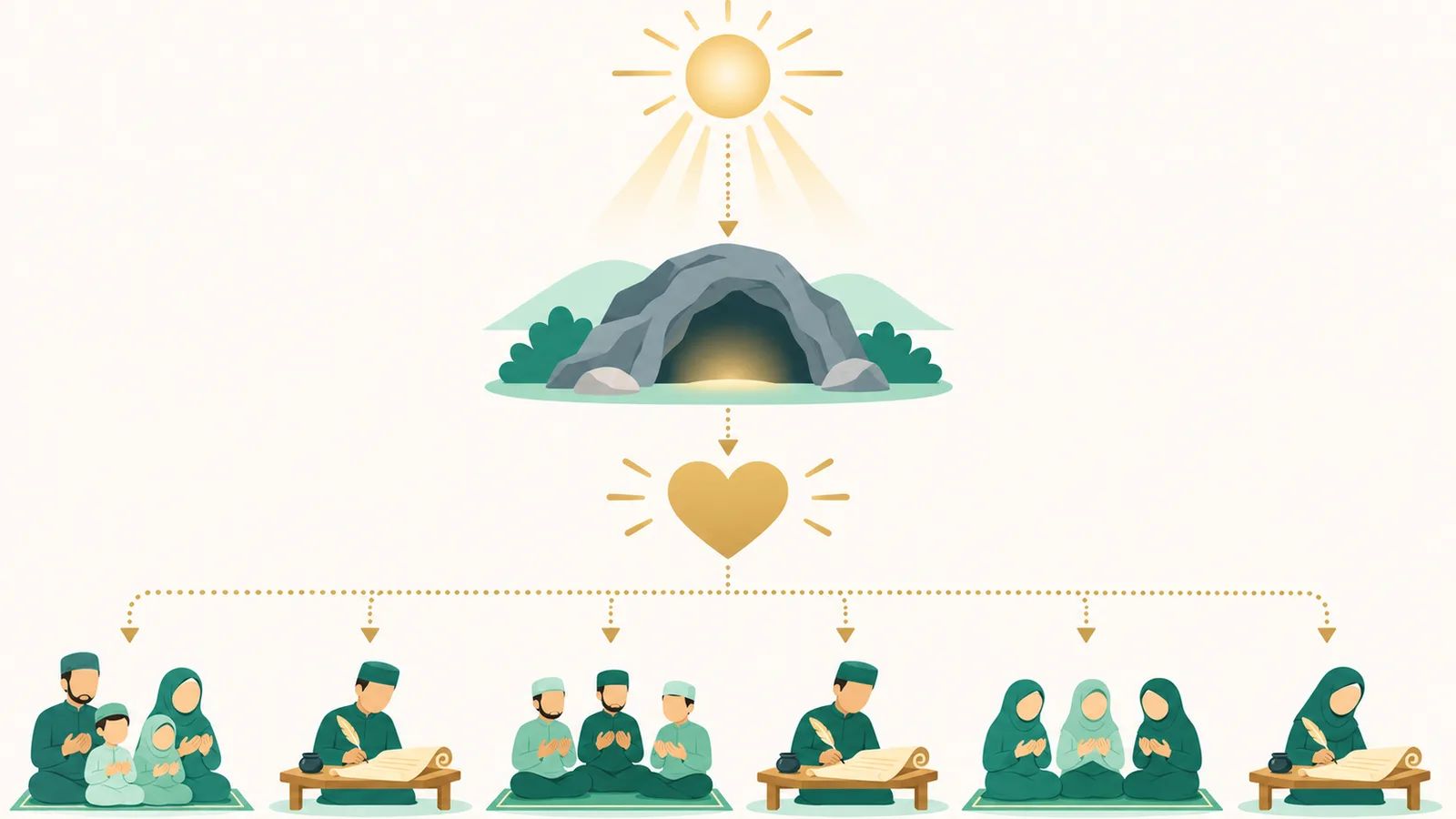
- Muslims believe the Qur'an is God's own word, not the Prophet's composition.
- It was preserved both in memory and in writing from the very beginning.
- Abu Bakr gathered it into one volume; Uthman sent standard copies across the Muslim lands.
- The Arabic text recited today is the same text Muslims everywhere use.