العربية
 Español
 Français
 中文
 हिन्दी
Zakat: The Right of the Poor
Most of us think of charity as something optional: kind, admirable, but up to us. Islam takes a different view. For a Muslim who has more than they need, a portion of their wealth was never really theirs to keep. It belongs to the poor, and paying it is not generosity — it is giving people what is already theirs.
A pillar of the faith
Zakat is the third of the Five Pillars of Islam. In the Qur’an it is mentioned again and again side by side with prayer, as in the command to establish prayer and give zakat (Qur’an 2:43). Worshipping God and caring for His creation are presented as two halves of one faith.
When the Prophet ﷺ sent his companion Mu’adh to teach the people of Yemen, he summarised zakat in a single sentence:
…Allah has made it obligatory for them to pay the Zakat from their property and it is to be taken from the wealthy among them and given to the poor…
Couldn't load — please try again.
The wealth moves in one direction: from those who have more to those who have less, within the same community.
A right, not a favour
The Qur’an describes the God-conscious as people in whose wealth there is a recognised share for others:
وَفِىٓ أَمْوَٰلِهِمْ حَقٌّۭ لِّلسَّآئِلِ وَٱلْمَحْرُومِ ﴿١٩﴾ And from their properties was [given] the right of the [needy] petitioner and the deprived.
Couldn't load — please try again.
The word used is haqq — a right, something owed. This changes the relationship between giver and receiver. The person who receives zakat need not feel humiliated, because they are taking what God has assigned to them. The person who gives it has no grounds for pride, because they are only returning what was entrusted to them. Islam teaches that everything we own is ultimately a trust from God; see Wealth and Money in Islam.
How zakat works
The basic rules are agreed among Muslims:
- Who pays: an adult Muslim whose wealth stays above a minimum threshold, called the nisab, for a full lunar year. The threshold is traditionally measured by the value of a set weight of gold or silver.
- How much: for savings in cash, gold, silver and trade goods, the rate is one fortieth — 2.5 per cent — of the wealth held. Crops and livestock have their own rates.
- What is exempt: the home you live in, your personal belongings and the tools of your trade are not counted.
- When: once a year. Many Muslims choose to pay in Ramadan, though the due date depends on when their own year began.
Separate from this is zakat al-fitr, a small gift of food, or its value, paid for every member of the household at the end of Ramadan so that the poor can celebrate the festival too.
Scholars differ on some details — for example, how to treat jewellery in everyday use, or certain modern forms of wealth such as pensions and shares. Muslims follow the guidance of their trusted scholars on these points. See Where Muslims Differ, and Why It’s Okay.
Who receives it
Zakat is not a general fund that can be spent on anything. The Qur’an itself lists who may receive it:
۞ إِنَّمَا ٱلصَّدَقَٰتُ لِلْفُقَرَآءِ وَٱلْمَسَٰكِينِ وَٱلْعَٰمِلِينَ عَلَيْهَا وَٱلْمُؤَلَّفَةِ قُلُوبُهُمْ وَفِى ٱلرِّقَابِ وَٱلْغَٰرِمِينَ وَفِى سَبِيلِ ٱللَّهِ وَٱبْنِ ٱلسَّبِيلِ ۖ فَرِيضَةًۭ مِّنَ ٱللَّهِ ۗ وَٱللَّهُ عَلِيمٌ حَكِيمٌۭ ﴿٦٠﴾ Zakah expenditures are only for the poor and for the needy and for those employed to collect [zakah] and for bringing hearts together [for Islam] and for freeing captives [or slaves] and for those in debt and for the cause of Allah and for the [stranded] traveler - an obligation [imposed] by Allah. And Allah is Knowing and Wise.
Couldn't load — please try again.
These eight groups include the poor and the needy, people crushed by debt, travellers stranded far from home, and — remarkably for the seventh century — the freeing of people held in bondage. Most zakat today goes to the poor and the needy, often within the giver’s own community.
Purifying the giver
Zakat literally means both “purification” and “growth”. The Qur’an addresses the Prophet ﷺ about the charity he collected:
خُذْ مِنْ أَمْوَٰلِهِمْ صَدَقَةًۭ تُطَهِّرُهُمْ وَتُزَكِّيهِم بِهَا وَصَلِّ عَلَيْهِمْ ۖ إِنَّ صَلَوٰتَكَ سَكَنٌۭ لَّهُمْ ۗ وَٱللَّهُ سَمِيعٌ عَلِيمٌ ﴿١٠٣﴾ Take, [O, Muhammad], from their wealth a charity by which you purify them and cause them increase, and invoke [Allah 's blessings] upon them. Indeed, your invocations are reassurance for them. And Allah is Hearing and Knowing.
Couldn't load — please try again.
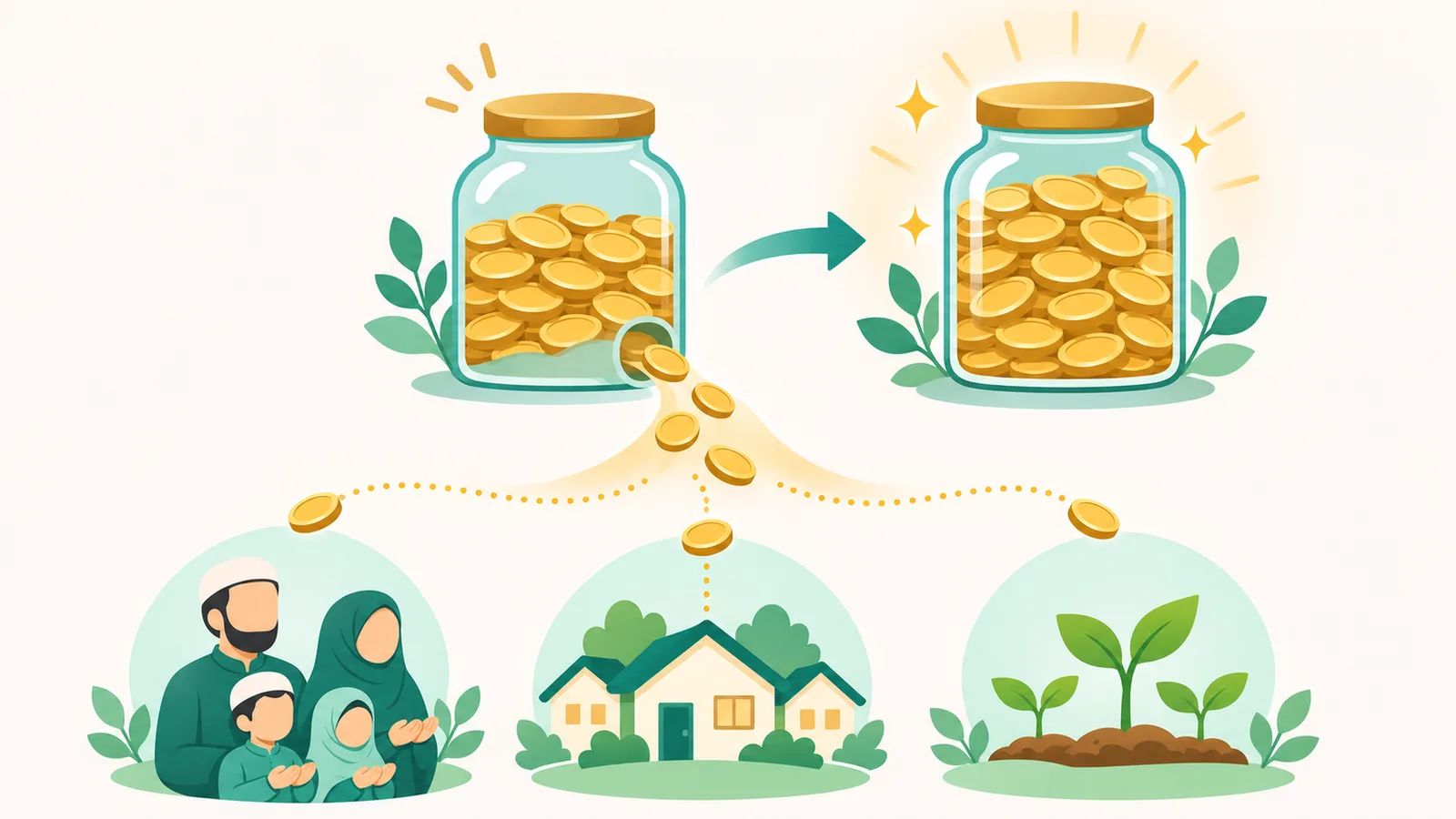
Giving purifies the heart of greed and the love of possessions, and it purifies the wealth that remains. Muslims also believe it brings blessing rather than loss. The Prophet ﷺ said:
…Charity does not decrease wealth…
Couldn't load — please try again.
Beyond zakat, Muslims are encouraged to give voluntary charity, called sadaqah, at any time and in any amount; the Prophet ﷺ taught that every good deed counts as charity (Bukhari 6021). We explore this wider culture of giving in Poverty and Charity in Islam.
A quiet revolution
Zakat is one of Islam’s most practical expressions of mercy. It asks nothing of the poor and something real of the comfortable, and it does so every single year. A community that truly lives by it cannot forget those who are struggling in its midst. That is the vision behind this pillar: a faith in which loving God and caring for people cannot be separated.
Key takeaways
- Zakat is the third pillar of Islam and is agreed upon by all Muslims.
- It is due once a year on wealth above a minimum threshold, usually at 2.5 per cent.
- The Qur'an names eight groups who may receive it, starting with the poor and the needy.
- Islam presents zakat as the right of the poor and as a purification for the giver.