العربية
 Español
 Français
 中文
 हिन्दी
Does Islam Allow Polygamy?

For many readers, this is one of the hardest questions about Islam. It touches on fairness, on women’s dignity and on the meaning of marriage itself. It deserves an answer that is honest about what Islam permits, and equally honest about the conditions it attaches.
What the Qur’an says
The key verse was revealed in Madinah, in a community that war had left with many widows and orphans, and it opens with the fair treatment of orphans:
وَإِنْ خِفْتُمْ أَلَّا تُقْسِطُوا۟ فِى ٱلْيَتَٰمَىٰ فَٱنكِحُوا۟ مَا طَابَ لَكُم مِّنَ ٱلنِّسَآءِ مَثْنَىٰ وَثُلَٰثَ وَرُبَٰعَ ۖ فَإِنْ خِفْتُمْ أَلَّا تَعْدِلُوا۟ فَوَٰحِدَةً أَوْ مَا مَلَكَتْ أَيْمَٰنُكُمْ ۚ ذَٰلِكَ أَدْنَىٰٓ أَلَّا تَعُولُوا۟ ﴿٣﴾ And if you fear that you will not deal justly with the orphan girls, then marry those that please you of [other] women, two or three or four. But if you fear that you will not be just, then [marry only] one or those your right hand possesses. That is more suitable that you may not incline [to injustice].
Couldn't load — please try again.
Three things stand out. The verse begins with concern for orphans, not for men’s desires. It sets a maximum of four, in a society where men had married without any limit. And it ends by saying that if a man fears he will not be just, he must marry only one, because that is nearer to avoiding injustice. The Prophet’s wife Aisha explained that the verse was addressed to guardians who were tempted to marry orphan girls in their care without giving them a fair dowry: they were told to deal justly with them or marry other women instead (Bukhari 4574).
The verse also refers to women held in slavery, an institution found across the ancient world that Islam regulated and strongly encouraged ending. It has no place in Muslim life today.
The condition: justice
Justice here is not a vague ideal. A husband with more than one wife must treat them equally in what he can control: housing, financial support, and the time he spends with each. The Qur’an is realistic about what he cannot control:
وَلَن تَسْتَطِيعُوٓا۟ أَن تَعْدِلُوا۟ بَيْنَ ٱلنِّسَآءِ وَلَوْ حَرَصْتُمْ ۖ فَلَا تَمِيلُوا۟ كُلَّ ٱلْمَيْلِ فَتَذَرُوهَا كَٱلْمُعَلَّقَةِ ۚ وَإِن تُصْلِحُوا۟ وَتَتَّقُوا۟ فَإِنَّ ٱللَّهَ كَانَ غَفُورًۭا رَّحِيمًۭا ﴿١٢٩﴾ And you will never be able to be equal [in feeling] between wives, even if you should strive [to do so]. So do not incline completely [toward one] and leave another hanging. And if you amend [your affairs] and fear Allah - then indeed, Allah is ever Forgiving and Merciful.
Couldn't load — please try again.
Feelings cannot be perfectly equal, the Qur’an admits. But a man may not neglect one wife and leave her in limbo, neither properly married nor free. The Prophet ﷺ warned what awaits a husband who does:
Narrated AbuHurayrah: The Prophet (ﷺ) said: When a man has two wives and he is inclined to one of them, he will come on the Day of resurrection with a side hanging down
Couldn't load — please try again.
This is a heavy warning, and it is why many scholars have said that a man should think long and hard before taking on such a responsibility.
Permitted, not commanded
Polygamy is not a pillar of Islam, not an obligation, and not the Islamic ideal of marriage. The Qur’an describes marriage as a bond of tranquillity, affection and mercy (Qur’an 30:21), and for most people that is best found with one spouse. In practice, the great majority of Muslim marriages, across the world and throughout history, have been monogamous.
The Prophet ﷺ himself was married to Khadijah alone for about twenty-five years, until her death. His later marriages, all but one to women who had been widowed or divorced, had their own circumstances and were governed by a ruling specific to him (Qur’an 33:50).
Where it is practised, it is meant to meet real needs: widows and orphans after war, a society with many more women than men, or a family situation where the alternative would be divorce. Scholars have also stressed that a man must be able to support each wife fully.
Rights of the women involved
Every wife has her own marriage contract, her own dowry, her own right to support and housing, and her own right to fair treatment. No woman may be married against her will. A wife who is wronged can take her case to a judge and seek a divorce. Many jurists also allowed a woman to include a condition in her marriage contract that her husband will not take another wife, though scholars differ over how binding such a condition is (see where Muslims differ).
Islam does not allow a woman to have more than one husband. Scholars connect this to the clarity of lineage and the rights of children, among other reasons.
In countries where polygamy is illegal, Muslims are bound by their commitment to obey the law of the land. Since polygamy is not required by Islam, keeping such a law costs them nothing of their religion.
The common misunderstanding
The common misunderstanding is that Islam encourages men to collect wives. In fact the Qur’an took an unlimited practice, limited it, attached a demanding condition of justice, and told anyone in doubt to marry one. It is a permission with heavy responsibility, meant as a safety net for real human situations, not a privilege. To understand the Islamic view of marriage more fully, read marriage in Islam and women in Islam.
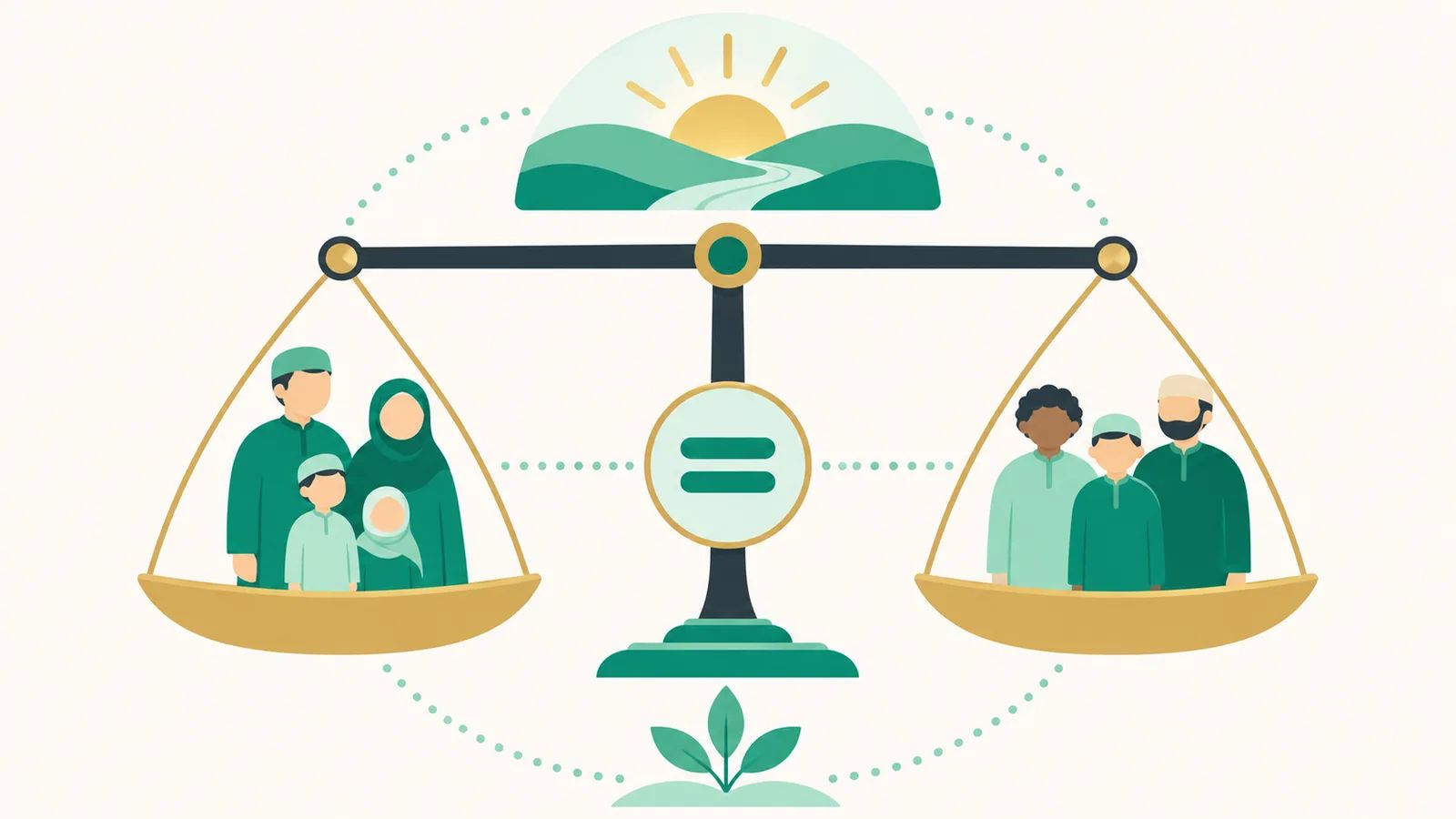
Key takeaways
- The Qur'an limited marriage to a maximum of four wives, in a world where there had been no limit.
- The permission comes with a strict condition of fairness; if a man fears he cannot be fair, he must marry only one.
- Polygamy is permitted, not obligatory or recommended as a norm; most Muslim marriages are monogamous.
- Every wife has full rights of her own, and no woman may be married against her will.
- Where the law of a country forbids it, Muslims are bound by their agreement to keep that law.