العربية
 Español
 Français
 中文
 हिन्दी
How Does Islam Care for Orphans?
Every society can be measured by how it treats those with no one to defend them. In seventh-century Arabia, a child without a father was among the most vulnerable people imaginable: no protector, no inheritance they could claim, and often no voice. Islam put such children at the centre of its moral teaching.
The orphan who became a prophet
The Prophet Muhammad ﷺ knew this vulnerability personally. His father died before he was born, his mother when he was about six, and the grandfather who then took him in died a couple of years later. He was raised by his uncle. When the Qur’an comforts him, it reminds him of this:
أَلَمْ يَجِدْكَ يَتِيمًۭا فَـَٔاوَىٰ ﴿٦﴾ وَوَجَدَكَ ضَآلًّۭا فَهَدَىٰ ﴿٧﴾ وَوَجَدَكَ عَآئِلًۭا فَأَغْنَىٰ ﴿٨﴾ فَأَمَّا ٱلْيَتِيمَ فَلَا تَقْهَرْ ﴿٩﴾ وَأَمَّا ٱلسَّآئِلَ فَلَا تَنْهَرْ ﴿١٠﴾ 6Did He not find you an orphan and give [you] refuge? 7And He found you lost and guided [you], 8And He found you poor and made [you] self-sufficient. 9So as for the orphan, do not oppress [him]. 10And as for the petitioner, do not repel [him].
Couldn't load — please try again.
The logic is simple and powerful: you were once an orphan and God sheltered you, so you must shelter orphans in turn. Muslims read these verses as addressed to them too. Every believer has, in some way, been found in need and cared for by God.
Close to the Prophet in Paradise
Islam does not just forbid harming orphans; it makes caring for them one of the most rewarded acts a person can do. The Prophet ﷺ described the reward with a gesture:
Narrated Sahl: Allah's Messenger (ﷺ) said, "I and the one who looks after an orphan will be like this in Paradise," showing his middle and index fingers and separating them
Couldn't load — please try again.
Two fingers side by side — that is how close the one who cares for an orphan will be to the Prophet ﷺ himself. The Arabic word used, kafil, means someone who takes responsibility for the orphan: providing for them, raising them, or supporting their care. Throughout Muslim history, this hadith has inspired families to take orphans into their homes and communities to set up endowments, schools and sponsorship programmes for them.
Their wealth is a sacred trust
Orphans who inherit property are especially easy to exploit. The Qur’an therefore speaks about orphans’ wealth in some of its strongest language. It commands guardians to hand over orphans’ property when they come of age, not to swap their good things for worse, and not to absorb it into their own (Qur’an 4:2). And it warns:
إِنَّ ٱلَّذِينَ يَأْكُلُونَ أَمْوَٰلَ ٱلْيَتَٰمَىٰ ظُلْمًا إِنَّمَا يَأْكُلُونَ فِى بُطُونِهِمْ نَارًۭا ۖ وَسَيَصْلَوْنَ سَعِيرًۭا ﴿١٠﴾ Indeed, those who devour the property of orphans unjustly are only consuming into their bellies fire. And they will be burned in a Blaze.
Couldn't load — please try again.
The Prophet ﷺ listed consuming an orphan’s wealth among the seven great destructive sins, alongside murder and associating partners with God (Sahih al-Bukhari 2766). At the same time, the Qur’an is practical. When the early Muslims became so anxious about this that they were afraid to mix their affairs with orphans at all, God told them that doing what is best for orphans is good, and that if they share households and expenses with them, they are their brothers and sisters (Qur’an 2:220). The goal is not distance but honest, loving care.
Turning away an orphan is a sign of a hardened heart
The Qur’an connects how we treat orphans with whether our faith is real. In a short chapter often recited in prayer, it asks:
أَرَءَيْتَ ٱلَّذِى يُكَذِّبُ بِٱلدِّينِ ﴿١﴾ فَذَٰلِكَ ٱلَّذِى يَدُعُّ ٱلْيَتِيمَ ﴿٢﴾ وَلَا يَحُضُّ عَلَىٰ طَعَامِ ٱلْمِسْكِينِ ﴿٣﴾ 1Have you seen the one who denies the Recompense? 2For that is the one who drives away the orphan 3And does not encourage the feeding of the poor.
Couldn't load — please try again.
Here, rejecting the orphan and ignoring the hungry are presented not as small social failings but as signs that a person does not truly believe in the Day of Judgement. Elsewhere, God rebukes people who fail to honour the orphan (Qur’an 89:17). Honour, not only food and shelter, is part of what orphans are owed.
Raising an orphan in your home
Muslims are encouraged to take orphans into their families and raise them with the same love as their own children. Islam does, however, preserve the child’s identity: the Qur’an instructs that children be known by the names of their real fathers, and that if the father is unknown, they are still brothers and sisters in faith (Qur’an 33:5). This form of care is often called kafalah — sponsorship or guardianship — rather than an adoption that erases a child’s origins.
The aim is to protect the child’s lineage, inheritance and right to know where they come from, while giving them a real home. Practical questions — such as family rules within the home once the child grows up, or how a guardian can leave the child a share of their wealth — are handled by Islamic law, and scholars give detailed guidance on them; see where Muslims differ.
A closing thought
The Prophet ﷺ who once had no father became, for countless orphans, the reason someone opened a door to them. Islam asks every believer to be that door. To read more about how Islam views childhood, see children in Islam, or explore why Islam is called a religion of mercy.
Key takeaways
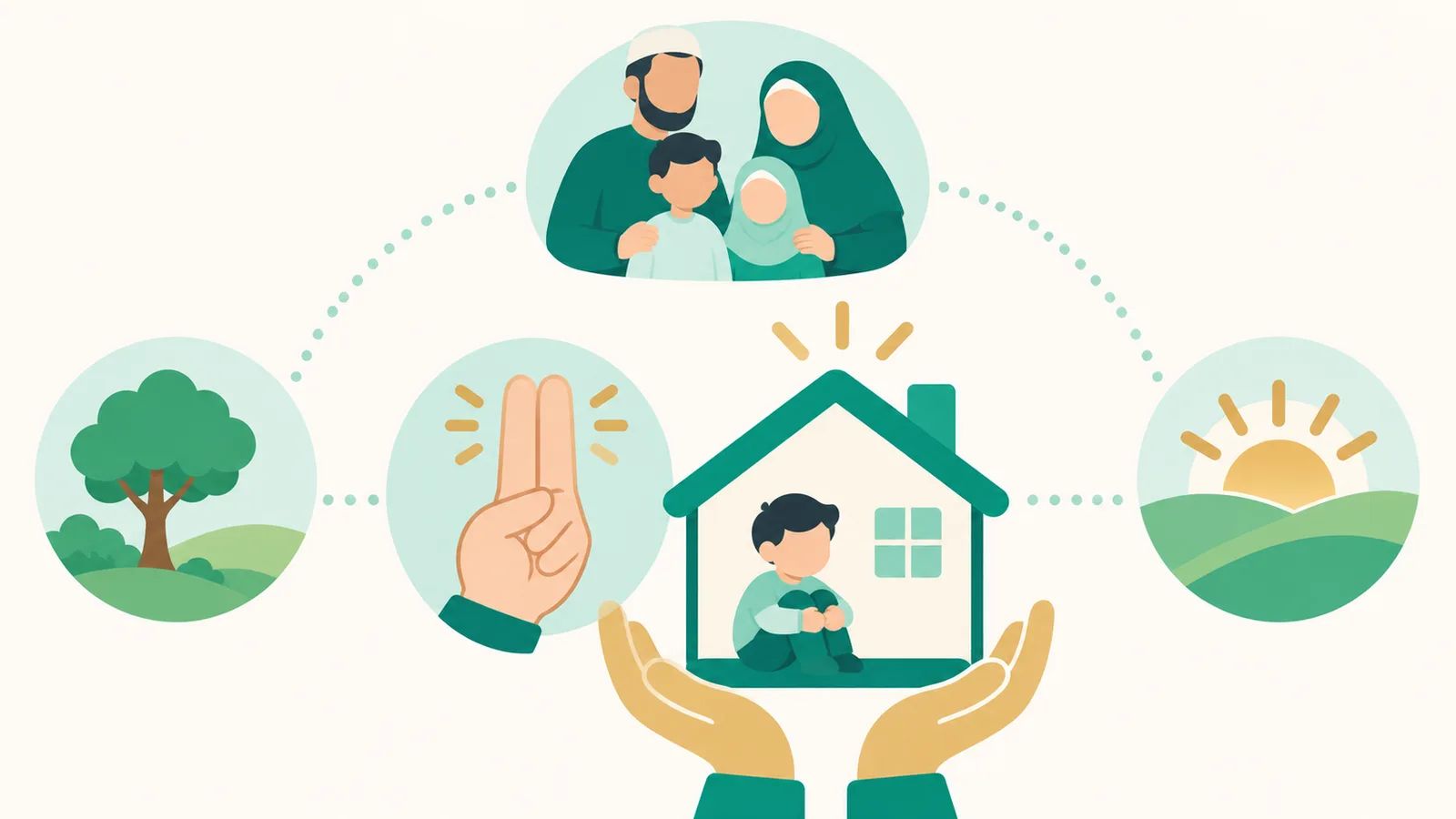
- The Prophet ﷺ was an orphan, and the Qur'an reminds him of God's care.
- Whoever sponsors an orphan will be near the Prophet ﷺ in Paradise.
- Consuming an orphan's wealth unjustly is one of the gravest sins.
- Islam encourages raising orphans in loving homes while preserving their lineage.