العربية
 Español
 Français
 中文
 हिन्दी
What Does Islam Teach About Parents?

Most of us only begin to understand our parents when we become tired, worried adults ourselves. Islam does not wait for that moment. From the very beginning, it teaches that the people who carried us, fed us and lost sleep over us have a claim on our love that is second only to God’s.
Right after the worship of God
The Arabic term for devoted kindness to parents is birr al-walidayn — literally “goodness to the two parents”. What is striking is where the Qur’an places it. In the same breath as the command to worship God alone, it commands good treatment of parents:
۞ وَقَضَىٰ رَبُّكَ أَلَّا تَعْبُدُوٓا۟ إِلَّآ إِيَّاهُ وَبِٱلْوَٰلِدَيْنِ إِحْسَٰنًا ۚ إِمَّا يَبْلُغَنَّ عِندَكَ ٱلْكِبَرَ أَحَدُهُمَآ أَوْ كِلَاهُمَا فَلَا تَقُل لَّهُمَآ أُفٍّۢ وَلَا تَنْهَرْهُمَا وَقُل لَّهُمَا قَوْلًۭا كَرِيمًۭا ﴿٢٣﴾ وَٱخْفِضْ لَهُمَا جَنَاحَ ٱلذُّلِّ مِنَ ٱلرَّحْمَةِ وَقُل رَّبِّ ٱرْحَمْهُمَا كَمَا رَبَّيَانِى صَغِيرًۭا ﴿٢٤﴾ 23And your Lord has decreed that you not worship except Him, and to parents, good treatment. Whether one or both of them reach old age [while] with you, say not to them [so much as], "uff," and do not repel them but speak to them a noble word. 24And lower to them the wing of humility out of mercy and say, "My Lord, have mercy upon them as they brought me up [when I was] small."
Couldn't load — please try again.
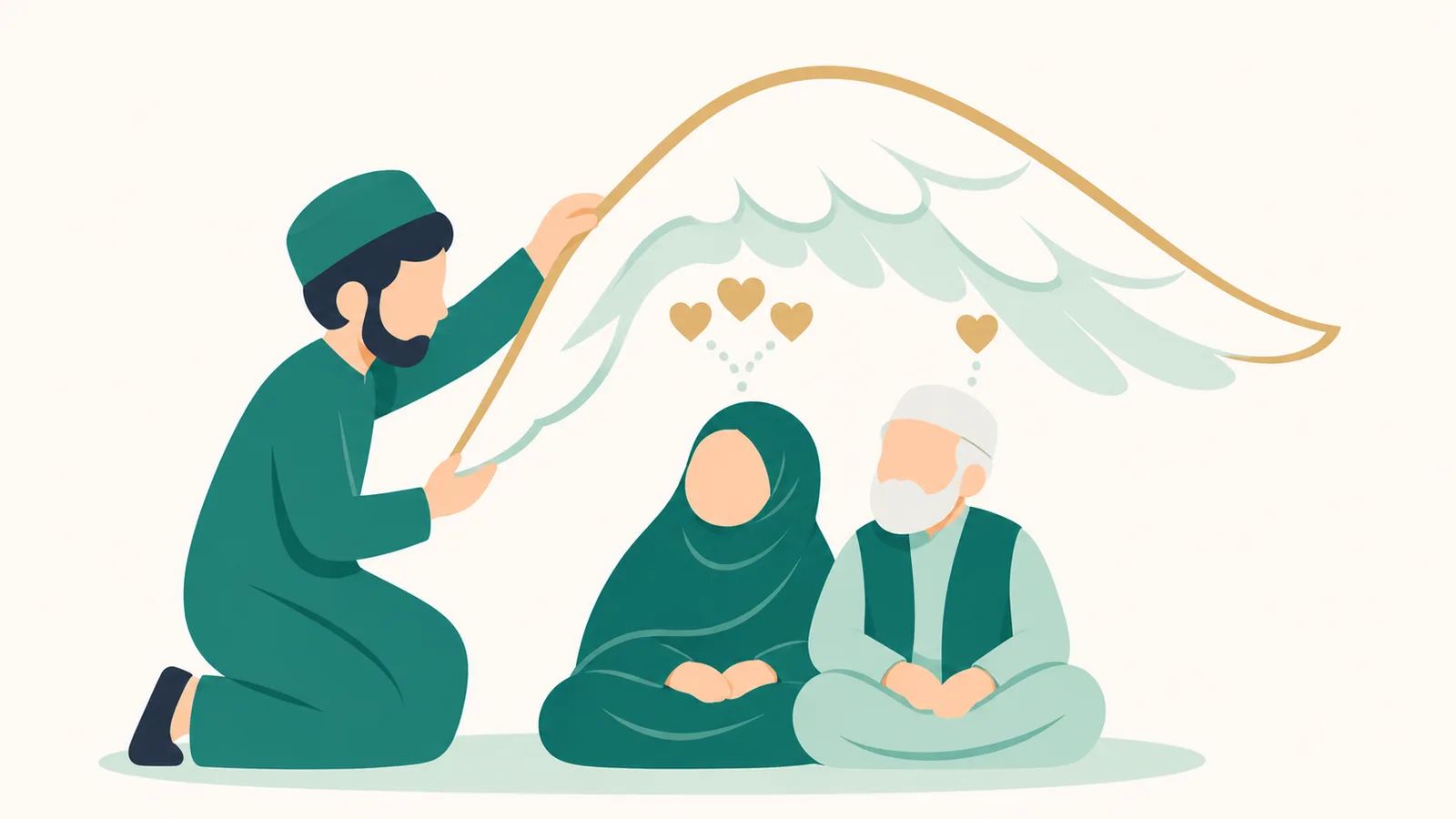
These two verses are worth reading slowly. They forbid even uff — the small sound of impatience everyone knows. They anticipate the hardest stage of the relationship: old age, when a parent may become slow, forgetful or dependent. And they ask the child to lower the wing of humility out of mercy — the image of a bird gently sheltering its young, except that now the child shelters the parent. The verses end with a prayer that turns memory into gratitude, asking God to have mercy on one’s parents just as they cared for their child when he was small.
The Prophet Muhammad ﷺ confirmed this ranking. When asked which deeds God loves most, he named prayer on time, and then being good and dutiful to one’s parents (Sahih al-Bukhari 527).
The special honour of mothers
Islam honours both parents, but it gives the mother a distinctive place. The Qur’an explains why, pointing to the physical cost of motherhood:
وَوَصَّيْنَا ٱلْإِنسَٰنَ بِوَٰلِدَيْهِ حَمَلَتْهُ أُمُّهُۥ وَهْنًا عَلَىٰ وَهْنٍۢ وَفِصَٰلُهُۥ فِى عَامَيْنِ أَنِ ٱشْكُرْ لِى وَلِوَٰلِدَيْكَ إِلَىَّ ٱلْمَصِيرُ ﴿١٤﴾ And We have enjoined upon man [care] for his parents. His mother carried him, [increasing her] in weakness upon weakness, and his weaning is in two years. Be grateful to Me and to your parents; to Me is the [final] destination.
Couldn't load — please try again.
The Prophet ﷺ made the same point in a memorable way:
Narrated Abu Huraira: A man came to Allah's Messenger (ﷺ) and said, "O Allah's Messenger (ﷺ)! Who is more entitled to be treated with the best companionship by me?" The Prophet (ﷺ) said, "Your mother." The man said. "Who is next?" The Prophet said, "Your mother." The man further said, "Who is next?" The Prophet (ﷺ) said, "Your mother." The man asked for the fourth time, "Who is next?" The Prophet (ﷺ) said, "Your father
Couldn't load — please try again.
Three times the mother, and only then the father. Muslim scholars have understood this as recognising the three burdens a mother alone carries — pregnancy, childbirth and nursing — while the father’s rights remain great. In many Muslim homes, this hadith is one of the first that children learn. For more on the dignity Islam gives women in every role, see women in Islam.
A road to Paradise — or a missed opportunity
Islam presents caring for parents not as a burden but as an open door. The Prophet ﷺ spoke strongly about someone who has that door in front of him and walks past it:
Abu Huraira reported Allah's Apostle (ﷺ) as saying:Let him be humbled into dust; let him be humbled into dust. It was said: Allah's Messenger, who is he? He said: He who sees either of his parents during their old age or he sees both of them, but he does not enter Paradise
Couldn't load — please try again.
In other words, an ageing parent is an opportunity. Every meal prepared, every hospital visit and every patient answer to a repeated question is a step towards God’s pleasure. The Prophet ﷺ even told a young man who wanted to join a military expedition to go back and exert himself in serving his living parents instead (Sahih al-Bukhari 3004). The opposite is treated very seriously: he listed being undutiful to parents among the gravest sins, right after associating partners with God (Sahih al-Bukhari 5976).
When parents are not Muslim
What if a person becomes Muslim and their parents do not? Islam’s answer is clear: the relationship of kindness continues. The Qur’an says that if parents push their child to worship others besides God, the child should not obey them in that — yet must still accompany them in this world with kindness (Qur’an 31:15).
A companion of the Prophet, Asma’ the daughter of Abu Bakr, faced exactly this situation when her mother, who was not Muslim, came to visit her:
Narrated Asma' bint Abu Bakr: My mother came to me during the lifetime of Allah's Messenger (ﷺ) and she was a pagan. I said to Allah's Apostle (seeking his verdict), "My mother has come to me and she desires to receive a reward from me, shall I keep good relations with her?" The Prophet (ﷺ) said, "Yes, keep good relation with her
Couldn't load — please try again.
For new Muslims, this is an important reassurance. Accepting Islam does not mean leaving your family behind. If anything, it should make you a gentler, more patient and more attentive son or daughter. Many converts find that their parents first notice Islam through exactly this change.
Kindness, not blind obedience
Honouring parents is not the same as giving up one’s conscience. The one limit Islam sets is that no human being — not even a parent — may be obeyed in disobeying God. A child may decline to do something wrong, but must decline politely, and keep serving, visiting and caring. Islam also does not ask anyone to accept abuse; in difficult or harmful family situations, a person should seek advice from a trusted scholar and the right professional help. How these principles apply in complex cases is something scholars weigh carefully, and details can differ — see where Muslims differ.
A closing thought
Islam asks us to look at our parents with the same patience they once showed us. If your parents are still living, this teaching is an invitation: call them, visit them, pray for them. To see how the same mercy flows down the generations, read children in Islam or the elderly in Islam.
Key takeaways
- The Qur'an links kindness to parents directly to the worship of God.
- Even a sigh of irritation at an elderly parent is discouraged.
- Mothers are given a special, threefold honour for what they endured.
- Children must be kind to their parents even if their parents are not Muslim.
- Obedience has one limit — no one may be obeyed in disobeying God.