العربية
 Español
 Français
 中文
 हिन्दी
What Does Islam Teach About War and Peace?

War is one of the hardest subjects any religion has to face. Every major tradition — and every modern nation — has had to ask when, if ever, it is right to fight, and what limits must never be crossed. Islam answers these questions in detail, and its answers are often very different from what the headlines suggest.
Peace is the goal
One of God’s names in the Qur’an is as-Salam (59:23), which speaks of perfect peace and safety. Muslims greet each other with as-salamu alaykum, “peace be upon you”, and the Qur’an describes God as inviting people to the Home of Peace (10:25). Islam does not glorify war. The Prophet Muhammad ﷺ even told his companions not to long for battle:
…O people! Do not wish to face the enemy (in a battle) and ask Allah to save you (from calamities)…
Couldn't load — please try again.
For thirteen years in Mecca, the early Muslims were persecuted, boycotted, tortured and killed, and they were not permitted to fight back. Only after they had been driven from their homes did God give permission to defend themselves, explaining that otherwise monasteries, churches, synagogues and mosques would be destroyed (22:39–40). We look at this history closely in Does Islam promote violence?
When fighting is permitted — and its limits
The Qur’an permits fighting to repel aggression and to stop oppression, but it immediately sets a boundary:
وَقَٰتِلُوا۟ فِى سَبِيلِ ٱللَّهِ ٱلَّذِينَ يُقَٰتِلُونَكُمْ وَلَا تَعْتَدُوٓا۟ ۚ إِنَّ ٱللَّهَ لَا يُحِبُّ ٱلْمُعْتَدِينَ ﴿١٩٠﴾ Fight in the way of Allah those who fight you but do not transgress. Indeed. Allah does not like transgressors.
Couldn't load — please try again.
Scholars explain that the forbidden transgression includes attacking people who are not fighting, breaking agreements, and going beyond what is necessary. Fighting can never be used to force anyone to accept Islam, because there is no compulsion in religion (see no compulsion in religion).
Rules of war
Centuries before modern conventions, the Prophet ﷺ gave clear instructions to his armies. When a woman was found killed after one battle, he condemned it:
Narrated `Abdullah: During some of the Ghazawat of the Prophet (ﷺ) a woman was found killed. Allah's Messenger (ﷺ) disapproved the killing of women and children
Couldn't load — please try again.
When he appointed a commander, he would advise him:
…do not embezzle the spoils; do not break your pledge; and do not mutilate (the dead) bodies; do not kill the children.…
Couldn't load — please try again.
From these and other texts, Muslim jurists developed detailed laws of war: non-combatants such as women, children, the elderly and religious hermits are protected; treaties must be honoured; prisoners must be treated humanely; and even an enemy soldier who asks for safety must be granted it and escorted to a safe place (9:6).
Inclining to peace
Perhaps the most important verse on this subject is short and clear:
۞ وَإِن جَنَحُوا۟ لِلسَّلْمِ فَٱجْنَحْ لَهَا وَتَوَكَّلْ عَلَى ٱللَّهِ ۚ إِنَّهُۥ هُوَ ٱلسَّمِيعُ ٱلْعَلِيمُ ﴿٦١﴾ And if they incline to peace, then incline to it [also] and rely upon Allah. Indeed, it is He who is the Hearing, the Knowing.
Couldn't load — please try again.
Elsewhere the Qur’an says that if an enemy withdraws, stops fighting and offers peace, God has given Muslims no reason to fight them (4:90). The Prophet ﷺ himself accepted the Treaty of Hudaybiyyah with his Meccan opponents, even though many of its terms seemed unfavourable to the Muslims, because it brought peace. Early Muslim historians observed that, in the calm that followed, far more people came to learn about Islam and accept it than during the years of conflict.
Who decides?
In Islamic law, declaring war is the responsibility of a legitimate state authority, not of individuals or self-appointed groups. Attacks on civilians, suicide bombings and the killing of innocent people violate the rules above and are condemned by Muslim scholars across the world. For more, read Islam and terrorism and What is jihad?
Muslims are also bound by the treaties and agreements their countries make. The Qur’an repeatedly commands keeping covenants, and the Prophet ﷺ warned against treachery even toward enemies. For a Muslim living as a citizen anywhere in the world, this means living peacefully, obeying the law and working for justice through lawful means.
Muslim-majority countries, like all countries, have fought wars that were unjust. Islam is judged by its teachings, not by the actions of every ruler who has claimed its name.
A closing thought
The Islamic ethic of war can be summed up simply: seek peace, defend the oppressed, never harm the innocent, and stop when the enemy stops. These principles remain a powerful challenge to every nation today. To learn how Islam frames justice more broadly, read justice in Islam.
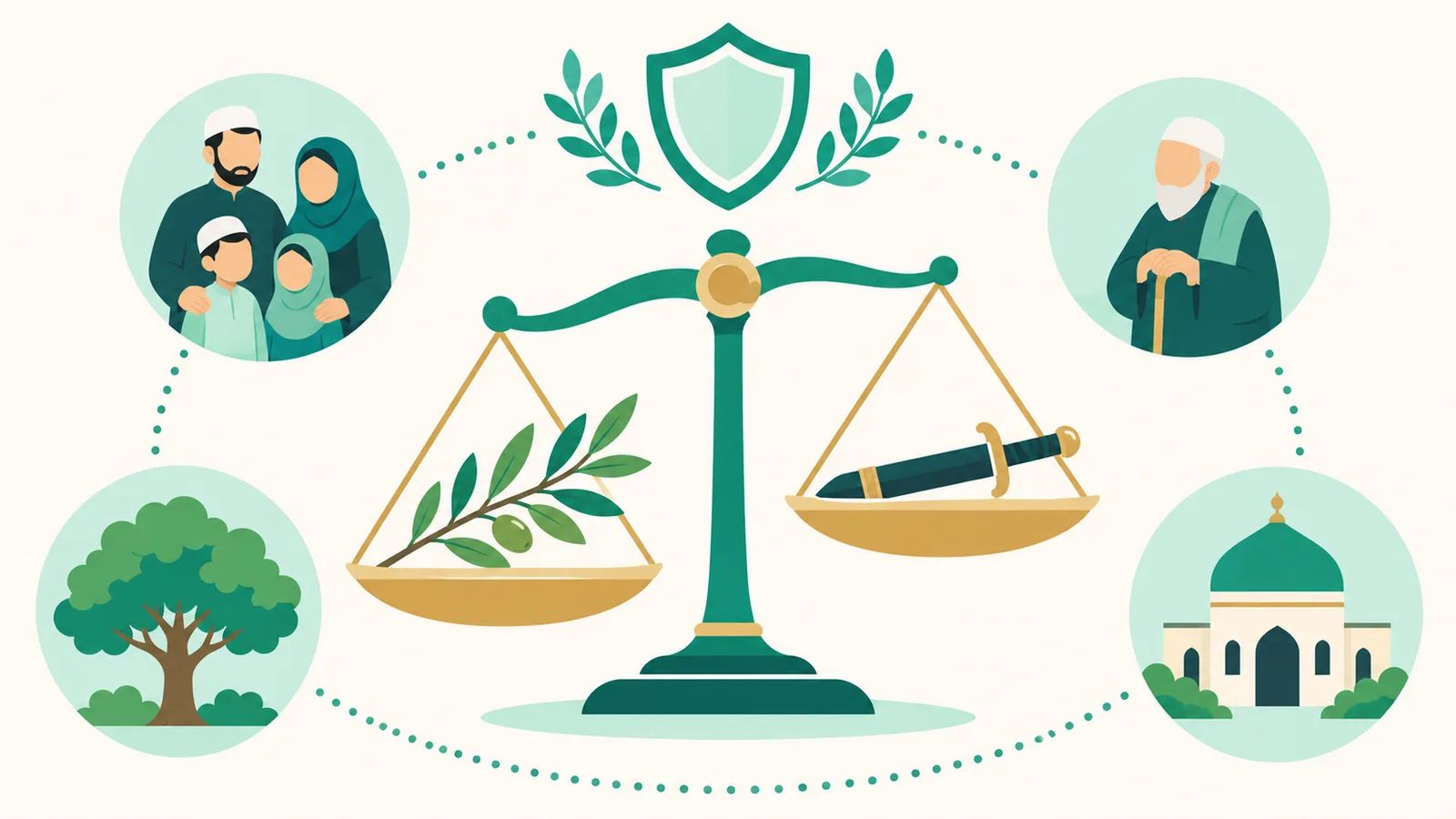
Key takeaways
- Peace is the goal; one of God's names is as-Salam, Peace.
- Fighting is permitted only to repel aggression and end oppression, never to force belief.
- Strict rules protect non-combatants — killing women and children is forbidden.
- If the enemy inclines to peace, Muslims must incline to it too.
- Only legitimate authority can declare war; terrorism is condemned.