العربية
 Español
 Français
 中文
 हिन्दी
How Does Islam Teach Us to Control Anger?

Most of the things people regret most — the cruel word, the slammed door, the message sent too fast, the blow that cannot be undone — happen in a few seconds of anger. Islam pays close attention to those seconds. It does not ask people to stop being human, but it asks them to become the master of their anger rather than its servant.
Redefining strength
In a culture that admired warriors and wrestlers, the Prophet Muhammad ﷺ turned the idea of strength upside down:
Narrated Abu Huraira: Allah's Messenger (ﷺ) said, "The strong is not the one who overcomes the people by his strength, but the strong is the one who controls himself while in anger
Couldn't load — please try again.
Anyone can lash out; it takes far more strength to hold back. This hadith has become one of the best-known sayings of the Prophet ﷺ, quoted by Muslim parents to children and by teachers to students around the world.
On another occasion, a man asked the Prophet ﷺ for a piece of advice. The Prophet ﷺ simply said: do not become angry. The man asked again and again, and each time received the same answer (Sahih al-Bukhari 6116). Of all the advice he could have given, he chose this — perhaps because so many other sins grow from uncontrolled anger.
The Qur’an on restraining anger
The Qur’an describes the kind of people whom God loves, and anger management is part of the description:
ٱلَّذِينَ يُنفِقُونَ فِى ٱلسَّرَّآءِ وَٱلضَّرَّآءِ وَٱلْكَٰظِمِينَ ٱلْغَيْظَ وَٱلْعَافِينَ عَنِ ٱلنَّاسِ ۗ وَٱللَّهُ يُحِبُّ ٱلْمُحْسِنِينَ ﴿١٣٤﴾ Who spend [in the cause of Allah] during ease and hardship and who restrain anger and who pardon the people - and Allah loves the doers of good;
Couldn't load — please try again.
The Arabic word used for restraining anger, kazm, comes from the image of closing the mouth of a full water-skin so that nothing spills. The feeling is real and may be strong — the point is not to let it pour out and cause damage. The Qur’an also praises believers who, when they are angry, forgive (Qur’an 42:37). It moves from simply holding anger in, to letting it go, to answering with kindness.
Practical steps from the Prophet ﷺ
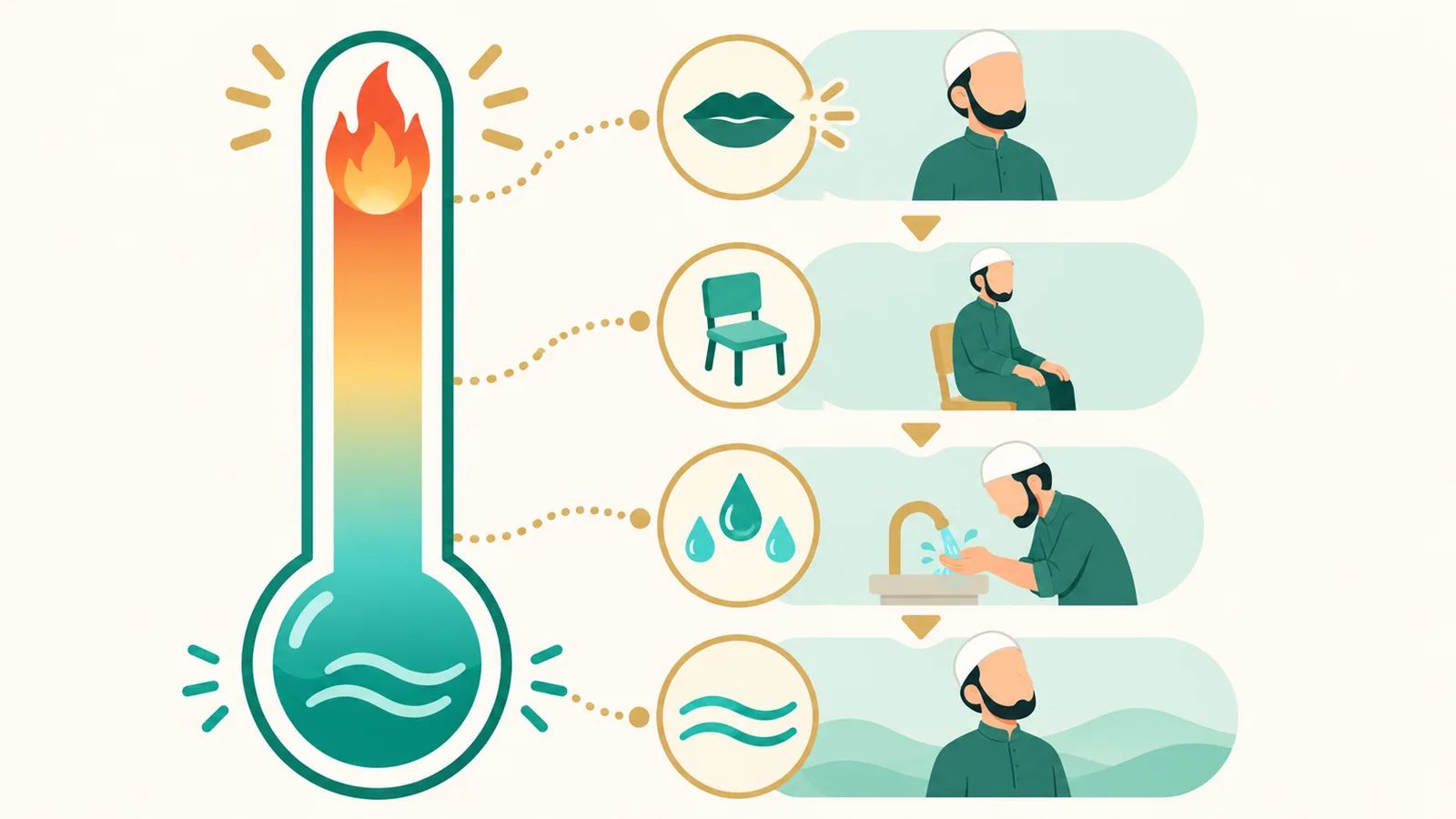
Islam’s guidance on anger is remarkably practical. Two men once began insulting each other in front of the Prophet ﷺ, and one of them became red in the face with rage. The Prophet ﷺ said:
…I know a word (sentence) the saying of which will cause him to relax if this man says it…
Couldn't load — please try again.
The word he meant was a short prayer: seeking refuge with God from Satan, the outcast — in Arabic, a’udhu billahi min ash-shaytan ir-rajim.
He also suggested changing one’s physical position:
Narrated AbuDharr: The Messenger of Allah (ﷺ) said to us: When one of you becomes angry while standing, he should sit down. If the anger leaves him, well and good; otherwise he should lie down
Couldn't load — please try again.
Modern advice on anger — pause, change your posture, breathe, step away — sounds very similar. Muslims add a spiritual dimension: turning to God in the moment of anger, remembering that He sees, and seeking His protection from the whisperings that push us towards harm. Staying silent until anger passes is also widely recommended by Muslim scholars, since words spoken in rage are often the ones we regret most.
The Prophet ﷺ also warned against making serious decisions while angry. He said that a judge should not judge between two people while he is angry (Sahih al-Bukhari 7158), and scholars have applied the same wisdom to any important decision.
How the Prophet ﷺ himself behaved
The Prophet’s companions described a man who was extraordinarily slow to anger in personal matters. Anas, who served him from childhood, said that in ten years the Prophet ﷺ never once said even uff to him, nor scolded him for what he had or had not done (Sahih al-Bukhari 6038). Aisha said that he never struck anyone with his hand — not a woman, not a servant — except in battle, and never took revenge for a personal wrong (Sahih Muslim 6050).
When he saw others misuse their anger, he intervened. A companion named Abu Mas’ud was once beating his servant when he heard the Prophet ﷺ behind him, reminding him that God has more power over him than he has over the boy. Abu Mas’ud dropped the whip and promised never to hit a servant again (Sahih Muslim 4306). This captures the heart of the Islamic approach: anger loses its grip when we remember that we, too, stand before Someone more powerful than us.
Is all anger wrong?
No. Islam distinguishes between selfish anger and anger at injustice. The Prophet ﷺ did become angry — but only when the sacred limits of God were violated, not over personal slights (Sahih al-Bukhari 3560). Anger at oppression, cruelty or dishonesty can be a healthy moral reaction. Even then, Islam asks that it be expressed with justice and wisdom, never through cruelty, revenge or harm to the innocent.
A closing thought
Islam’s teaching on anger is a call to a different kind of strength — the strength to pause, to stay silent, and to forgive. If anger is something you struggle with, you are not alone, and every small victory over it counts. To take the next step, read forgiveness in Islam or patience in Islam.
Key takeaways
- Real strength is controlling yourself when angry, not overpowering others.
- The Qur'an praises those who restrain their anger and forgive.
- The Prophet ﷺ taught practical steps — seek refuge in God, be silent, sit down.
- Decisions and judgements should not be made in anger.
- Anger at injustice is legitimate, but must be guided, never destructive.