العربية
 Español
 Français
 中文
 हिन्दी
Suffering in Islam and Buddhism: Two Paths Compared

According to Buddhist tradition, a young prince named Siddhartha Gautama grew up sheltered in a palace. When he finally saw an old man, a sick man and a corpse, he was shaken; when he then saw a calm wandering ascetic, he left everything to seek the way out of suffering. People came to call him the Buddha, “the awakened one”. Islam begins from a different place, but it too faces suffering with open eyes. Comparing the two can teach us much about both.
The Buddha’s diagnosis
In his first teaching, the Buddha set out the Four Noble Truths (in the Pali texts, Samyutta Nikaya 56.11):
- Dukkha — life as we usually live it is marked by suffering or unsatisfactoriness. Even pleasant things do not last, so they cannot fully satisfy.
- The origin of dukkha is craving (tanha): grasping after pleasure, existence and things we cannot keep.
- The cessation of dukkha is possible — this is nirvana, the extinguishing of craving.
- The path to it is the Noble Eightfold Path: right view, intention, speech, action, livelihood, effort, mindfulness and concentration.
Buddhism has many schools. Theravada, common in Sri Lanka and South-East Asia, emphasises the path of the individual practitioner. Mahayana traditions, common in East Asia, emphasise compassion and the ideal of the bodhisattva, who works for the liberation of all beings; Pure Land Buddhists rely on the compassionate vow of the Buddha Amitabha. Most Buddhist traditions do not teach a creator God.
Surprising common ground
A Muslim reading the Four Noble Truths will find much that resonates.
Everything passes. The Qur’an reminds us that all created things are temporary, and only God remains:
كُلُّ مَنْ عَلَيْهَا فَانٍۢ ﴿٢٦﴾ وَيَبْقَىٰ وَجْهُ رَبِّكَ ذُو ٱلْجَلَٰلِ وَٱلْإِكْرَامِ ﴿٢٧﴾ 26Everyone upon the earth will perish, 27And there will remain the Face of your Lord, Owner of Majesty and Honor.
Couldn't load — please try again.
Craving cannot be satisfied. The Prophet Muhammad ﷺ described human greed in words a Buddhist teacher might appreciate:
Narrated Anas bin Malik: Allah's Messenger (ﷺ) said, "If Adam's son had a valley full of gold, he would like to have two valleys, for nothing fills his mouth except dust. And Allah forgives him who repents to Him
Couldn't load — please try again.
He also taught that real wealth lies within:
Narrated Abu Huraira: The Prophet (ﷺ) said, "Wealth is not in having many possessions, but rather (true) wealth is feeling sufficiency in the soul
Couldn't load — please try again.
Do not cling. The Qur’an teaches a kind of inner freedom — neither crushed by loss nor carried away by gain:
مَآ أَصَابَ مِن مُّصِيبَةٍۢ فِى ٱلْأَرْضِ وَلَا فِىٓ أَنفُسِكُمْ إِلَّا فِى كِتَٰبٍۢ مِّن قَبْلِ أَن نَّبْرَأَهَآ ۚ إِنَّ ذَٰلِكَ عَلَى ٱللَّهِ يَسِيرٌۭ ﴿٢٢﴾ لِّكَيْلَا تَأْسَوْا۟ عَلَىٰ مَا فَاتَكُمْ وَلَا تَفْرَحُوا۟ بِمَآ ءَاتَىٰكُمْ ۗ وَٱللَّهُ لَا يُحِبُّ كُلَّ مُخْتَالٍۢ فَخُورٍ ﴿٢٣﴾ 22No disaster strikes upon the earth or among yourselves except that it is in a register before We bring it into being - indeed that, for Allah, is easy - 23In order that you not despair over what has eluded you and not exult [in pride] over what He has given you. And Allah does not like everyone self-deluded and boastful -
Couldn't load — please try again.
Both traditions also value compassion for all living beings, and both cultivate attention: Buddhists through mindfulness and meditation, Muslims through khushu’ (presence of heart) in prayer and dhikr, the constant remembrance of God.
Where the paths part
Where suffering comes from. For Buddhism, suffering arises chiefly from craving and ignorance. Islam agrees that greed and attachment cause much misery, but it also sees hardship as part of a meaningful test from a wise and merciful God (see Why Does God Allow Suffering?). Suffering is not only a problem to be escaped; it can also be a path back to God.
Desire. In Islam, desire is not the enemy. Food, marriage, beauty and friendship are blessings to be enjoyed within limits God has set. The goal is not to extinguish desire, but to guide it — and above all to direct the heart’s deepest longing towards God.
The self. Buddhism teaches anatta, “not-self”: there is no permanent, unchanging self. Islam teaches that each person has a soul (ruh), created by God, which lives on after death and will meet its Lord.
The goal. For Buddhists, the goal is nirvana, which they describe not as mere annihilation but as the unconditioned peace beyond craving. For Muslims, the goal is nearness to God and His pleasure, and the peace of Paradise.
Who helps. Many Buddhist schools emphasise one’s own effort on the path. Islam teaches that we strive, but that guidance and salvation are finally gifts from God, who hears every prayer.
Holding the world lightly
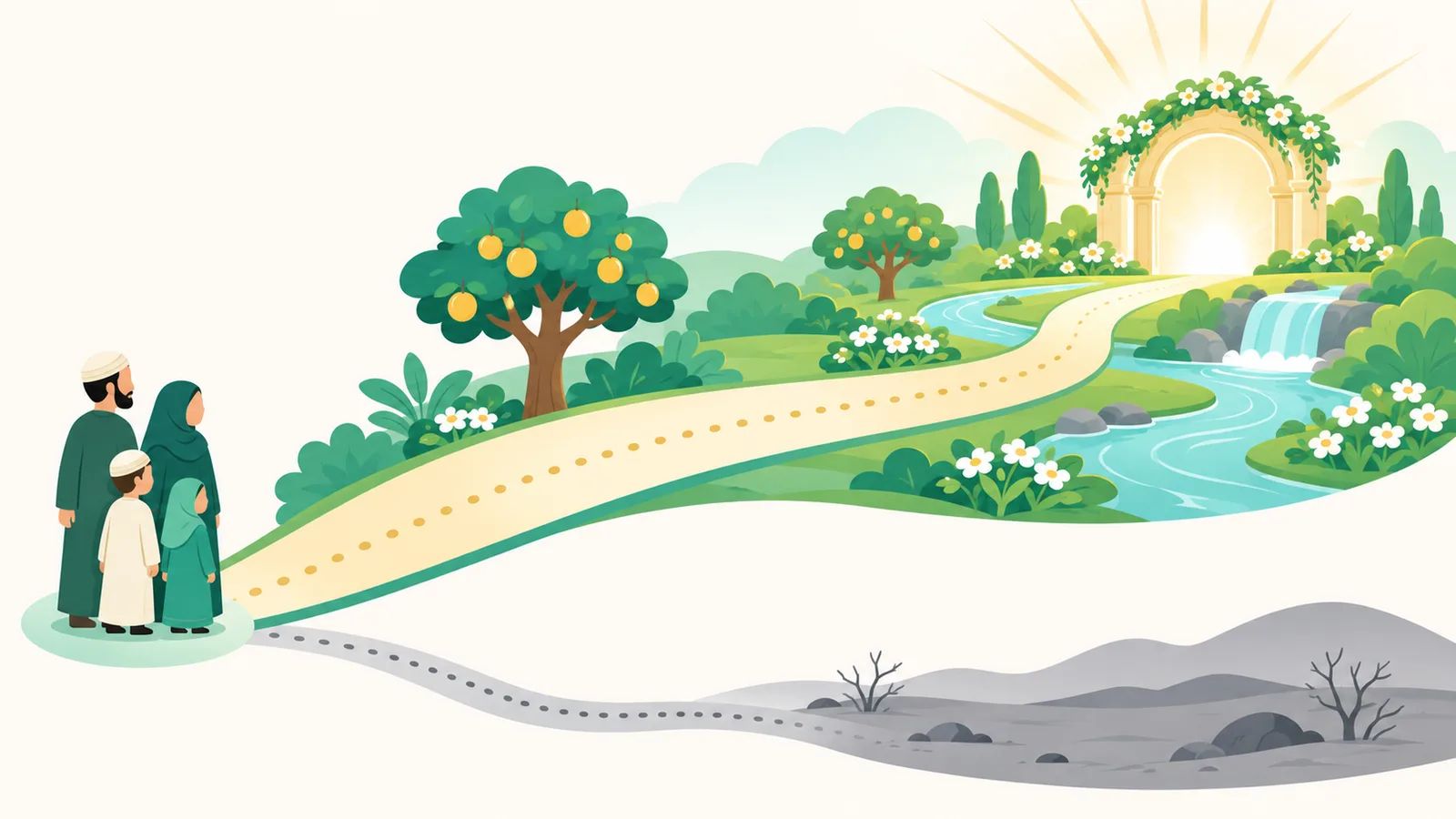
Islam does not ask believers to leave the world for a monastery. It asks them to live fully in it — working, marrying, serving — while holding it lightly. The Prophet ﷺ summed this up in one sentence:
…Be in this world as if you were a stranger or a traveler.…
Couldn't load — please try again.
A traveller enjoys the road, helps fellow travellers and is grateful for a good place to rest, but never forgets that it is not home.
A closing thought
Buddhists and Muslims can learn from each other’s honesty about suffering and from each other’s discipline of the heart. Islam’s distinctive invitation is this: that behind the passing world is not an empty silence but a merciful Creator, who turns even our pain into a way back to Him. You may also like Reincarnation or Resurrection? and Mental Health and Hope.
Key takeaways
- The Buddha's Four Noble Truths diagnose suffering as rooted in craving and offer a path to its end.
- Islam shares Buddhism's sense of impermanence and its warning against greed and clinging.
- Islam does not see desire itself as the enemy, but asks that it be guided and kept in its place.
- The paths part on God, the self and the final goal — nirvana, or nearness to God.